Indian Workers Turn Everyday Chores Into Training Data for the Next Generation of Robots
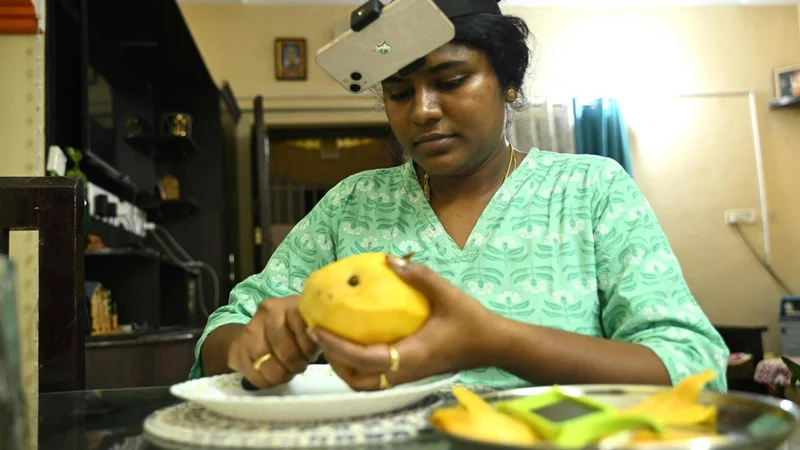
Image: Japantimes.co
Main Takeaway
Indian workers are earning about $2.60 an hour to record household tasks that help technology companies teach humanoid robots how people move.
Jump to Key PointsSummary
The workers behind robot training
Indian workers are turning ordinary household chores into training data for humanoid robots, earning about 250 rupees, or roughly $2.60, for each hour of recorded work. In Chennai, homemaker Nagireddy Sriramyachandra wears a smartphone on her head while slicing mangoes, capturing the first-person footage developers use to model human movement.
The work includes folding clothes, wiping tables, opening doors, arranging objects, washing dishes, and other domestic routines. Thousands of people are taking part in this expanding labor market, giving robotics companies access to movements that are difficult to reproduce with scripted demonstrations. The arrangement creates a sharp economic tension: workers are paid to teach machines skills that companies hope will eventually reduce demand for human labor.
Why first-person footage matters
First-person video gives AI systems a view close to the one a person has while performing a task. Developers call this egocentric data, and they use it to connect visual information with hand movements, object placement, timing, and the sequence of actions needed to complete a chore.
A robot that learns only from labeled images can identify a plate or a mango, but it still needs examples of how people grasp, rotate, cut, carry, and respond to objects in a real setting. Head-mounted phones capture those relationships in homes and training facilities. The footage helps specialized models learn routines such as preparing food, folding towels, and navigating cluttered spaces, according to the accounts from Aljazeera, Sify, and Timesofindia.indiatimes.
India’s role in the robotics race
India is becoming a major supplier of real-world robotics data because it combines a large workforce with comparatively low labor costs. Companies have emerged to collect and package human demonstrations for robotics firms in the United States and China, giving India a way to participate in the AI economy beyond building models or operating data centers.
The work also reflects a division in the global AI industry. Wealthier technology companies need vast amounts of physical-world data to train machines, while Indian contractors and workers perform the repetitive demonstrations required to produce it. CNBC described the activity as a route into the global AI race for a country often viewed as behind the leading model developers. Bloomberg AI framed the same trend around a race for real-world data, especially for humanoid systems.
The economics of automation
The immediate benefit for workers is flexible income for familiar tasks. Sriramyachandra described the 250-rupee hourly payment as attractive because it turns routine housework into paid work. For companies, the same payment buys a large stream of demonstrations that can be reused across training programs and robot products.
That exchange raises questions about who captures the long-term value. Workers supply the embodied knowledge, while technology companies develop the models and machines that may perform similar chores at scale. The reporting does not establish how workers are compensated when footage contributes to commercial systems, how broadly recordings are reused, or whether participants receive training for higher-paid technical roles. Those details will shape whether India’s data economy creates durable opportunity or remains a low-wage layer beneath the robotics industry.
Privacy and labor questions
Recording domestic activity introduces privacy concerns alongside the employment story. A head-mounted phone can capture more than the intended hand movement, including rooms, personal belongings, household members, and private conversations. The accounts focus on the payment and the training task, while leaving data ownership and consent practices central to the unresolved debate.
The labor issue is equally direct. People perform tasks that robots are designed to imitate, but the speed and scale of automation depend on many factors beyond footage, including hardware reliability, safety, cost, and the ability of models to generalize across homes and cultures. The work therefore represents an early stage in an automation pipeline, even as it gives companies a valuable record of human behavior.
What happens next
The next phase will center on whether recorded demonstrations produce robots that can operate reliably outside controlled environments. Household chores involve irregular objects, changing surfaces, limited space, and decisions that people make without conscious planning. More varied footage can improve training, but it also increases the need for careful labeling, privacy protections, and evaluation.
For India, the opportunity extends beyond supplying footage if companies build capabilities in annotation, robotics testing, data governance, and model development. For workers, the outcome depends on whether today’s recording jobs lead to better-paid technical roles or remain disposable contracts. The global robotics industry is already paying for a human record of everyday life. Its next challenge is turning that record into machines that work safely and consistently.
Key Points
Indian workers record household chores for about $2.60 hourly to train humanoid robotics systems.
Head-mounted smartphones capture egocentric footage linking human movements with objects and task sequences.
Indian companies supply real-world robotics data to technology firms in the United States and China.
The work creates immediate income while raising concerns about automation, privacy, and data ownership.
India’s longer-term opportunity lies in robotics testing, data governance, and technical development.
Questions Answered
Indian workers train AI robots by wearing smartphones or cameras while performing everyday tasks. Their first-person footage records movements such as slicing food, folding clothes, opening doors, and washing dishes for robotics model training.
Indian workers earn about 250 rupees, or approximately $2.60, for one hour of recorded activity. The work turns familiar household routines into paid demonstrations for companies collecting robotics data.
India supplies humanoid robot data because it has a large workforce and comparatively low labor costs. Indian companies can collect extensive real-world demonstrations for robotics firms in the United States and China.
Egocentric data is first-person footage recorded from a person’s viewpoint while completing a task. Robotics developers use it to connect what a person sees with hand movements, object handling, and task timing.
The robot training work is designed to help machines perform tasks that people currently do, including household chores. The eventual effect on employment depends on robot reliability, cost, safety, and whether workers gain access to higher-skilled roles.
Source Reliability
50% of sources are highly trusted · Avg reliability: 79
Go deeper with Organic Intel
Simple AI systems for your life, work, and business. Each one includes copyable prompts, guides, and downloadable resources.
Explore Systems