Agility Robotics’ Digit 5 Brings Humanoid Robots Closer to Unfenced Warehouse Work
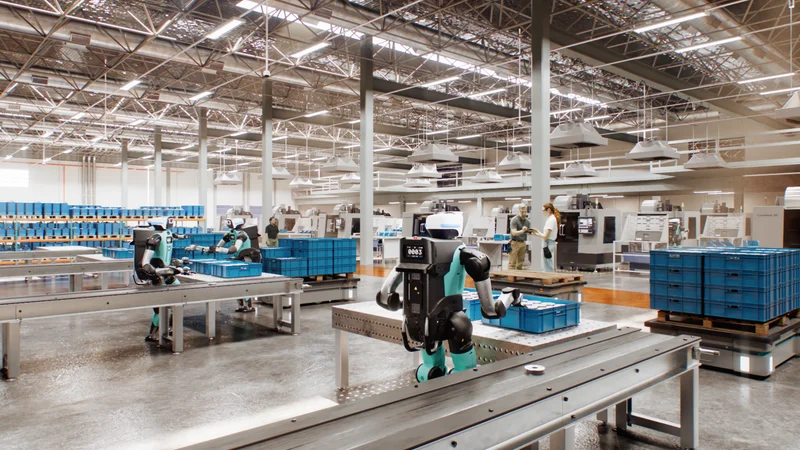
Image: Ars Technica AI
Main Takeaway
Agility Robotics unveiled Digit 5, a humanoid robot built to stop, squat and work near people without conventional safety barriers.
Jump to Key PointsSummary
Digit 5 targets shared workspaces
Agility Robotics has unveiled Digit 5, a humanoid robot designed to operate close to human workers without the physical cages traditionally used around industrial machines. The company’s central claim is a safety architecture that lets the robot detect nearby people, stop before contact and lower its body when necessary. Bloomberg described the launch as a milestone for an industry that usually separates robots from people.
Digit 5 builds on Agility’s warehouse-focused strategy. The company has concentrated on material handling, where robots move totes and other goods through facilities designed for human workers. That focus has placed Digit among the humanoid machines with the clearest commercial operating context, with earlier deployments and pilots tied to logistics and manufacturing customers.
Safety moves beyond barriers
Digit 5’s defining change is cooperative safety, with the robot stopping when a person approaches too closely and squatting to reduce the risk of striking a coworker. Ars Technica described those behaviors as a step toward robots working outside physical cages, while Business Insider reported that earlier Digit systems generally operated behind warehouse safety barriers.
The design shifts the safety problem from facility layout to robot behavior, sensing and control. That matters in warehouses, where workers, carts and automated equipment share changing paths. The Robot Report said the new version includes a broader safety architecture alongside revised legs and upgraded batteries. The approach still depends on reliable detection, rapid response and operating rules that customers can validate on their own floors.
A logistics machine first
Digit remains a practical warehouse robot before it becomes a general household assistant. Agility’s earlier product strategy centered on repetitive material-handling tasks, and industry demonstrations have shown the machine working with supply-chain workflows rather than performing a wide range of unrelated chores. That specialization gives customers a narrower deployment decision: identify a repeatable movement task, then measure whether the robot can perform it safely and consistently.
Public descriptions of Digit vary by generation and source. Listings describe a roughly human-scale machine with legged mobility and a payload around 16 kilograms, while earlier coverage identifies a 155-centimeter version. Those differences reflect model changes and inconsistent specifications, but the broader picture is stable. Digit is built to fit human environments, carry goods and navigate warehouse operations. Agility has also shown new capabilities developed with customers at ProMat, a sign that deployment feedback is shaping the product.
Commercial proof matters
Digit 5 arrives after Agility spent years positioning Digit as a working industrial system rather than a laboratory demonstration. Coverage has linked the robot to Amazon pilot programs, manufacturing partnerships and paid logistics work, while Agility says its experience includes delivering robotics systems into operating facilities. Those references give the launch a commercial frame, even as the scale and performance of individual deployments remain central questions for buyers.
The company is also preparing for larger production and broader industry use. Agility’s RoboFab factory and its public emphasis on domestic autonomous humanoid manufacturing point to a supply problem that every robotics maker faces: proving the machine and producing enough units to matter. The company’s 2026 rebrand from Agility Robotics to Agility reflects its effort to expand beyond warehouse use cases, although Digit’s strongest evidence still comes from logistics and industrial settings.
The next test is scale
Digit 5’s significance will be measured by ordinary operating results: uptime, incident rates, task accuracy, maintenance demands and the cost of replacing or augmenting human labor. A robot that can stop safely beside workers has a wider operating envelope, but safety behavior alone doesn't establish economic value. Customers still need predictable throughput and integration with conveyors, warehouse software and existing work rules.
The launch also raises a broader competitive question for humanoid robotics. Agility is betting that a narrower, revenue-producing path can reach factories and distribution centers before general-purpose machines master every household task. Success would strengthen the case for humanoids designed around specific jobs, while setbacks would reinforce the argument that flexible industrial automation remains difficult. For now, Digit 5’s combination of human-scale mobility, safer proximity behavior and established logistics focus gives Agility a distinct commercial position.
Key Points
Agility Robotics unveiled Digit 5, a humanoid built to work near people without conventional safety barriers.
Digit 5 stops before approaching humans too closely and squats to reduce contact risk.
Agility is targeting warehouse logistics, material handling and industrial workflows with its latest humanoid.
Updated legs, batteries and safety systems support Digit 5’s push toward commercial-scale deployments.
Customer collaborations and earlier pilots give Agility a practical route into manufacturing and distribution centers.
Questions Answered
Agility Robotics designed Digit 5 to handle repetitive logistics and material-handling work in warehouses and industrial facilities. The humanoid is built to move through spaces designed for people and work near human employees.
Agility Robotics Digit 5 detects nearby people, stops before getting too close and squats to reduce the risk of contact. The design is intended to reduce reliance on physical cages and safety barriers.
Agility Robotics Digit 5 includes revised legs, new knees, upgraded batteries and a broader safety architecture. The changes support longer and safer operation in commercial environments.
Agility Robotics is deploying Digit in logistics, warehousing and manufacturing environments. Earlier pilots and partnerships have connected the robot with supply-chain and industrial customers, including Amazon and Schaeffler.
Agility Robotics must demonstrate reliable uptime, throughput, safety performance and operating economics at customer sites. Production capacity, software integration and validation with warehouse operators will determine how widely Digit 5 is adopted.
Source Reliability
46% of sources are established · Avg reliability: 58
Go deeper with Organic Intel
Simple AI systems for your life, work, and business. Each one includes copyable prompts, guides, and downloadable resources.
Explore Systems