Chinese Humanoid Robot Runs 100 Meters in 9.39 Seconds at Beijing Games
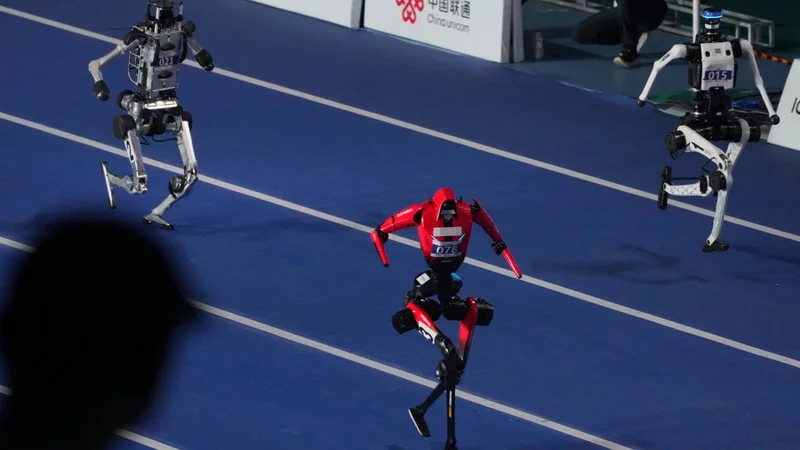
Image: Fortune AI
Main Takeaway
A Chinese humanoid robot reportedly ran 100 meters in 9.39 seconds at Beijing’s World Humanoid Robot Games, surpassing Usain Bolt’s human record.
Jump to Key PointsSummary
The record-setting run
A humanoid robot ran 100 meters in 9.39 seconds at the opening ceremony of Beijing’s second World Humanoid Robot Games, beating Usain Bolt’s human world record of 9.58 seconds set in 2009. The performance was reported through Chinese state media and cited across international coverage, though the event’s timing and verification standards remain unspecified.
The reported run took place on August 22 or 23, 2026, as the five-day competition opened at the National Speed Skating Oval, a venue built for the 2022 Winter Olympics. The result gives the event its clearest headline moment, but a robot’s time is not directly comparable with an official human athletics record unless organizers disclose the course, starting protocol, mechanical specifications and timing system.
Beijing’s robot Olympics
The sprint was one event in a much larger competition involving more than 2,000 humanoid robots, according to the organizer as cited by Fortune AI. The games feature 51 events and more than 1,000 competitions, including running, table tennis and soccer, turning robot testing into a public sporting spectacle.
The event coincided with Beijing’s 2026 World Robot Conference, where companies displayed about 3,000 products. Together, the conference and games present robotics as both an industrial sector and a national showcase, with competitions designed to make progress in balance, movement, perception and control visible to a general audience.
What the number proves
The 9.39-second result demonstrates that at least one humanoid platform completed a fast 100-meter run under competition conditions. It does not establish that humanoid robots have surpassed humans across athletic performance, since the sources provide no details about the robot’s size, weight, actuation system, battery load, track assistance, number of attempts or independent inspection.
Human sprint records measure biological athletes under tightly defined rules. Robots operate under a different set of engineering constraints, including motor power, thermal management, stability and energy consumption. A meaningful technical comparison would require organizers to publish raw timing data, video from the full course, equipment rules and a clear explanation of how the robot began and maintained its run.
China’s robotics push
The games fit a broader Chinese campaign to display progress in humanoid robotics as competition with the United States intensifies. Fortune AI described the event as an Olympics-like demonstration of China’s rapid advances in advanced robotics, while the surrounding robot conference gave companies a platform to show commercial products.
That public positioning matters because humanoid robotics remains a race involving hardware manufacturing, control software, sensors, batteries and supply chains. A record-style demonstration attracts attention, but deployment in factories, warehouses and services will depend on reliability, operating cost, maintenance and safe interaction with people. The sprint supplies a memorable benchmark; commercial adoption will be decided by less glamorous hours of repeated work.
The limits of spectacle
The reported victory is significant as a demonstration, but the available descriptions do not establish an independently certified world record. Several outlets published headlines about the achievement without providing full event results or technical documentation, and the underlying account traces back to reporting by Xinhua News Agency.
That distinction does not erase the achievement. Running 100 meters at 9.39 seconds requires rapid actuator control, dynamic balance and coordinated motion, all difficult engineering problems for a bipedal machine. It does mean readers should treat the figure as an event result until organizers or an independent authority publish the rules and measurements behind it.
What happens next
The next test is whether the Beijing games produce repeatable results beyond a single sprint. Competitions in soccer, table tennis and other disciplines will offer broader evidence about how humanoid robots handle coordination, recovery from errors and changing conditions.
For robotics developers, the most useful follow-up will be technical disclosure rather than another headline. Details about the winning machine, its manufacturer, power system, control stack and race attempts would show whether the 9.39-second run reflects a durable advance or a tightly optimized demonstration. The event’s scale, with thousands of robots and hundreds of contests, gives organizers an unusual opportunity to publish comparable performance data.
Key Points
A Chinese humanoid robot reportedly ran 100 meters in 9.39 seconds at Beijing’s World Humanoid Robot Games.
The reported robot time surpassed Usain Bolt’s 9.58-second human world record set in 2009.
More than 2,000 humanoid robots are participating across 51 events and over 1,000 competitions.
Beijing’s robot games coincide with a World Robot Conference displaying roughly 3,000 products.
Independent verification requires published timing rules, robot specifications, course conditions and raw performance data.
Questions Answered
A Chinese humanoid robot reportedly ran 100 meters in 9.39 seconds, faster than Usain Bolt’s 9.58-second record. The result has not been shown in the available coverage as an independently certified athletics record.
The humanoid robot sprint took place at Beijing’s National Speed Skating Oval during the World Humanoid Robot Games. The venue was built for the 2022 Winter Olympics.
More than 2,000 humanoid robots are participating in Beijing’s World Humanoid Robot Games. Organizers scheduled 51 events and more than 1,000 competitions, including running, table tennis and soccer.
The robot’s 9.39-second result cannot be compared directly with Bolt’s record until organizers publish comparable rules and measurements. Robot size, starting procedure, timing equipment, course conditions and independent oversight all affect the comparison.
The Beijing humanoid robot games showcase China’s robotics development through public competitions involving thousands of machines. The event also coincides with a major robotics conference, linking athletic demonstrations with commercial and industrial technology.
Source Reliability
83% of sources are highly trusted · Avg reliability: 87
Go deeper with Organic Intel
Simple AI systems for your life, work, and business. Each one includes copyable prompts, guides, and downloadable resources.
Explore Systems