China’s Humanoid Robot Push Gains an Industrial Lead as Manufacturers Chase Commercial Scale

Main Takeaway
Chinese companies now account for 97% of humanoid robot shipments, as factories and policymakers turn experimental machines into industrial tools.
Jump to Key PointsSummary
China’s early lead
China has taken an early lead in humanoid robotics, with domestic manufacturers accounting for 97% of global shipments, according to Bloomberg. The figure reflects a concentrated manufacturing push rather than proof that Chinese robots have solved the hardest problems in dexterity, reliability, or economics.
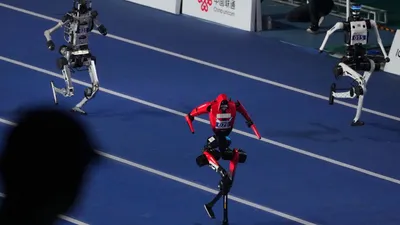
The country’s advantage is visible at the World Robot Conference in Beijing, where humanoid machines demonstrated box sorting, laundry handling, and clothes bagging. Unitree founder Wang Xingxing said commercial adoption could accelerate within 2 years, while other coverage described an industry trying to convert striking demonstrations into useful factory work.
Factories become the proving ground
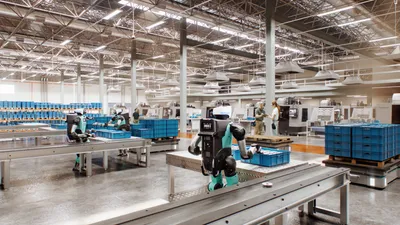
Manufacturing is the clearest near-term market for Chinese humanoid robots because factories offer controlled environments, repeatable tasks, and existing automation infrastructure. Chinese robot makers are targeting material handling, inspection, logistics, and assembly, where machines can work alongside established industrial equipment.
That focus marks a shift from spectacle to utility. Reuters described companies seeking practical applications, while Bloomberg showed demonstrations built around ordinary physical work rather than acrobatics. The strategy fits China’s manufacturing base, which supplies motors, batteries, sensors, electronics, and mechanical components at scale.
The supply chain advantage
China’s robotics lead rests on more than robot makers. The country has dense industrial supply chains, extensive electronics manufacturing capacity, and a large domestic market for testing machines in warehouses and factories. Those conditions reduce the distance between prototype, pilot project, and production run.
The New York Times framed China’s central role in robot components as a structural challenge for companies seeking alternatives. Carnegie Endowment and Merics described embodied AI as a strategic bet that joins software intelligence with physical machines. Control of components and manufacturing gives Chinese firms influence even when the final robot is designed elsewhere.
Software is the next battleground
Hardware volume gives China a strong starting position, but robot intelligence will determine whether deployments deliver lasting value. Humanoids must recognize changing surroundings, plan movements, recover from mistakes, and perform tasks safely around people. Training data from real industrial use will become an important asset.
Chinese companies are building that feedback loop through demonstrations and factory pilots. Bloomberg reported that artificial intelligence is making Chinese humanoids more capable, a development that has drawn attention from Tesla chief executive Elon Musk. Carnegie Endowment’s analysis places these machines within China’s broader embodied-AI strategy, where robotics, computer vision, and machine learning reinforce one another.
Competition with the United States
China’s shipment lead raises the pressure on U.S. companies, but the contest remains broader than unit counts. American firms bring strengths in advanced AI models, robotics research, software, and capital, while Chinese companies bring manufacturing depth, component access, and a large industrial customer base.
Tesla’s Optimus program has made humanoid robots a prominent U.S. technology project, and Musk’s public concern reflects the speed of China’s industrial push. The race will turn on operating costs, uptime, safety, integration, and customer results. A robot that ships in large numbers but fails to deliver reliable work will not establish a durable lead.
What happens next
The next phase will be measured in factory deployments, production contracts, and hours of dependable operation. Chinese robot makers are expected to emphasize narrow tasks first, using industrial settings to improve software and reduce costs before attempting broader household use.
That path also exposes the industry’s weak points. Demonstrations can hide supervision, limited task ranges, and performance constraints. Reuters’ focus on useful applications, Bloomberg’s account of industrial utility, and policy analysis from Merics and Carnegie Endowment point to the same test: China has built momentum, but commercial dominance requires repeatable economic value.
Key Points
China leads humanoid robot shipments with a reported 97% share of the global market.
Chinese robot makers are shifting demonstrations toward manufacturing, logistics, and repetitive industrial tasks.
China’s component ecosystem gives domestic humanoid companies advantages in cost, scale, and deployment speed.
Artificial intelligence is improving robot perception, movement planning, and adaptation in factory environments.
Tesla and other U.S. companies face pressure from China’s manufacturing depth and industrial testing base.
Questions Answered
China accounts for a reported 97% of global humanoid robot shipments. The figure reflects China’s manufacturing scale and early deployment push, though shipment share alone doesn’t establish long-term commercial success.
China is ahead because it combines robot manufacturers with dense supply chains for batteries, motors, sensors, electronics, and mechanical components. Its large industrial base also gives companies more factories and warehouses for testing machines.
Chinese humanoid robots are being developed for box sorting, laundry handling, clothes bagging, logistics, inspection, assembly, and other repetitive factory tasks. Companies are prioritizing controlled industrial settings before broader household applications.
China’s humanoid robot push increases competitive pressure on Tesla’s Optimus program. Tesla retains strengths in software and AI, while Chinese companies have advantages in manufacturing scale, component access, and industrial deployment.
Reliable performance, safe operation, low running costs, high uptime, and measurable productivity will determine whether Chinese humanoid robots succeed commercially. Factory pilots and production contracts will provide stronger evidence than trade-show demonstrations.
Source Reliability
56% of sources are highly trusted · Avg reliability: 69
Go deeper with Organic Intel
Simple AI systems for your life, work, and business. Each one includes copyable prompts, guides, and downloadable resources.
Explore Systems