Xi Warns Trump of 'Clashes and Even Conflicts' Over Taiwan at Beijing Summit
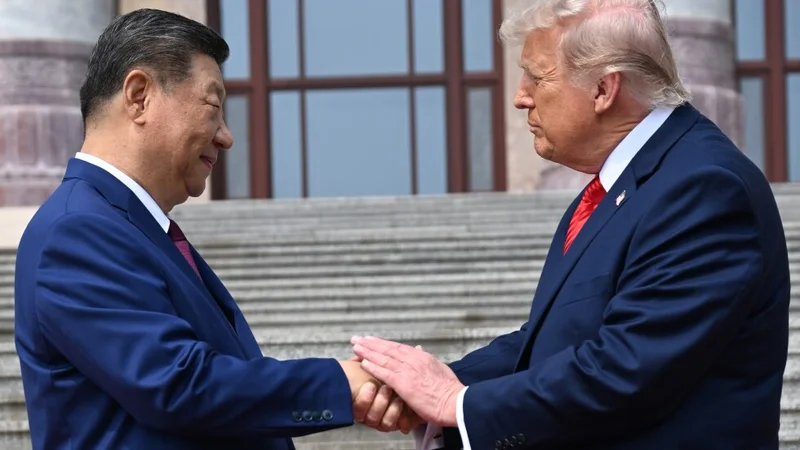
Image: Apnews
Main Takeaway
Chinese President Xi Jinping warned Donald Trump at their Beijing summit that Taiwan differences could spark 'clashes and even conflicts,' as Trump's approval of a record $11 billion arms package to the island loomed over the talks.
Jump to Key PointsSummary
What Xi actually said in Beijing
Chinese President Xi Jinping opened his summit with U.S. President Donald Trump on Thursday with an uncommonly blunt warning about Taiwan, telling his American counterpart that differences over the self-governing island could produce 'clashes and even conflicts' if not 'handled properly.' According to Chinese state media and multiple news reports, Xi described the Taiwan issue as a 'highly dangerous situation' that could push U.S.-China relations into what he called an 'extremely dangerous situation.' The remarks came early in the two-day meeting at Beijing's Great Hall of the People, which marked the first U.S. state visit to China since 2017.
The harsh tone stood in marked contrast to Trump's public posture. The Associated Press noted that Xi delivered an 'unusually harsh admonition' even as Trump offered praise for his Chinese counterpart. The New York Times reported that despite Xi's warning, both leaders later struck a more positive tone in their public remarks. This tonal dissonance, between private warnings and public cordiality, has become a hallmark of Trump-era diplomacy with Beijing. NBC News confirmed that trade and the Iran war were also high on the summit agenda, suggesting Taiwan was deliberately placed at the top of discussion by the Chinese side.
Behind Xi's urgency sat a concrete U.S. action that had not been publicly emphasized before. In December, Trump approved a record-breaking $11 billion arms package to Taiwan that included missiles, drones, artillery systems and military software. Trump had reportedly treated these sales as a bargaining chip with China, a framing that Taiwanese leaders pushed back against. Taiwan's president, in comments reported by Fortune, called the U.S. arms sales 'the most important deterrent' of regional conflict, underscoring how Taipei views the military support as existential rather than transactional.
Why Taiwan remains the flashpoint
Taiwan sits at the center of the most dangerous great-power rivalry on Earth, and both leaders know it. China claims the island democracy as part of its territory and has not ruled out taking it by force. The United States, by contrast, has maintained a policy of 'strategic ambiguity' about whether it would defend Taiwan, though it is legally committed to helping the island maintain self-defense capability through the Taiwan Relations Act. As Yahoo Finance noted in its coverage, Beijing wants full control over Taiwan while Washington has deliberately remained quiet about what it would actually do in a crisis.
The $11 billion arms deal, approved months before this summit, represents the material reality beneath the diplomatic language. Missiles, drones, and artillery systems are not abstract negotiating positions; they are capabilities that could complicate any Chinese military action. Xi's decision to lead with Taiwan warnings, despite this being the first state visit since 2017, suggests Beijing read Trump's chip-calling accurately and wanted to reset the table before any further deals got struck. Taiwanese leadership, meanwhile, has made clear it does not appreciate its security being characterized as a poker token in U.S.-China negotiations.
The summit's choreography, Taiwan first and everything else after, reveals Beijing's hierarchy of concerns. Trade volumes and Iran war policy matter, but unification with Taiwan carries a weight in Chinese political discourse that no economic indicator can match. For Xi, the arms package was not a detail to negotiate around but a provocation to confront head-on.
What happens next
Neither side appears interested in a public rupture. Trump's praise for Xi, even after the private warning, followed a pattern of personal warmth paired with policy friction that defined his first term. The question is whether the $11 billion arms deal was the opening bid or the settled position. If Trump treated it as a bargaining chip, he may have expected Xi to offer something in return, a concession on trade terms or a statement on Iran. Xi's refusal to play along, choosing instead to escalate rhetorically, suggests the chip strategy did not land as intended.
Taiwan's government, for its part, has every incentive to keep the arms flowing while avoiding the appearance of being anyone's bargaining chip. The president's statement to Fortune, calling the sales 'the most important deterrent,' was calibrated for multiple audiences: reassuring domestic voters, signaling to Beijing that Taipei has powerful friends, and reminding Washington that Taiwan's security is not a favor to be granted or withdrawn at whim.
The next months will test whether either leader's definition of 'handled properly' overlaps enough to prevent the clashes Xi warned about.
Key Points
Xi Jinping warned Trump that Taiwan differences could lead to 'clashes and even conflicts' at their Beijing summit
Trump approved a record $11 billion arms package to Taiwan in December, including missiles, drones, and artillery systems
Trump reportedly treated the arms sales as a 'bargaining chip' with China
Taiwan's president called the U.S. arms sales 'the most important deterrent' of regional conflict, rejecting the bargaining chip framing
The harsh private warning contrasted with public cordiality between the two leaders
Questions Answered
Xi warned that differences over Taiwan could produce 'clashes and even conflicts' if not 'handled properly,' calling it a 'highly dangerous situation' that could push U.S.-China relations into an 'extremely dangerous situation.'
In December, Trump approved a record-breaking $11 billion arms package that included missiles, drones, artillery systems, and military software.
Taiwan's president pushed back against the characterization, calling the U.S. arms sales 'the most important deterrent' of regional conflict, framing them as essential security support rather than a negotiating token.
Source Reliability
50% of sources are highly trusted · Avg reliability: 80
Go deeper with Organic Intel
Simple AI systems for your life, work, and business. Each one includes copyable prompts, guides, and downloadable resources.
Explore Systems