Trump and Xi Discuss AI Guardrails and Nvidia Chip Sales Amid Shifting Tech Trade Tensions
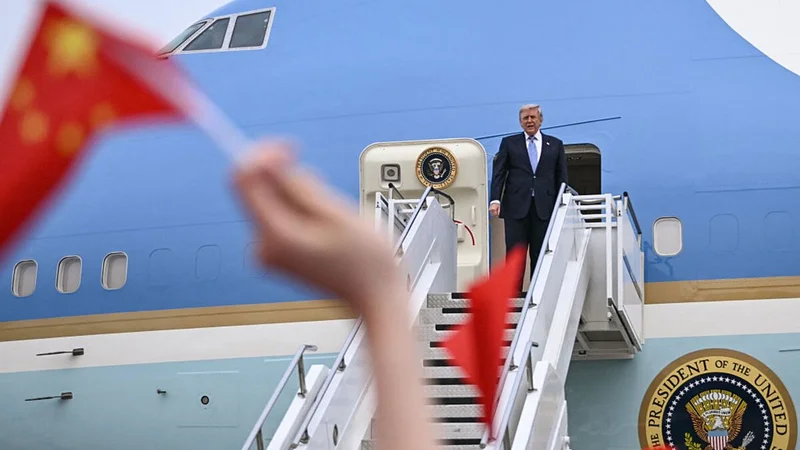
Image: Bloomberg AI
Main Takeaway
Trump says he discussed AI guardrails with Xi Jinping, with Nvidia's H200 chips on the table but Blackwell kept off limits.
Jump to Key PointsSummary
What Trump and Xi actually discussed
US President Donald Trump said he discussed guardrails on artificial intelligence with Chinese leader Xi Jinping during a two-day summit in Beijing, while confirming that Nvidia's H200 chips also came up in their conversations. According to Bloomberg, Trump told reporters aboard Air Force One that the two sides "talked about possibly working together for guardrails" on AI, characterizing them as "standard guardrails that we talk about all the time." The South China Morning Post reported that the discussions took place during Trump's state visit to Beijing, with both AI safety protocols and chip shipments on the agenda.
However, Trump was explicit about what was not discussed. Evertiq reported that after the meeting, Trump confirmed that Nvidia's next-generation Blackwell AI chips were not part of the conversation, stating, "We're not talking about the Blackwell." This clarification followed earlier signals from Trump that he might raise the Blackwell chips with Xi, with ZeroHedge noting that Trump had previously praised the chip as "super-duper" and said "We'll be speaking about Blackwells" ahead of the meeting. The shift in what was actually discussed versus what was anticipated created immediate market reaction, with Yahoo Finance reporting that Nvidia shares pared earlier gains and lost about 2 percent following Trump's clarification.
Why China is blocking its own companies from buying H200s
Trump revealed a surprising dynamic in the chip trade relationship: Beijing is actively preventing Chinese companies from purchasing Nvidia's H200 chips despite having US approval to do so. According to Tom's Hardware, Trump stated that China "chose not to" approve the purchases because "they want to develop their own." Bloomberg reported that 10 Chinese firms had received US approval to buy H200s, but Beijing would not allow the transactions to proceed.
This represents a significant reversal of the typical narrative around US-China tech restrictions, where Washington is usually portrayed as the party limiting exports. Yahoo Finance noted that Trump, alongside representatives from Micron, Qualcomm, and Nvidia, had traveled to China to address the trade relationship between the two countries. The revelation that China is self-restricting on advanced chip purchases suggests Beijing is prioritizing its domestic semiconductor industry over immediate access to cutting-edge foreign technology, even when that access is legally permitted.
What Trump said about Blackwell chip access
The status of Nvidia's most advanced Blackwell chips emerged as a clear red line in US technology export policy. Trump stated in a taped interview with CBS's "60 Minutes" that Nvidia's most advanced chips would be reserved for US companies and kept out of China and other countries, according to English.Aawsat. This hardline stance on Blackwell access was reinforced by Trump's post-meeting clarification that the chips were never even raised with Xi.
The market had initially priced in potential progress on Blackwell discussions, making Trump's clarification particularly consequential for Nvidia's stock. Yahoo Finance reported that the $5 trillion AI rally hit a pause following Trump's statement that Blackwell chips were not discussed. The disconnect between Trump's pre-meeting signals and post-meeting reality created volatility, with ZeroHedge having previously reported that Nvidia shares rose in premarket trading based on Trump's earlier comments about discussing Blackwells. The episode illustrates how sensitive semiconductor stocks have become to even ambiguous signals about China access.
How AI guardrails fit into the broader US-China tech rivalry
The discussion of AI guardrails represents an attempt to find limited common ground in an otherwise adversarial tech relationship. According to the South China Morning Post, Trump described the guardrails as standard protocols that both sides discuss regularly, suggesting a degree of institutional continuity in US-China AI diplomacy despite the broader trade tensions. Bloomberg reported that the guardrails conversation occurred alongside the chip discussions, indicating that the two leaders were attempting to compartmentalize cooperation on AI safety from competition on semiconductor access.
The framing of AI guardrails as a collaborative venture stands in contrast to the zero-sum dynamics around chip exports. Metodoviral noted that Trump confirmed he put "one of the hottest topics in global tech geopolitics on the table" during the summit. The Hill also reported on the AI guardrails discussion, underscoring that this aspect of the talks was treated as a discrete area of potential cooperation. Whether these guardrails will translate into concrete agreements remains uncertain, but their discussion signals that both sides recognize shared interests in managing AI risk even as they compete fiercely for technological dominance.
What happens next for Nvidia and semiconductor trade
The summit's outcomes leave Nvidia and the broader semiconductor industry navigating a complex landscape of US export controls, Chinese self-restriction, and persistent market uncertainty. Tom's Hardware reported that China's decision to block its own companies from H200 purchases reflects a strategic bet on domestic chip development that could reshape global semiconductor supply chains over the medium term. If Beijing continues to prioritize homegrown chips over foreign imports, even when permitted, the addressable market for Nvidia's China-compliant products could shrink substantially.
Trump's explicit reservation of Blackwell chips for US companies, as reported by English.Aawsat, establishes a clear hierarchy in American export policy that Nvidia must operate within. The company's challenge will be maintaining growth in a China market that is simultaneously restricted by Washington and voluntarily limited by Beijing. For investors, the immediate volatility around Trump's statements, documented by Yahoo Finance, is likely to persist as long as US-China tech diplomacy remains unpredictable and closely tied to presidential announcements. The next inflection point may come when Beijing clarifies whether its H200 blocking is a temporary negotiating tactic or a long-term industrial policy.
Key Points
Trump and Xi discussed AI guardrails and Nvidia's H200 chips during their Beijing summit, but Blackwell chips were explicitly kept off the agenda
China is blocking its own companies from buying H200 chips despite US approval, with Trump stating Beijing wants to develop domestic alternatives
Trump declared that Nvidia's most advanced Blackwell chips will be reserved for US companies and kept out of China
Market volatility followed Trump's shifting signals, with Nvidia shares rising on pre-meeting comments then falling 2% after clarifications
The summit reveals a complex dynamic where both US and Chinese restrictions now limit semiconductor trade, not just American export controls
Questions Answered
No. Despite Trump's earlier suggestion that he might raise Blackwell chips with Xi, he confirmed after the meeting that "We're not talking about the Blackwell." Trump had previously called the chip "super-duper" and indicated it might be on the agenda.
According to Trump, China "chose not to" approve H200 purchases by Chinese companies because "they want to develop their own" chips. This is notable because 10 Chinese firms had already received US approval to buy H200s, making Beijing's restriction a voluntary self-limitation rather than an American-imposed barrier.
Trump said the two sides "talked about possibly working together for guardrails" on AI, describing them as "standard guardrails that we talk about all the time." The discussion suggests limited common ground on AI safety, though concrete agreements were not announced.
Nvidia shares experienced volatility. They rose in premarket trading based on Trump's earlier signals about discussing Blackwell chips, then pared gains and fell about 2% after he clarified that Blackwell was not actually raised with Xi.
Trump stated that Nvidia's most advanced Blackwell chips will be reserved for US companies and kept out of China and other countries. This represents a hardline stance on the most cutting-edge American semiconductor technology.
Source Reliability
36% of sources are trusted · Avg reliability: 65
Go deeper with Organic Intel
Simple AI systems for your life, work, and business. Each one includes copyable prompts, guides, and downloadable resources.
Explore Systems