OpenAI Tries to Bring 'Jackass' Trophy Into Court as Musk Trial Evidence
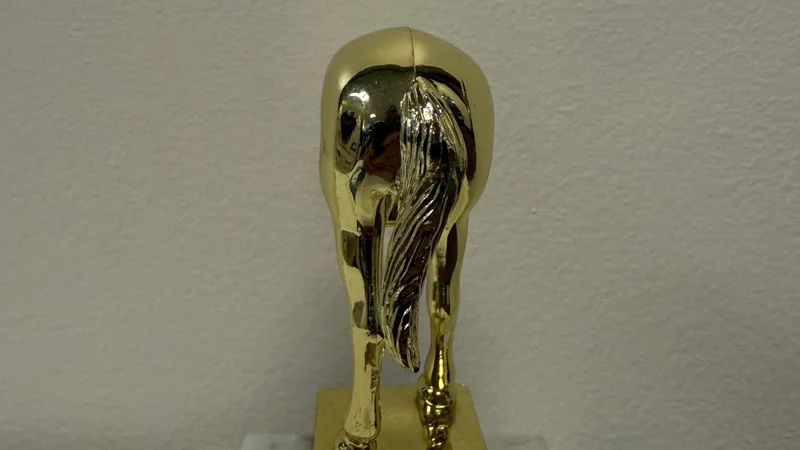
Image: The Verge AI
Main Takeaway
OpenAI sought to introduce a gold donkey statue as evidence in the Musk v. Altman trial, revealing tensions over AI safety during Musk's 2018 departure.
Jump to Key PointsSummary
What the jackass trophy reveals about OpenAI's early culture
OpenAI's legal team attempted to enter a small gold statue into evidence during the Musk v. Altman trial, a move that quickly became one of the case's more surreal moments. The trophy, depicting the rear half of a donkey on a white stone base, bore the inscription: "Never stop being a jackass for safety." According to Wired, OpenAI lawyer Bradley Wilson presented the item to US District Judge Yvonne Gonzalez Rogers before jurors entered the courtroom. The statue was originally presented to Joshua Achiam, who joined OpenAI as an intern in 2017 and now serves as the company's chief futurist studying societal responses to AI.
The trophy's existence points to a workplace culture where pushing back against leadership carried both risk and reward. Employees reportedly pooled together to commission the piece after a tense all-hands meeting, turning an insult into a badge of honor. The Verge noted that jurors never actually saw the trophy in person; Judge Rogers had lawyers read the inscription aloud for the press instead. This procedural twist kept the physical evidence from the jury while still allowing its narrative to enter the record.
The episode also highlights how personal conflicts from OpenAI's early days are now being weaponized in legal proceedings. What began as an inside joke among employees has become a strategic piece of evidence in a high-stakes contract dispute.
How the trophy originated during Musk's 2018 departure
The backstory begins with Elon Musk's final all-hands meeting at OpenAI before his 2018 exit. During that gathering, Musk outlined his vision for racing ahead of Google in artificial intelligence development. Joshua Achiam, then a relatively junior researcher focused on AI safety, challenged this approach. According to Officechai, Musk responded by calling Achiam a "jackass" in front of colleagues. The following all-hands meeting saw employees present Achiam with the commissioned trophy, effectively reclaiming the insult as a statement of principle.
Business Insider, citing The Wall Street Journal, reported that the confrontation centered on whether Musk had fully considered the implications of pursuing artificial general intelligence through Tesla after leaving OpenAI. Musk's decision to develop AGI capabilities at Tesla while exiting the nonprofit he co-founded has become a central thread in the current litigation. The trophy thus serves as physical documentation of a philosophical split that predated the formal legal dispute by years.
The timing matters. In 2018, OpenAI was still a small research organization with fewer than 100 employees. An intern publicly challenging a billionaire co-founder represented genuine professional risk. That colleagues would commemorate this pushback suggests safety concerns carried enough weight within the organization to override typical hierarchy.
Why AI safety sat at the center of the dispute
The Achiam-Musk exchange wasn't an isolated incident but rather an early signal of a tension that would define OpenAI's evolution. When Achiam questioned Musk's priorities, he reportedly raised concerns about whether Musk had adequately thought through safety implications of rapidly pursuing AGI technology. KTVU reported that this testimony emerged as part of the trial's final witness presentations before both sides rested their cases.
Musk's alleged response, calling Achiam a "jackass," revealed his apparent frustration with internal resistance to his strategic direction. At the time, Musk had offered to take over OpenAI outright, fearing it was falling behind Google's DeepMind. When the board rejected this proposal, he departed to pursue AI development through Tesla's Autopilot and subsequent Optimus programs. The safety-versus-speed tension Achiam voiced has only intensified as OpenAI itself has faced criticism from former employees about commercialization outpacing safety work.
The trophy's inscription, "Never stop being a jackass for safety," now reads as a prescient mission statement. OpenAI's current positioning in the trial, using this moment to paint Musk as dismissive of safety concerns, represents a remarkable narrative inversion. The company Musk co-founded to ensure AI safety is now using his departure to argue he never fully shared that commitment.
What happened when the trophy reached the courtroom
Judge Yvonne Gonzalez Rogers handled the unusual evidence request with visible skepticism. According to The Verge, she declined to allow jurors to view the physical trophy, instead having attorneys read the inscription aloud before press members. This procedural compromise let the sentiment enter the record without risking the spectacle of passing a golden donkey rear among jurors.
The judge's broader handling of trial theatrics suggests she recognized the case's public profile without indulging its more performative elements. Yahoo Finance reported that Rogers grew visibly impatient with Musk's repeated use of the phrase "You just can't steal from a charity" during his testimony, eventually striking the line from the record and reminding him, "You're not a lawyer." The trophy episode fit a pattern of both parties testing how much dramatic license the courtroom would permit.
For OpenAI's legal strategy, the trophy served multiple functions even in limited form. It established a concrete timeline for safety concerns during Musk's tenure. It humanized Achiam's testimony with a memorable physical artifact. And it created a media moment that reinforced their narrative before closing arguments. Whether any of this persuades the nine-member jury remains to be seen, but the trophy's introduction guaranteed the safety-versus-speed framing would dominate coverage of the trial's final phase.
Where the trial stands and what comes next
Both sides rested their cases on Wednesday after testimony from multiple Microsoft employees, OpenAI staff, and expert witnesses. KTVU reported that the nine-member jury and Judge Rogers prepared to hear closing arguments Thursday, with deliberations to follow. The trial's central question, whether OpenAI's shift to a capped-profit structure violated agreements made during Musk's involvement, remains technically narrow despite the sprawling testimony.
The trophy's attempted introduction, however, signals how both parties view this as fundamentally a case about character and credibility. OpenAI wants jurors to see Musk as impulsive and dismissive of safety, willing to insult junior employees who challenged him. Musk's team has countered that he was the true safety advocate, pushed out by a board that subsequently abandoned the nonprofit mission he helped establish. The golden donkey, in its way, encapsulates this dueling-narrative problem. It proves something happened, but what exactly, and what it means for contract interpretation, remains contested.
The verdict's implications extend well beyond the parties. A ruling for Musk could force OpenAI to restructure or pay substantial damages. A ruling for OpenAI would validate its current governance and potentially accelerate its commercial expansion. Either outcome will likely be appealed, extending resolution well into 2027. For observers, the trophy serves as a reminder that even the most consequential technology disputes retain elements of workplace drama that no amount of venture funding can fully professionalize away.
What this says about tech trial theatrics in the AI era
The Musk v. Altman litigation marks something new in technology disputes: the weaponization of startup culture artifacts as legal evidence. Previous tech trials featured emails, contracts, and deposition testimony. This case has added physical trophies, all-hands meeting recollections, and workplace slang to the evidentiary mix. The shift reflects how AI companies have cultivated distinctive internal cultures that now become discoverable and deployable in litigation.
For journalists and observers, the trophy also illustrates the theatrical challenge of covering AI disputes. The underlying legal questions, nonprofit corporate law and contract interpretation, resist easy narrative rendering. The golden donkey provides an accessible entry point that risks overshadowing substantive issues. Both sides understand this dynamic and have leaned into it, Musk with his repeated "steal from a charity" formulation, OpenAI with its carefully staged evidence presentation.
The broader pattern suggests AI litigation will increasingly resemble entertainment as much as jurisprudence. Companies that grew up in social media's attention economy bring those instincts to courtroom strategy. Whether this serves the public interest, or the interests of the parties, remains an open question as closing arguments approach and the jury begins its work.
Key Points
OpenAI's legal team attempted to introduce a golden donkey trophy as evidence in the Musk v. Altman trial, but the judge only allowed the inscription to be read aloud rather than shown to jurors.
The trophy was presented to Joshua Achiam, then an intern, after Elon Musk called him a 'jackass' for challenging Musk's AI safety approach during a 2018 all-hands meeting before Musk's departure.
The inscription 'Never stop being a jackass for safety' reflects early tensions between safety prioritization and competitive speed that continue to shape OpenAI's public positioning.
Both sides rested their cases after testimony from multiple witnesses, with the trial proceeding to closing arguments before a nine-member jury.
The episode illustrates how personal conflicts and workplace culture artifacts from AI companies' early days are becoming strategic elements in high-stakes legal disputes.
Questions Answered
A small gold statue depicting the rear half of a donkey on a white stone base, inscribed with the message: 'Never stop being a jackass for safety.'
After Elon Musk called Achiam a 'jackass' for questioning his AI safety approach during a 2018 all-hands meeting, colleagues commissioned the trophy to commemorate Achiam's willingness to push back against leadership.
No. Judge Yvonne Gonzalez Rogers declined to allow jurors to view the physical trophy, instead having attorneys read the inscription aloud for press members before jurors entered.
Whether OpenAI's shift from a nonprofit to a capped-profit structure violated agreements made during Elon Musk's involvement with the organization, and whether Musk's subsequent competitive actions were permissible.
Both sides rested their cases after presenting testimony from Microsoft employees, OpenAI staff, and expert witnesses. Closing arguments were scheduled to follow, after which the nine-member jury would deliberate.
Source Reliability
57% of sources are trusted · Avg reliability: 66
Go deeper with Organic Intel
Simple AI systems for your life, work, and business. Each one includes copyable prompts, guides, and downloadable resources.
Explore Systems