Trump's Golden Dome missile shield estimated at $1.2 trillion, nearly seven times original price tag
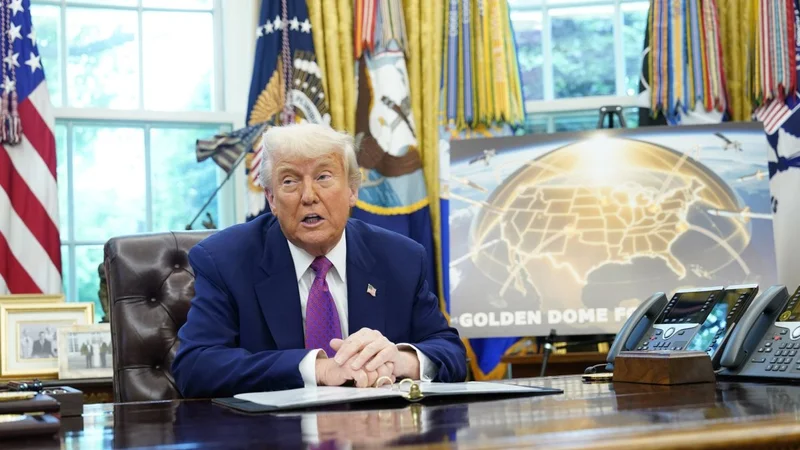
Image: Upi
Main Takeaway
Congressional Budget Office projects Trump's 'Golden Dome' missile defense system will cost $1.2 trillion over 20 years, far exceeding the $175 billion.
Jump to Key PointsSummary
What the CBO actually projected
The Congressional Budget Office released a report estimating that President Trump's proposed Golden Dome missile defense system would cost approximately $1.2 trillion to develop, deploy, and operate over two decades. This figure represents a dramatic revision from the $175 billion price tag Trump cited when announcing the program in 2025. According to Fortune, the CBO characterized its own analysis as reflecting "one illustrative approach rather than an estimate of a specific Administration proposal," suggesting the methodology itself remains contested. The nonpartisan agency's projection includes acquisition costs exceeding $1 trillion alone, covering interceptor layers and a space-based missile warning and tracking system. The sheer scale of the estimate places the program's cost above the entire annual Defense Department budget, a comparison that underscores how substantially the program's financial footprint has expanded since its initial framing.
The CBO's numbers landed with particular force because they contradicted a specific presidential commitment. Trump had pledged the system would be completed by the end of his term with close to a 100 percent success rate, promising it would "forever end[] the missile threat to the American homeland," according to the Washington Post. The gap between that promise and the CBO's arithmetic creates immediate political and budgetary pressure. The report also introduced a sobering operational caveat: the system might not actually stop a full-scale attack by a peer adversary such as Russia or China, per Yahoo Finance's reading of the document. This dual failure, on both cost and effectiveness, transforms what was presented as a finished policy into an open question about feasibility.
How the price tag ballooned
The $1.2 trillion estimate encompasses more than hardware. Personnel compensation, research and development, maintenance, upgrades, and space-based infrastructure all feed into the total. The Independent noted that industry insiders have suggested the project "has barely gotten off the ground," implying that even this figure may rest on optimistic assumptions about future development. The CBO's methodology appears to have treated the executive order's ambitious scope, including space-based components, as its baseline rather than applying a more constrained interpretation of Trump's public statements.
Fox 5 Atlanta emphasized that the projection is "hundreds of billions of dollars higher" than Trump's 2025 estimate, while UPI put the multiplier at nearly seven times. The consistency across sources on the core $1.2 trillion figure, despite varying framings, suggests the CBO report itself was unambiguous. What differs is the political valence: some outlets foregrounded the gap between promise and reality, while others stressed the technical complexity that drives such costs in missile defense. Neither framing contradicts the other; they reflect different editorial judgments about what constitutes the newsworthy element. The program's expense now approaches the scale of major entitlement programs, a category shift that changes which congressional committees and procedural mechanisms will govern its fate.
Whether the system would even work
The CBO report introduced a critical caveat that has received less attention than the price tag but may prove more consequential over time. According to Yahoo Finance, the analysis warned that the Golden Dome "could be vulnerable to a full-scale attack by Russia or China." This assessment directly undermines the president's claim of near-perfect protection. Missile defense has always occupied an uneasy space between deterrence and delusion, programs that demonstrate technical progress while failing to deliver the strategic impregnability their architects promise. The Golden Dome appears to follow this pattern, with the additional complication of its space-based architecture, which multiplies technical challenges and cost drivers simultaneously.
The vulnerability finding matters because it reframes the debate from whether America can afford the system to whether it should build it at all. If the shield leaks against the very threats it was designed to counter, the $1.2 trillion becomes harder to justify as insurance rather than theater. UPI's coverage noted that the CBO released its assessment on Tuesday, suggesting the timing was independent of any administration attempt to manage the news cycle. The report's emergence nonetheless complicates Trump's narrative of a completed, effective system ready within his term. The gap between promised performance and assessed capability may prove harder to bridge than the fiscal shortfall.
What this means for defense budgeting
The CBO projection arrives at a moment when federal budget constraints are already tightening, with debt ceiling negotiations and discretionary spending caps creating zero-sum competition between priorities. A program that consumes $1.2 trillion over 20 years would represent a generational commitment, crowding out other modernization efforts or forcing substantial tax increases or borrowing. The Independent's observation that the sum exceeds the entire Defense Department's annual expenditure provides useful scale; this is not a marginal add-on to existing capabilities but a restructuring of defense resource allocation.
Congressional dynamics will likely prove determinative. The CBO's nonpartisan status gives its figures institutional weight in appropriations hearings, even when lawmakers wish to dismiss them. Fox 5 Atlanta's coverage highlighted that the projection is "hundreds of billions of dollars higher" than administration claims, language that positions the CBO as a check rather than a partner. For a Republican-controlled Congress generally supportive of Trump's agenda, the challenge will be reconciling fiscal hawkishness with loyalty to the president's signature security initiative. Democrats may find the cost escalation useful for opposing the program, though they will need to articulate an alternative vision for missile defense rather than simply negating Trump's. The budgetary fight will unfold across multiple appropriations cycles, with early-year decisions about research and development funding establishing path dependencies that later Congresses will find difficult to reverse.
Where the program goes from here
Industry insiders quoted by The Independent suggest the Golden Dome remains in early stages, with limited progress toward operational capability despite the president's 2029 deadline. This timeline compression, promising deployment within a presidential term for a system the CBO expects to evolve over two decades, creates implementation risk that compounds financial risk. The Washington Post reported Trump's claim that the system would be "completed by the end of his term," a target now appearing technically implausible regardless of funding levels.
The program's future likely depends on whether Congress accepts the CBO's framing or opts for a narrower scope that brings costs closer to the original $175 billion figure. Such narrowing would require abandoning space-based components or interceptor layers, precisely the elements that distinguish Golden Dome from existing missile defense architecture. Alternatively, proponents may argue that the CBO's "illustrative approach" overstates costs by assuming gold-plated procurement rather than efficient acquisition. This counterargument will face skepticism given the historical pattern of defense cost growth, but it provides rhetorical space for continued advocacy. What seems clear is that the Golden Dome can no longer be discussed credibly without acknowledging the trillion-dollar threshold it has crossed, a psychological and political boundary that changes how the program will be perceived by legislators, taxpayers, and potential adversaries alike.
Key Points
The CBO projects Trump's Golden Dome missile defense system will cost $1.2 trillion over 20 years, compared to Trump's stated $175 billion figure.
The estimate includes over $1 trillion in acquisition costs for interceptors and space-based tracking, plus personnel, R&D, and maintenance.
The CBO warned the system may remain vulnerable to full-scale attacks by Russia or China, contradicting Trump's near-perfect protection claims.
Industry insiders suggest the program has made limited progress despite Trump's 2029 completion target.
The nonpartisan agency described its analysis as an illustrative approach, not a binding estimate of administration policy.
Questions Answered
The Golden Dome is a proposed U.S. missile defense system ordered by President Trump through executive order, designed to protect against ballistic and cruise missile attacks using space-based and ground-based components.
Trump cited a $175 billion price tag when announcing the program in 2025. The CBO estimate is nearly seven times higher, representing hundreds of billions of dollars in additional costs.
According to the CBO analysis reported by multiple outlets, the system could remain vulnerable to a full-scale attack by Russia or China, contradicting Trump's claim of near-100 percent effectiveness.
Trump has claimed the system would be completed by the end of his term, implying by 2029, but industry insiders suggest the program has made limited progress and the CBO's 20-year timeline suggests a much longer development period.
Source Reliability
57% of sources are trusted · Avg reliability: 78
Go deeper with Organic Intel
Simple AI systems for your life, work, and business. Each one includes copyable prompts, guides, and downloadable resources.
Explore Systems