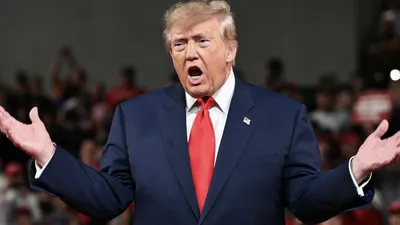
Trump Orders Federal Takeover of AI Rules, Threatens States' Funding
Image: Sullcrom
Main Takeaway
White House releases sweeping AI framework that strips states of regulatory power and dangles loss of federal broadband money as penalty.
Jump to Key PointsSummary
What exactly did Trump just sign?
Two documents landed. First, on December 11 2025, an executive order titled "Ensuring a National Policy Framework for Artificial Intelligence" that tells the Justice Department to sue states with “onerous” AI laws and warns the Commerce Department to withhold future broadband funds from those same states . Second, on March 20 2026, a seven-point legislative blueprint that translates that order into proposed federal law and asks Congress to codify the pre-emption of any state or local AI rule that goes beyond the White House’s lighter-touch standard .
Which state laws are now in the crosshairs?
California, Colorado, Illinois, New York and Texas have the most comprehensive AI statutes on the books, so they sit at the top of the target list . The order specifically flags laws that impose algorithmic bias audits, mandatory risk assessments, or special liability on developers of large models. Any statute that is judged “inconsistent with the national strategy to achieve global AI dominance” can trigger the funding claw-back provision .
How does the new framework change the rules for tech companies?
The federal plan strips away most state-mandated compliance costs. Age-verification for users under 18 becomes the single major new requirement; everything else is voluntary best-practice guidance . Developers gain a safe-harbor shield: if they follow the federal checklist, they cannot be sued under state consumer-protection or civil-rights laws. For frontier-model labs, the shift means one rulebook instead of fifty, but it also removes the stricter safety testing regimes that states like California were building .
What penalties can states actually face?
The Commerce Department is instructed to “prioritize” states that repeal or never pass “burdensome” AI laws when it doles out $42.5 billion in BEAD broadband grants . In practice, governors would have to choose between high-speed internet money and their own AI safety rules. Separately, the Justice Department task-force can file pre-emption suits seeking injunctions; no state has yet been named, but California’s attorney general has already vowed to fight any such case .
Why is the administration doing this now?
Official line: a single federal standard prevents a “patchwork” that could slow American AI firms and cede ground to China . Critics note the timing: major state AI bills were set to take effect in 2026, and the order landed days after Senate Democrats introduced a federal algorithmic accountability act that looked more like California’s rules. The administration wants to box Congress into passing its lighter alternative before the mid-terms .
What happens next?
Congress must decide whether to adopt the White House blueprint wholesale, negotiate a hybrid, or ignore it. States can sue to keep their laws alive, arguing that policing algorithmic harm is a traditional police power. Meanwhile, companies face immediate uncertainty: do they keep complying with California’s pending audits or gamble that federal courts will soon void them? The first test will come when Commerce publishes its grant criteria this summer .
Could this actually slow down AI development?
Paradoxically, yes. Startups that banked on California’s forthcoming transparency mandates may now scramble to re-tool products. Venture investors tell TechCrunch they are adding “regulatory pre-emption risk” to term sheets, which could chill late-stage rounds. And if states sue and win, companies could end up with neither federal certainty nor state clarity for months, exactly the “regulatory whiplash” the order claims to prevent .
Key Points
Trump signed an executive order on Dec 11 2025 directing DOJ to sue states with "onerous" AI laws and Commerce to withhold broadband funds from those states.
A companion legislative framework released March 20 2026 asks Congress to codify federal pre-emption of all state AI regulations beyond light federal standards.
California, Colorado, Illinois, New York and Texas face immediate risk of losing billions in BEAD broadband grants if they keep stricter AI laws.
Tech companies gain a single national rulebook and liability shield but lose the stricter safety testing regimes some states were preparing.
States and civil-rights groups plan legal challenges, setting up a federalism battle that could leave the sector in regulatory limbo through 2026.
Questions Answered
The Justice Department has created a dedicated task force for this purpose, as mandated by the December 2025 executive order.
Roughly $42.5 billion in BEAD grants could be redirected away from states that refuse to roll back their AI laws.
Not automatically. It sets up a legal fight; California’s law stays in force until a federal court or Congress strikes it down.
Add age-verification for users under 18 and follow voluntary best-practice guidance; compliance grants a safe-harbor from state liability.
The Commerce Department is expected to publish grant criteria this summer, with awards announced in early 2027.
Yes. The framework is only a proposal; lawmakers can adopt, modify, or ignore it, and any new federal statute would override the order.
Source Reliability
63% of sources are highly trusted · Avg reliability: 83
Go deeper with Organic Intel
Simple AI systems for your life, work, and business. Each one includes copyable prompts, guides, and downloadable resources.
Explore Systems