SpaceX Launches $20 Billion Investment-Grade Bond Offering to Fund AI Expansion After Record IPO
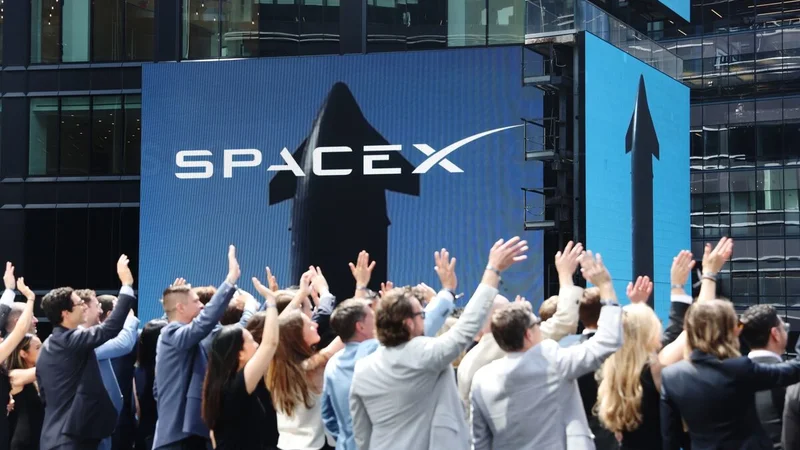
Image: Bloomberg AI
Main Takeaway
SpaceX debuts $20 billion investment-grade bond sale to refinance debt and bankroll its AI infrastructure buildout following a $75 billion IPO.
Jump to Key PointsSummary
SpaceX hits the debt markets for the first time
SpaceX has begun its inaugural investment-grade U.S. dollar bond offering, with bankers preparing to meet investors as early as next week. The offering targets at least $20 billion, according to multiple sources familiar with the matter cited by Reuters, Bloomberg, and the South China Morning Post. Bank of America, Citi, JPMorgan, Goldman Sachs, and Morgan Stanley are jointly underwriting the deal, signaling strong institutional confidence in the newly public company despite its untested credit profile.
The bond sale represents a dramatic pivot in corporate strategy for a firm that has historically relied on private capital and government contracts. Proceeds will refinance a bridge loan maturing in 2027, giving SpaceX breathing room while it pursues one of the most ambitious capital deployment plans in corporate history.
Why the bond market matters for Musk's empire
Investment-grade status is not automatic for a company with SpaceX's risk profile. The designation rests on the strength of its satellite constellation, government launch contracts, and now its public equity base following a record $75 billion IPO. Bloomberg reports that the bond offering kicks off what analysts expect to be a sustained borrowing spree, with the company needing tens of billions for data centers, computing hardware, and power infrastructure.
The timing reflects pressure on Elon Musk to demonstrate financial discipline after taking SpaceX public. Bond investors demand different assurances than venture capitalists: predictable cash flows, collateral value, and covenant protection. SpaceX's Starlink subscription revenue provides a recurring revenue stream that credit analysts can model, but its Starship development costs and AI investments remain large, uncertain outlays.
The AI infrastructure bill comes due
SpaceX's AI ambitions are driving the capital urgency. The company is building data center capacity and acquiring computing hardware at a scale that dwarfs its historical aerospace spending. Bloomberg and SCMP both note that the bond proceeds will support this expansion, which Musk has framed as essential to competitive positioning against OpenAI, Google, and other well-capitalized rivals.
The spending plan raises questions about how SpaceX will balance its traditional aerospace mission with its newer AI priorities. Satellite launches and Mars colonization remain capital-intensive, but AI training clusters now compete for the same corporate resources. The bond market's willingness to fund both at attractive rates will test whether investors view SpaceX as a diversified technology conglomerate or a aerospace company with expensive side projects.
Market reception and investor positioning
Early market signals are mixed. Bloomberg separately reported that SpaceX shares slid as much as 4.6% in premarket trading on June 22, putting the stock on pace for a third consecutive decline as U.S. markets reopened after a holiday. The share price weakness could complicate bond pricing if equity volatility feeds into credit spreads.
Still, the underwriting syndicate's composition suggests strong institutional backing. JPMorgan and Goldman Sachs in particular have deep relationships with both SpaceX and Musk's other ventures, including xAI. Their participation signals that Wall Street expects sufficient demand to absorb a $20 billion or larger issuance, even in a market environment where corporate bond spreads have widened modestly.
What this means for corporate debt markets
A successful SpaceX bond sale would mark a milestone for the high-grade market, potentially opening the door for other recently public technology companies to access long-term debt financing. The deal size, if it reaches the upper range of expectations, would rank among the largest corporate bond offerings in recent years and could influence pricing for comparable issuers.
For fixed-income investors, the offering presents a novel risk-reward proposition. SpaceX carries no established credit rating history, government launch contracts provide revenue stability, and the company's private valuation history demonstrates investor appetite for Musk-led ventures. The bonds will likely price with a premium to traditional aerospace and defense credits, reflecting both opportunity and uncertainty.
Road ahead for SpaceX financing
The bond roadshows beginning next week will determine whether SpaceX can achieve its targeted terms. Company representatives and underwriters will need to convince investors that satellite revenue growth and AI optionality justify investment-grade pricing rather than high-yield spreads.
Longer term, analysts expect this bond sale to be the first of several. Bloomberg has noted that Musk's combined capital needs across SpaceX, xAI, and other ventures will require sustained market access. How SpaceX manages its debut offering, sets precedents for disclosure, and balances debt service with growth investment will shape its financial trajectory for years.
Key Points
SpaceX launches debut $20 billion investment-grade U.S. dollar bond offering with five major banks underwriting.
Proceeds will refinance a 2027 bridge loan and fund AI infrastructure including data centers and computing hardware.
The offering follows SpaceX's record $75 billion IPO and marks its first entry into public debt markets.
Investor roadshows could begin as early as next week, with timing complicated by recent share price weakness.
The deal tests whether bond investors accept SpaceX as a diversified tech conglomerate rather than pure aerospace play.
Questions Answered
SpaceX is targeting at least $20 billion in its debut investment-grade bond offering. The final size has not been set and could grow based on investor demand during upcoming roadshows.
SpaceX needs capital to refinance a bridge loan maturing in 2027 and to fund an ambitious AI expansion requiring tens of billions in data center and computing investments. The bond market offers lower-cost, longer-duration funding than equity or venture capital.
Bank of America, Citi, JPMorgan, Goldman Sachs, and Morgan Stanley are jointly underwriting the deal. Their involvement signals strong Wall Street confidence in placing a large, novel credit with institutional investors.
Yes, the bond sale directly follows SpaceX's record $75 billion IPO. Public company status and the associated disclosure requirements make investment-grade bond issuance feasible for the first time in the company's history.
SpaceX will use proceeds to refinance existing debt and fund AI infrastructure including data centers, computing hardware, and power infrastructure. The company is pursuing an aggressive buildout to compete with OpenAI, Google, and other well-capitalized AI rivals.
Source Reliability
50% of sources are highly trusted · Avg reliability: 77
Go deeper with Organic Intel
Simple AI systems for your life, work, and business. Each one includes copyable prompts, guides, and downloadable resources.
Explore Systems