SpaceX Beats Q2 Revenue With $7.8B But AI Spending and Stock Slump Fuel an Identity Crisis
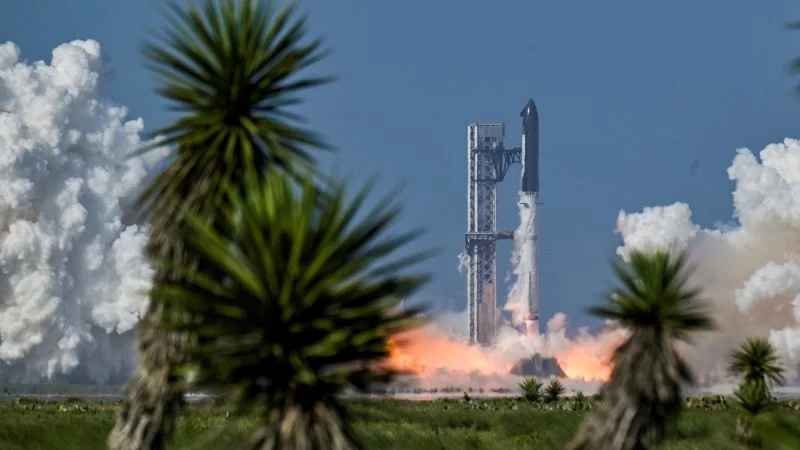
Image: Cnn
Main Takeaway
SpaceX reported $7.8 billion in Q2 revenue in its first public earnings report, beating estimates as neocloud AI revenue tripled to $2.6 billion, but heavy capital spending and a 50% stock decline from its peak overshadowed the beat.
Jump to Key PointsSummary
The numbers that beat the street
SpaceX cleared Wall Street's revenue bar in its first-ever quarterly report as a public company. The firm posted Q2 revenue of $7.8 billion, topping the $6.81 billion consensus estimate tracked by Bloomberg. That figure also represents a sharp sequential jump from the $4.7 billion the company reported in Q1, according to Yahoo Finance. Adjusted EBITDA hit $2.33 billion, while the adjusted loss per share came in at $0.15, a narrower deficit than many analysts had modeled.
Yet the raw top-line beat didn't stop the stock from sliding. Shares have fallen more than 50% from an intraday peak of $225.64 shortly after the June IPO, settling around $108 as of late July, TradingKey notes. Short sellers have piled on during the decline, racking up $8.3 billion in paper profits, according to TradingView. The market's reaction underscores a tension between SpaceX's accelerating revenue and the sheer scale of spending required to chase its multi-industry ambitions.
Why neocloud revenue is the real story
Buried in the segment breakdown is a figure that explains why SpaceX briefly touched a $2.85 trillion market cap in June. AI compute revenue, what the company calls its neocloud operations, tripled year over year to $2.6 billion, The Verge reports. That growth is driven by deals SpaceX struck to provide raw compute capacity to other AI companies, effectively renting out its massive GPU clusters.
This neocloud business is what pushed SpaceX's valuation past Amazon and Microsoft for a fleeting moment in mid-June, Yahoo Finance notes. The logic on Wall Street is that SpaceX sits at the intersection of three massive markets: space launch, satellite internet, and AI infrastructure. The rapid scaling of the AI segment validates the bull case that SpaceX is more than a rocket company. Constellation Research points out that the IPO priced at $135 per share, good for a $1.77 trillion valuation, and the subsequent AI-driven pop signaled just how much investors are betting on the compute layer.
But the segment is still young and capital-hungry. The revenue growth is real, but the cost of building and powering GPU clusters is enormous. SpaceX's total revenue for 2025 was $18.7 billion, Sacra estimates, with a 63% year-over-year growth rate. The AI business is now a significant slice of that pie, but keeping it fed is expensive.
The identity crisis inside a $800 billion company
SpaceX enters its first earnings season with a problem that has nothing to do with rocket engines. Wall Street doesn't know how to value a conglomerate that spans launch services, satellite internet, and AI compute. TradingView reports that analyst Zhu described the company as facing an identity crisis across its three business lines. Is it a defense contractor? A telecom? A cloud provider? The answer matters because each category commands a different multiple.
This confusion is visible in the stock's violent swings. The company went public at $135, surged past $225, then cratered below $108, TradingKey and CBS News report. Aswath Damodaran, the valuation expert, wrote on his Substack that he's revisiting his pre-IPO valuation now that the prospectus data is available, acknowledging that his earlier work relied on unofficial sources. The core challenge, Damodaran argues, is that SpaceX's three businesses have wildly different economics, and investors are struggling to price the bundle.
The company's own segment reporting confirms the split. Weiss Ratings notes the three operating segments: Space, Starlink connectivity, and the AI compute business. Each one demands massive capital investment, and Wall Street is trying to figure out which one will drive the next decade of returns.
Where the money goes and why the stock is falling
Revenue beat expectations, but the cost side of the ledger is what spooked investors. SpaceX's AI capital expenditure is running hot, and the company is losing money overall, The Verge reports. The Q2 report showed that losses are already outpacing the entirety of 2025's full-year deficit, according to Fortune. For a company that once promised a path to profitability, the scale of the spending is forcing a reckoning.
A share lockup expiration is adding to the pressure. Fortune reports that company insiders will soon be able to sell shares for the first time since the IPO, a moment that often triggers volatile trading as early employees and investors cash out. Combined with the $8.3 billion in short positions noted by TradingView, the setup is tense. Morgan Stanley has maintained a $300 price target, TradingKey reports, but that bull case depends on AI revenue continuing to scale faster than costs.
The market's current verdict is clear: the revenue growth is impressive, but the path to sustainable profitability is still unproven. Investors want to see the AI compute business reach escape velocity before the capital demands of the rocket and satellite businesses pull the company into a cash crunch.
The Elon Musk factor and investor patience
SpaceX's first public earnings call gave investors their first direct line to Elon Musk since the IPO. Fortune notes that shareholders got the chance to question him directly after the report dropped. The dynamic is crucial because Musk's personal brand and his role across multiple companies, Tesla, xAI, X, and now SpaceX, creates a unique governance risk that public market investors are still pricing in.
The June IPO was the largest in history, CNN Business reports, and the initial pop to $2.85 trillion briefly made SpaceX the most valuable company on the planet. That euphoria has since faded. The stock's 50% decline from peak represents a roughly $500 billion wipeout in market value, TradingView calculates. Investors are now asking whether Musk oversold the company's near-term prospects in the run-up to the offering.
CNN Business notes that investors specifically want more detail on AI spending, Starlink revenue streams, and the company's progress toward profitability. The earnings report provided some answers, but the stock's reaction suggests the market wanted more clarity on the timeline for turning the AI compute business into a profit center rather than a capital sink.
What happens next
The next test comes quickly. The insider lockup expiration is a near-term overhang that could inject more selling pressure into the stock, Fortune reports. Beyond that, the company needs to show that the AI compute business can scale without consuming ever-larger amounts of capital. The $2.6 billion in neocloud revenue is impressive, but the losses suggest the cost of that revenue is still too high.
Analyst consensus tracked by Koyfin and cited by TradingView expects $6.82 billion in revenue and $2.05 billion in EBITDA for the quarter, numbers that SpaceX beat. But the market is already looking ahead to the next quarter. The question is whether the AI segment can continue its triple-digit growth trajectory while the company brings down the cost of delivering that compute.
SpaceX's experiment as a public company is just beginning. It has the revenue, the growth rate, and the market position. What it doesn't yet have is a clear narrative that justifies its valuation. The identity crisis that Zhu flagged will persist until the company proves that its three businesses are more than the sum of their parts.
Key Points
SpaceX reported $7.8 billion in Q2 2026 revenue, beating the $6.81 billion consensus in its first public earnings report.
Neocloud AI compute revenue tripled year-over-year to $2.6 billion, driven by deals providing GPU capacity to other AI companies.
The stock has fallen more than 50% from its post-IPO peak, erasing roughly $500 billion in market value.
Short sellers have accumulated $8.3 billion in paper profits as the company faces an identity crisis across its three business segments.
Losses are accelerating beyond 2025 levels, and a looming share lockout expiration could add more selling pressure.
Questions Answered
SpaceX reported Q2 2026 revenue of $7.8 billion, beating the Bloomberg consensus estimate of $6.81 billion. This was the company's first quarterly earnings report since its June 2026 IPO.
SpaceX's neocloud AI compute revenue tripled year-over-year to $2.6 billion in Q2 2026. The growth came from deals to provide GPU compute capacity to other AI companies.
SpaceX stock fell from an intraday peak of $225.64 to around $108 as of late July 2026 due to concerns about heavy AI capital spending, ongoing losses, and an identity crisis over how to value the company across its three business segments. Short sellers have accumulated $8.3 billion in paper profits.
Analyst Andrew Zhu says SpaceX faces an identity crisis because it operates three distinct businesses: space launch, Starlink satellite internet, and AI compute. Investors are struggling to value the company as a single entity because each segment has different economics and growth profiles.
Yes, SpaceX is still losing money overall. The company's Q2 2026 losses outpaced all of 2025's full-year deficit, driven by heavy capital expenditure on its AI compute infrastructure.
A share lockout expiration is approaching, which will allow company insiders to sell shares for the first time since the June IPO. This could trigger additional selling pressure on the stock, which has already fallen more than 50% from its peak.
Source Reliability
44% of sources are highly trusted · Avg reliability: 75
Go deeper with Organic Intel
Simple AI systems for your life, work, and business. Each one includes copyable prompts, guides, and downloadable resources.
Explore Systems