SpaceX Files for Record $75 Billion IPO to Bankroll AI and Rocket Ambitions
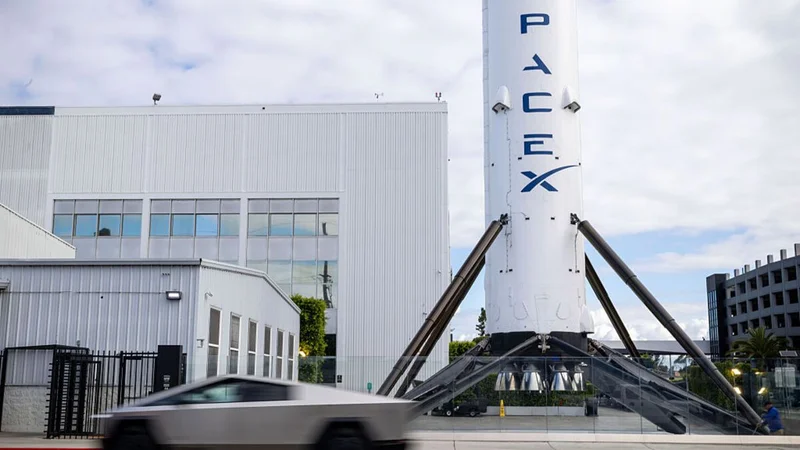
Image: Bloomberg AI
Main Takeaway
SpaceX targets a $75 billion IPO, the largest in history, to fund artificial intelligence and launch operations.
Jump to Key PointsSummary
Why SpaceX is going public now
SpaceX has filed for a $75 billion initial public offering that would rank as the biggest IPO ever recorded, according to Bloomberg. The filing represents a dramatic strategic pivot for Elon Musk's privately held aerospace and technology conglomerate, which has relied on private capital and government contracts since its founding in 2002. The timing signals mounting capital demands across multiple fronts, from next-generation rocket development to satellite network expansion and now artificial intelligence infrastructure.
The scale of the offering, if achieved, would dwarf previous records and test investor appetite for mega-listings at a moment when technology valuations remain volatile. Bloomberg reports that the company views this as a historic debut that could clear a path for similarly massive listings from other deep-tech firms.
How the funds will be split across AI and launch operations
The dual funding priorities reveal SpaceX's evolution beyond pure aerospace into a vertically integrated technology platform. Artificial intelligence spending targets both autonomous flight systems and data processing capabilities for the Starije Starlink satellite constellation, which now serves millions of subscribers globally. Launch operations funding supports the Starship program, designed to enable lunar landings, Mars missions, and potentially orbital manufacturing.
This capital allocation strategy mirrors broader industry patterns where defense-adjacent technology companies are pouring resources into AI to maintain competitive positioning. The rocket program remains extraordinarily capital-intensive; each Starship test flight costs approximately $90 million, with hundreds of millions more in facility and tooling investments required for operational status.
What this means for Musk's empire and governance
The IPO introduces complex questions about corporate structure and control. Musk currently maintains tight operational integration across SpaceX, Tesla, X, and xAI, with shared engineering talent and occasionally blurred corporate boundaries. Public market scrutiny will demand clearer financial disclosures and potentially constrain the operational flexibility that has allowed rapid resource reallocation between entities.
Investors will scrutinize related-party transactions and intellectual property flows between SpaceX and Musk's other ventures, particularly xAI, which competes directly with OpenAI and Anthropic. Wqln notes that the blockbuster spending plans span rockets and AI, suggesting deliberate strategic linkages rather than separate business lines. The filing timing, coming as Tesla faces margin pressure and X navigates advertiser challenges, positions SpaceX as the most financially robust vehicle for Musk's long-term technology ambitions.
Market context and investor risks
The IPO arrives during a challenging period for new offerings, with 2025 seeing muted activity due to interest rate uncertainty and geopolitical tensions. SpaceX's private valuation most recently hovered near $350 billion, making the $75 billion raise theoretically achievable but dependent on maintaining premium multiples under public market discipline.
Revenue concentration poses a structural concern. Government contracts from NASA and the Department of Defense represent a substantial portion of current income, subject to political and budgetary volatility. Starlink consumer growth has been robust but faces terrestrial broadband competition and regulatory barriers in key markets including China and India. The AI revenue stream remains nascent, with no established commercial product comparable to cloud offerings from Amazon Web Services or Google Cloud.
Competitive ripple effects across aerospace and AI
The offering resets expectations for capital formation across both industries. Rivals including Blue Origin, Rocket Lab, and China's state-backed launch providers may accelerate their own public market strategies to avoid being overshadowed by SpaceX's fundraising capacity. In AI, the capital injection intensifies the arms race with OpenAI, Anthropic, and Google DeepMind, all of which have raised multi-billion dollar rounds recently.
The satellite constellation sector faces particular pressure. Starlink's network effects and manufacturing scale already dwarf competitors including Amazon's Project Kuiper and OneWeb. An additional $75 billion in balance sheet capacity would enable accelerated deployment, potentially cementing orbital communications infrastructure as a natural monopoly before alternatives can establish viable economics.
What happens next for the listing timeline
Regulatory review from the Securities and Exchange Commission typically spans three to six months for complex offerings, though SpaceX's classified government work may extend this process. The company must resolve accounting treatment for its hybrid government-commercial revenue model and disclose previously private financial performance metrics.
Banking syndicate selection will attract intense attention, with fees for a $75 billion offering potentially exceeding $500 million. Traditional aerospace and defense investors will compete for allocation against technology growth funds and sovereign wealth vehicles seeking exposure to both space infrastructure and AI capabilities. The ultimate success of this listing will determine whether other deep-tech founders view public markets as viable alternatives to continued private financing.
Key Points
SpaceX files for $75 billion IPO, the largest offering in financial history
Proceeds target artificial intelligence systems and rocket launch operations
Filing marks strategic pivot from private capital to public market financing
IPO introduces governance complexities across Musk's interconnected business empire
Offering intensifies capital competition in aerospace and AI sectors
Questions Answered
SpaceX is seeking to raise $75 billion, which would make it the largest initial public offering ever recorded.
The proceeds are designated for artificial intelligence development, including autonomous flight and satellite data processing, and rocket launch operations, primarily the Starship program.
The filing reflects mounting capital demands across rocket development, satellite network expansion, and AI infrastructure that exceed what private funding rounds can efficiently provide.
Public market scrutiny will require clearer financial disclosures and may constrain the operational flexibility that has allowed resource sharing between SpaceX, Tesla, X, and xAI.
SEC regulatory review typically takes three to six months, though classified government work may extend this timeline.
Source Reliability
50% of sources are highly trusted · Avg reliability: 82
Go deeper with Organic Intel
Simple AI systems for your life, work, and business. Each one includes copyable prompts, guides, and downloadable resources.
Explore Systems