SK Hynix's Record Seoul Plunge After $26.5 Billion US Debut Isn't the Crisis It Looks Like
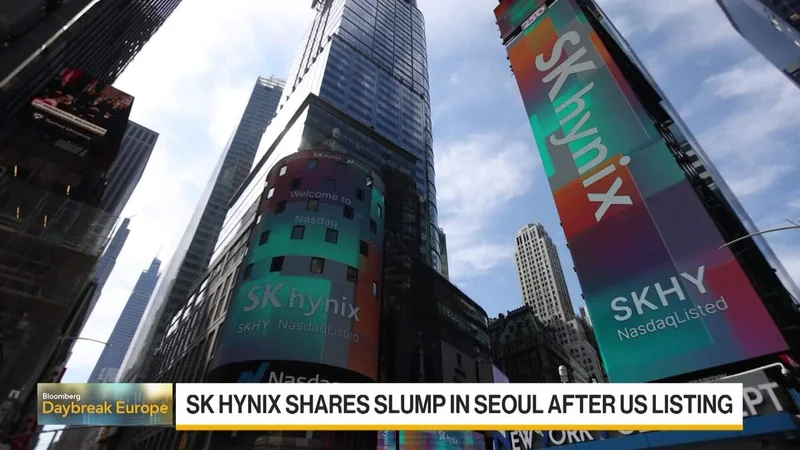
Image: Bloomberg AI
Main Takeaway
SK Hynix shares dropped over 15% in Seoul after its historic $26.5 billion Nasdaq debut, but Cleo Capital's Sarah Kunst argues the selloff is overshadowed.
Jump to Key PointsSummary
Why the Seoul selloff happened
SK Hynix shares plummeted more than 15% in Seoul on Monday, marking the steepest single-day drop on record for the memory chipmaker. The rout came immediately after the company's highly anticipated US trading debut on the Nasdaq, where it raised $26.5 billion in what became the largest US listing by a foreign company, according to Reuters and Bloomberg. The Seoul-listed shares tumbled to roughly 1.85 million won while the American depositary receipts traded near $122.70, creating a sharp and unusual price gap that rattled Korean investors.
The selloff wasn't isolated to SK Hynix. Barchart reports that the plunge sparked a broader retreat in AI-related stocks worldwide, with September Nasdaq 100 E-Mini futures dropping 0.94% and S&P 500 futures falling 0.29% as chipmakers came under renewed selling pressure. Samsung Electronics shares also tumbled more than 9% in a rout that CNBC described as spreading from Wall Street into Asian markets, deepening what was already a painful period for Korean tech stocks.
What Sarah Kunst sees that the market is missing
Sarah Kunst, founder and general partner of Cleo Capital, dismissed the selloff as far less alarming than the headlines suggest. Speaking to Bloomberg, Kunst pointed out that SK Hynix has gained more than 500% over the past year, a rally so substantial that even a record-breaking single-day drop barely dents the long-term trajectory. Her argument is straightforward: zoom out, and the chart tells a completely different story than the panic of a single trading session.
Kunst's perspective reframes the narrative from crisis to correction. A stock that quintuples in value over twelve months is bound to experience violent pullbacks, and the mechanics of a dual-listing debut often create temporary dislocations as arbitrageurs and institutional investors rebalance positions across exchanges. The Seoul plunge, in this reading, looks less like a fundamental repricing of SK Hynix's AI-driven memory business and more like a technical aftershock of a massive cross-border equity event.
The scale of the US debut and what it unlocks
SK Hynix priced its American depositary receipts at $149 each, raising $26.5 billion in what Reuters confirms is the largest US offering ever completed by a foreign company. The Nasdaq listing, which began trading on Friday July 10, gives US investors direct access to a company that had previously been difficult to own outside of workarounds like the KraneShares Artificial Intelligence and Technology ETF. Yahoo Finance notes that for years, American capital was largely stuck on the sidelines while SK Hynix dominated the high-bandwidth memory market that powers Nvidia's AI accelerators.
The company stated that IPO proceeds will fund fab expansions and purchases of advanced manufacturing equipment, according to Tradingview. HSBC lifted its Korean-share price target to 4.0 million won, explicitly citing the Nasdaq listing and improved US market access as catalysts. With 37 analysts covering the stock and a consensus strong buy rating, the average Korean-share target sits near 3.21 million won, well above the post-selloff levels.
How the memory market underpins the bull case
Creative Strategies senior analyst Austin Lyons told Yahoo Finance that SK Hynix picked the "perfect time" to list in the US, positioning itself squarely at the center of surging demand for high-bandwidth memory and DRAM chips. HBM is the specialized memory that sits alongside GPUs in AI training and inference clusters, and SK Hynix is the dominant supplier to Nvidia's most advanced systems. That supply chain position isn't threatened by a single-day equity selloff, and Lyons' analysis suggests the underlying demand drivers remain intact.
The competitive landscape reinforces this view. While US investors have historically gravitated toward Micron Technology and Sandisk for memory exposure, SK Hynix has been the more successful operator in the AI-specific memory segment, according to Yahoo Finance. The Nasdaq listing simply removes the friction that kept American capital from participating in that outperformance. The Seoul selloff, in this context, looks like a local repricing event disconnected from the global demand story for AI infrastructure components.
The price gap and what it signals for traders
Tradingview data highlights a stark dislocation: the ADR traded near $122.70 while Seoul shares sat around 1.85 million won, creating a gap that active traders immediately seized upon. Dual-listed stocks often experience such disconnects in the early days of trading as market participants figure out the arbitrage mechanics, currency hedging costs, and liquidity differences between venues. The gap itself exerts gravitational pull, incentivizing trades that narrow the spread over time.
The 15% Seoul drop, while dramatic, occurred against a backdrop where the ADR debut was priced at $149, meaning the Korean shares were already adjusting to a reference point set by US institutional demand. Barchart notes that the selloff rippled through futures markets and pressured chipmakers globally, but that contagion effect is a short-term trading phenomenon rather than a signal about SK Hynix's earnings power or its competitive position in the HBM supply chain.
What happens next for investors
The immediate question is whether the price gap closes through a Seoul recovery or an ADR decline. HSBC's upgraded target of 4.0 million won implies confidence in the former scenario, and the consensus analyst view remains firmly bullish. The $26.5 billion war chest gives SK Hynix the capital to accelerate capacity expansion at a moment when AI demand for memory shows no signs of slowing, and the US listing opens a permanent channel to the deepest pool of equity capital in the world.
For US investors, the debut transforms SK Hynix from an inaccessible outperformer into a direct portfolio option alongside Micron and Sandisk. The selloff narrative, as Kunst argues, is a one-day story superimposed on a multi-year structural shift in who can own the companies building the physical backbone of AI. The Seoul plunge is eye-catching, but the capital raise and market access it represents may matter far more over the horizon that long-term investors actually care about.
Key Points
SK Hynix raised $26.5 billion in the largest US listing by a foreign company, pricing ADRs at $149 on Nasdaq.
Seoul shares plunged over 15% in a record single-day drop, triggering selloffs in Samsung and global chip stocks.
Cleo Capital's Sarah Kunst dismissed the selloff, citing SK Hynix's 500% gain over the past year as the dominant trend.
HSBC upgraded its price target to 4.0 million won and analyst consensus remains a strong buy with a 3.21 million won average target.
The US debut gives American investors direct access to the leading HBM supplier for Nvidia's AI accelerators.
Questions Answered
SK Hynix shares dropped more than 15% in Seoul immediately after its $26.5 billion Nasdaq debut, marking the steepest single-day decline on record. The selloff was driven by a sharp price dislocation between the Korean-listed shares and the newly issued American depositary receipts, which created arbitrage pressure and triggered a broader retreat in Korean chip stocks including Samsung Electronics.
According to Cleo Capital's Sarah Kunst, the selloff is not a fundamental problem. She points out that SK Hynix gained more than 500% over the past year, making a sharp pullback statistically normal after such an extended rally. The underlying demand for high-bandwidth memory chips used in AI accelerators remains strong, and the selloff reflects technical dual-listing dynamics rather than a repricing of the business.
SK Hynix raised $26.5 billion by pricing its American depositary receipts at $149 each, making it the largest US listing ever completed by a foreign company. The company stated that the IPO proceeds will be used to expand fabrication facilities and purchase advanced manufacturing equipment to meet growing AI-driven demand for high-bandwidth memory.
Analyst consensus on SK Hynix remains a strong buy, with an average Korean-share price target of approximately 3.21 million won. HSBC lifted its target to 4.0 million won, explicitly citing the Nasdaq listing and improved US market access as positive catalysts. The bullish outlook is anchored in SK Hynix's dominant position supplying HBM chips for Nvidia's AI systems.
The Nasdaq listing gives US investors direct access to SK Hynix for the first time, eliminating the need for workarounds like owning the KraneShares AI and Technology ETF. SK Hynix now sits alongside Micron Technology and Sandisk as a directly investable memory-chip option, with the added distinction of being the leading HBM supplier for the AI accelerator market.
Source Reliability
57% of sources are highly trusted · Avg reliability: 83
Go deeper with Organic Intel
Simple AI systems for your life, work, and business. Each one includes copyable prompts, guides, and downloadable resources.
Explore Systems