SK Group Chairman Chey Tae-won Confident AI Demand Will Grow, Plans Much Bigger US Investment Push
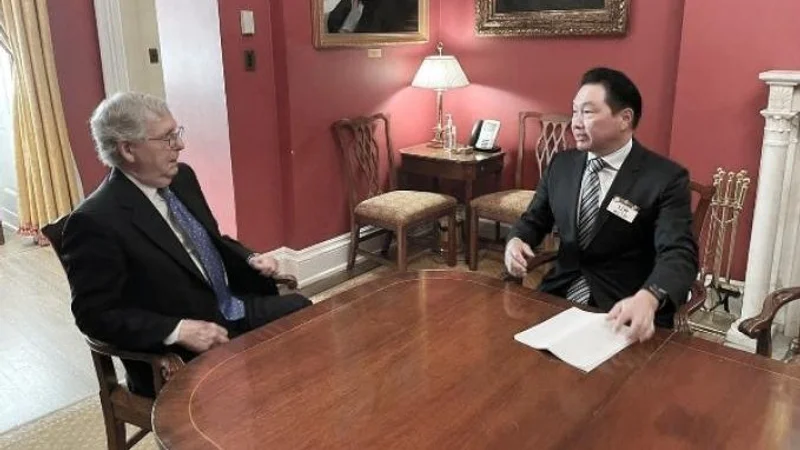
Image: Upi
Main Takeaway
SK Group Chairman Chey Tae-won expressed confidence that AI-driven chip demand will keep growing and revealed plans for a much bigger US investment strategy.
Jump to Key PointsSummary
Why Chey Tae-won is confident about AI demand
SK Group Chairman Chey Tae-won told Bloomberg he has "some confidence" that demand for the company's products will continue to grow, driven by the artificial intelligence boom. Customers have been directly telling him they want SK to expand more, he said in an interview on "Bloomberg Tech." The chairman's optimism aligns with a broader wave of tech leaders betting that AI infrastructure spending isn't slowing down anytime soon.
This confidence isn't abstract. SK Hynix, the group's memory chip arm and the world's second-largest memory chipmaker, supplies high-bandwidth memory chips that are essential for AI processors. As AI models grow hungrier for compute, the need for these specialized chips keeps climbing. Chey's remarks signal that SK sees this as a durable trend, not a short-term spike. His New Year message to employees earlier this year reinforced that view, where he urged the company to ride the "powerful winds" of artificial intelligence and position itself at the center of the AI-driven economy.
The scale of SK's US investment ambitions
Chey Tae-won told Bloomberg that SK Group has a "much, much bigger" plan to invest more money in the United States, though he didn't put a specific dollar figure on the latest vision during that interview. The language suggests a significant escalation from previously announced commitments. In 2022, SK Group pledged $22 billion in new US investments across semiconductors, green energy, and bioscience projects, according to Reuters. That same year, the group touted plans to increase total US investments to more than $50 billion by the end of 2025.
By late 2022, UPI reported that Chey had pledged $52 billion in US investment by 2030, with roughly half directed toward eco-friendly businesses. The "much, much bigger" phrasing now implies those numbers may be revised upward. During a CNBC interview ahead of SK Hynix's Nasdaq debut, Chey said he expects the company to make "at least" tens of billions of dollars worth of investments on the AI side alone, and he confirmed he is open to expanding chip-making investment in the US, provided his team finds the right location.
SK Hynix's historic Nasdaq debut and what it unlocks
SK Hynix made its long-awaited US stock market debut on the Nasdaq, raising $26.5 billion in what Bloomberg described as the largest-ever US listing by a foreign company. Chey called the moment a "dream come true," noting the company had waited a long time for this step. The listing gives SK Hynix direct access to American capital markets at a moment when the company needs massive funding for its AI-driven expansion.
Chey also told Bloomberg that SK Hynix is open to issuing more US shares in the future, keeping the door open for additional capital raises. The debut and the willingness to sell more equity suggest the company is preparing for a multi-year investment cycle that will require sustained access to deep pools of capital. The Nasdaq listing also raises SK Hynix's profile among US investors and customers at a time when semiconductor supply chains are increasingly geopolitical.
The conditions and focus areas for expansion
Chey's enthusiasm for US expansion comes with practical conditions. He told CNBC that if his team finds the right location in the US to build chip-making facilities, SK Hynix would proceed with the necessary investments. The conditional "yes" reflects the complexity of semiconductor fabrication site selection, where factors like water access, power infrastructure, talent availability, and regulatory incentives all weigh heavily.
Beyond chip manufacturing, Chey is looking at larger investments across the AI ecosystem. He specifically mentioned data centers, related technologies, and AI startups as areas of interest. This broader scope fits the SK Group's conglomerate structure, which spans energy, batteries, bioscience, and semiconductors. The group's appointment of its first head of US corporate and government affairs signals a serious commitment to navigating the American policy landscape as these investments take shape.
How this fits into SK's global AI strategy
Chey's US push is part of a broader strategic repositioning. In a joint YouTube interview released in late 2025, the SK Group chairman and Korea Chamber of Commerce and Industry chief said Korea's economic model needs to change because "it's no longer possible to solve our growth problems just by exporting more." That recognition is driving SK to embed itself more deeply in the markets where AI demand is concentrated, with the US being the largest.
The chairman's New Year message to employees stressed that SK remains well-positioned to play a central role in the emerging AI-driven economy. He also called for stronger economic ties with Japan, signaling that SK's AI ambitions aren't limited to the US. The combination of a historic Nasdaq listing, conditional US fab expansion, and a broader investment vision across AI infrastructure paints a picture of a conglomerate betting heavily that the AI demand story has years left to run.
What happens next for SK in the American market
The immediate next steps center on site selection for potential US chip-making facilities and the deployment of capital raised through the Nasdaq listing. Chey's "much, much bigger" investment plan remains undefined in dollar terms, but the direction is clear: more money, more facilities, and a deeper integration into the US AI supply chain.
The appointment of a dedicated US government affairs leader suggests SK is preparing for the regulatory and political dimensions of large-scale semiconductor investment, especially in an election year environment where industrial policy and foreign investment face scrutiny. Whether SK ultimately builds advanced packaging facilities, front-end fabrication, or both in the US will depend on the location search Chey referenced. For now, the chairman's confidence in AI demand, combined with customers asking for more supply, provides the strategic rationale for what looks like a generational expansion of SK's American footprint.
Key Points
SK Group Chairman Chey Tae-won expressed confidence AI-driven chip demand will keep growing based on direct customer requests for expansion.
SK Group plans a much bigger US investment push beyond prior pledges of $22 billion and $52 billion by 2030.
SK Hynix raised $26.5 billion in its Nasdaq debut, the largest-ever US listing by a foreign company.
Chey confirmed willingness to expand US chip-making if his team finds the right location, expecting tens of billions in AI-side investments.
The chairman is targeting broader AI ecosystem investments including data centers, related technologies, and startups.
Questions Answered
Chey Tae-won told Bloomberg he has some confidence that demand will continue to grow, noting that customers have been directly asking SK to expand more. He expects SK Hynix to make at least tens of billions of dollars in AI-related investments.
Chey Tae-won told Bloomberg SK Group has a much bigger plan for US investment than previously announced, though he didn't specify a new dollar figure. Prior pledges included $22 billion announced in 2022 and $52 billion by 2030, with roughly half going to eco-friendly businesses.
SK Hynix raised $26.5 billion in its Nasdaq debut, which Bloomberg reported as the largest-ever US stock market listing by a foreign company. Chairman Chey called the milestone a dream come true and said the company is open to issuing more US shares.
Chairman Chey told CNBC he is open to expanding chip-making investment in the US, but it depends on his team finding the right location. If a suitable site is identified, SK Hynix would proceed with the necessary investments.
Chey Tae-won said he is looking at larger investments across the AI ecosystem, specifically mentioning data centers, AI-related technologies, and AI startups as focus areas beyond semiconductor fabrication.
Chey has argued that Korea's economic model needs to change beyond just exporting more, and he is positioning SK at the center of the AI-driven economy. The US push is part of a broader strategy that also includes strengthening economic ties with Japan.
Source Reliability
44% of sources are trusted · Avg reliability: 71
Go deeper with Organic Intel
Simple AI systems for your life, work, and business. Each one includes copyable prompts, guides, and downloadable resources.
Explore Systems