SpaceX Files for Record $1.75 Trillion IPO, Forcing Wall Street to Rebuild Around It
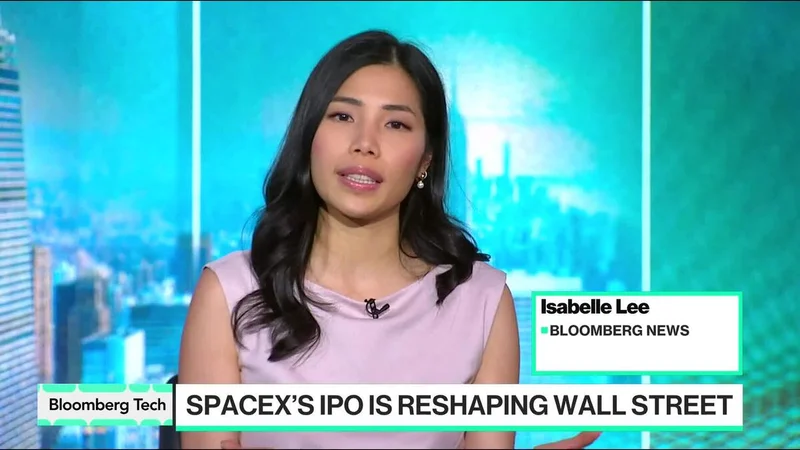
Image: Bloomberg AI
Main Takeaway
SpaceX filed for a $1.75 trillion IPO that would be the largest ever, triggering a sector-wide rally and forcing index providers to reorganize their systems.
Jump to Key PointsSummary
Why this IPO dwarfs every previous debut
SpaceX's filing targets a valuation of up to $1.75 trillion, more than double any prior IPO, according to multiple sources. Bloomberg reports the company is pitching itself as a hybrid of rockets, satellites, and AI with a claimed market opportunity of $28.5 trillion. The sheer scale has index providers scrambling, since no existing framework handles a debut this large. The New York Times notes Wall Street's fear of missing out now exceeds its fear of the deal flopping.
The Wall Street Journal confirmed the filing set off immediate operational changes across financial infrastructure. Morgan Stanley responded by creating the "Space 60," a curated list of space-related stocks, as reported by The Globe and Mail. This isn't a standard IPO, it is a restructuring event for capital markets.
How space stocks surged on the news
Rocket Lab jumped 57% since late March, leading a broad rally across the sector. Reuters reported U.S. space company shares climbed steadily as investors priced in a fundamental repricing of the entire space economy. Redwire, Firefly Aerospace, and satellite plays joined the advance, per Investors and Stockinvest.
The rally wasn't uniform. Bloomberg AI documented a second-day stumble for some names as the hype met reality. Barron's raised the specter of a short squeeze driving final-stage gains, questioning whether the momentum can hold through actual listing.
This volatility reveals a market learning to price space exposure in real time. The sector lacked a liquid benchmark until now, so every ticker became a proxy for SpaceX access.
What forced Wall Street to reorganize its machinery
News.bloombergtax stated plainly that no prior blockbuster IPO required such rapid infrastructure adaptation. Index providers face a mechanical problem, a $1.75 trillion entry instantly warps any benchmark it enters. Weighting formulas designed for gradual growth can't absorb a company already larger than most sectors.
Wall Street Prep framed the valuation question directly, asking whether SpaceX can justify its price. The analysis highlighted a structural shift in how companies come to market, the median IPO age has risen dramatically since 2005, making SpaceX both the culmination and exception to the stay-private-longer trend.
The operational stress extends to underwriting syndicates, trading systems, and research coverage. Banks are building space-specific analyst teams from scratch.
What Elon Musk gains beyond capital
The IPO would make Musk the world's first trillionaire, per Leverageshares. But the financial windfall masks a strategic transformation. Quiltyspace noted SpaceX already evolved from a launch company into a vertically integrated satellite constellation operator, the IPO cements its identity as an aerospace-AI conglomerate.
Musk's discomfort with public markets is well documented, he has called Tesla's public status a distraction. Yet the capital demands of Starship, Starlink expansion, and AI development apparently outweighed his reluctance. The filing represents a concession that private markets alone cannot fund his stated ambitions.
The dual-class or similar governance structure will determine whether this becomes another Musk-controlled empire or a conventionally managed public company. That structure remains undisclosed in early filings.
What happens when the stock actually lists
Short-term, volatility is guaranteed. Barron's short squeeze warning and Bloomberg's faltering rally both point to a messy price discovery process. The $1.5-1.75 trillion range itself may shift multiple times before debut.
Longer term, the IPO establishes a liquid benchmark for space valuation. Every satellite startup, defense contractor with space exposure, and related technology play will be measured against SpaceX's multiples. This could unlock or freeze capital flows across the sector depending on whether the stock trades up or down post-IPO.
Ng.investing called this Wall Street's most bullish event and its biggest test simultaneously. The infrastructure changes, analyst hiring, and index rebalancing are irreversible. Markets will be living with the consequences of this filing for years.
Key Points
SpaceX filed for a $1.75 trillion IPO, the largest ever proposed
Rocket Lab surged 57% as space stocks rallied on the filing news
Wall Street index providers and banks are reorganizing infrastructure to handle the debut
Morgan Stanley launched a Space 60 stock index in response to investor demand
Elon Musk would become the world's first trillionaire at the targeted valuation
Questions Answered
SpaceX is targeting a valuation of up to $1.75 trillion, which would more than double the record for any previous IPO.
Rocket Lab led gains with a 57% surge, while Redwire, Firefly Aerospace, and other satellite and rocket companies also climbed significantly.
The $1.75 trillion scale instantly warps any market index it enters, requiring index providers, underwriting syndicates, and research departments to build new systems and teams.
At the targeted valuation, Musk would become the world's first trillionaire while gaining access to public capital for Starship, Starlink expansion, and AI development.
Some signs of volatility have emerged, with Bloomberg reporting a second-day stumble for some names and Barron's warning of a potential short squeeze driving late-stage gains.
Source Reliability
46% of sources are highly trusted · Avg reliability: 75
Go deeper with Organic Intel
Simple AI systems for your life, work, and business. Each one includes copyable prompts, guides, and downloadable resources.
Explore Systems