SoftBank's $60 Billion OpenAI Gamble Divides Executives as Son Bets the Firm on Altman
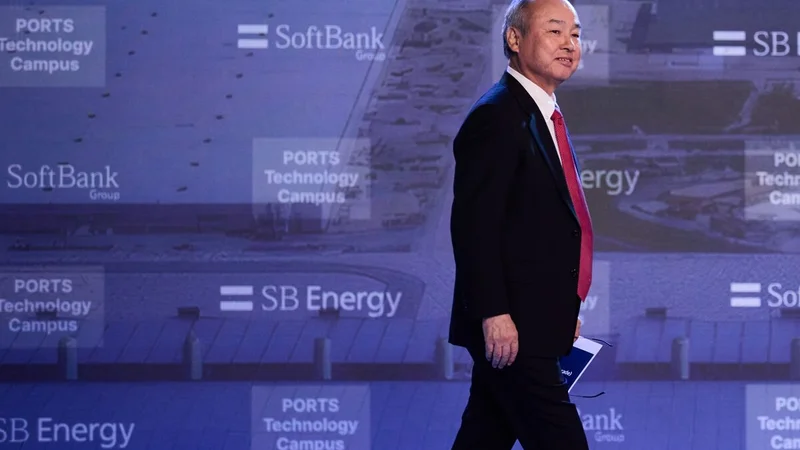
Image: Bloomberg AI
Main Takeaway
SoftBank has committed over $60 billion to OpenAI, triggering internal alarm over Masayoshi Son's personal devotion to Sam Altman.
Jump to Key PointsSummary
How one man's conviction became a corporate strategy
Masayoshi Son has channeled more than $60 billion of SoftBank's capital into OpenAI, transforming a personal fascination with Sam Altman into the single largest corporate bet on artificial intelligence anywhere in the world. The commitment exceeds what most nations spend on their entire military annually. For Son, this represents the culmination of a career spent making oversized wagers on technology cycles, from his $20 million early investment in Alibaba that ballooned to $130 billion, to the Vision Fund's meteoric rise and subsequent WeWork collapse.
The scale has rattled colleagues. Bloomberg reports that some SoftBank insiders are growing uneasy over Son's devotion to Altman, describing a dynamic where the founder's conviction in OpenAI's CEO has become difficult to question internally. The concern isn't merely financial, though the dollar figure is staggering. It's that Son's decision-making appears less analytical than relational, a pattern that has both created and destroyed fortunes throughout his career.
The accounting that emboldened the bet
SoftBank's fiscal fourth quarter delivered a net income of ¥1.83 trillion, crushing analyst estimates of ¥295.2 billion by a factor of six. The engine behind this outperformance was almost entirely OpenAI. CNBC confirmed that SoftBank booked a yearly gain of $46 billion at its Vision Fund, with investment gains in OpenAI totaling $45 billion in the year ended March. The Wall Street Journal separately reported a $25 billion gain on the OpenAI position.
These paper gains have paradoxically intensified rather than reduced the risk. Japan Times noted that the surge in quarterly profit boosted confidence at SoftBank to bet even more on the ChatGPT-maker. This is the classic Son pattern: wins beget bigger bets, not diversification. The ¥1.83 trillion figure represents validation that emboldens rather than cautions, a feedback loop that has historically preceded both his greatest triumphs and most spectacular failures.
Why insiders fear a repeat of WeWork
The WeWork debacle cost SoftBank roughly $17 billion and remains fresh in the institutional memory of anyone who worked through it. StartupHub reported that concerns are mounting within SoftBank regarding the massive $60 billion bet, with insiders specifically questioning the firm's lack of control and the potential risks of such concentrated exposure. The parallel to WeWork is uncomfortable: another charismatic founder, another vision of world-transforming real estate utilization, another case where Son's personal conviction overrode conventional risk management.
The difference this time is scale. WeWork, at its most damaging, represented a fraction of the OpenAI commitment. The $60 billion figure also represents a fundamentally different kind of risk than a traditional venture investment. SoftBank does not appear to have secured commensurate governance rights or board control for its capital. The concentration is extreme even by SoftBank's own standards, where the Vision Fund was designed to spread bets across dozens of companies.
What the financial structure reveals about power
The $60 billion commitment appears to have been deployed in stages, with CNBC tracking more than $30 billion invested and the remaining balance committed but not yet fully drawn. This staged approach gives OpenAI enormous leverage, as SoftBank becomes progressively more committed and thus less likely to abandon the relationship. Reuters framed Son as a "fragile link in AI chain," suggesting that his personal health, judgment, or continued access to Altman represents a systemic vulnerability.
The power asymmetry is striking. OpenAI has multiple major investors including Microsoft, while SoftBank's AI strategy has become overwhelmingly dependent on this single relationship. Bismarck Analysis characterized Son as having tied the fortunes of his enormous venture investment funds to OpenAI's success. The phrase captures the structural reality: this is not a portfolio approach but an all-in wager that makes SoftBank's outcomes nearly isomorphic with OpenAI's.
What happens if the Altman-Son relationship fractures
The personal dimension is not incidental to the financial risk. Bloomberg's reporting on Son being "starstruck" and "convinced" Altman is leading the most important technology shift of the century describes a dependency that is partly emotional. This has worked while the relationship functions, but introduces fragility. Altman has his own complex investor relationships, including with Microsoft, and OpenAI's governance has proven volatile before.
Should the personal chemistry deteriorate, or should OpenAI's technical trajectory falter, SoftBank lacks obvious alternatives at this scale. The $45 billion in annual gains could reverse just as quickly. Son's history suggests he does not hedge emotionally or financially when he believes in a founder. The question dividing SoftBank executives is whether this represents visionary conviction or the same pattern that produced the WeWork catastrophe, now played for exponentially higher stakes.
Why this matters beyond SoftBank's balance sheet
The SoftBank-OpenAI dynamic has become a bellwether for how capital concentration in AI is evolving. When a single investor commits $60 billion to a single company in a single technology sector, it shapes competitive dynamics for everyone else. Smaller AI startups face a funding environment where the largest pools of capital are locked into an incumbent. Enterprise customers watching this unfold must assess whether OpenAI's dominance is being manufactured by capital deployment rather than purely technical merit.
The episode also tests whether personality-driven investing can work at this scale in AI. Son's six-minute decision to invest in Yahoo, his early Alibaba bet, and his WeWork disaster all share a common thread: rapid judgment based on founder assessment. AI may be different. The capital requirements are larger, the technical risks more complex, and the competitive landscape more dynamic. Whether Son's instinctive approach succeeds or fails will influence how the next trillion dollars of AI investment gets allocated.
Key Points
SoftBank has committed over $60 billion to OpenAI in history's largest AI investment
Vision Fund gained $46 billion annually, with $45 billion from OpenAI valuation increases
Internal executives worry Son's personal devotion to Altman overrides risk analysis
WeWork's $17 billion loss haunts staff questioning concentrated exposure
Staged capital deployment gives OpenAI escalating leverage over SoftBank
Questions Answered
CNBC reported more than $30 billion invested with additional committed capital bringing the total above $60 billion.
Bloomberg reported that Son's personal devotion to Altman is difficult to question, creating governance concerns and WeWork parallels.
SoftBank booked $45 billion in OpenAI gains in the year ended March, driving Vision Fund profits to $46 billion annually.
Son lost approximately $17 billion on WeWork after being similarly captivated by founder Adam Neumann's vision and charisma.
Reports suggest SoftBank lacks commensurate governance for its capital, unlike Microsoft's more structured OpenAI relationship.
Given the concentration, a significant OpenAI reversal would devastate SoftBank's financial position and AI strategy simultaneously.
Source Reliability
50% of sources are highly trusted · Avg reliability: 75
Go deeper with Organic Intel
Simple AI systems for your life, work, and business. Each one includes copyable prompts, guides, and downloadable resources.
Explore Systems