Ray Dalio Warns AI Bubble Is 80% Formed and Politically Explosive, Urges Investors Not to Flee Yet
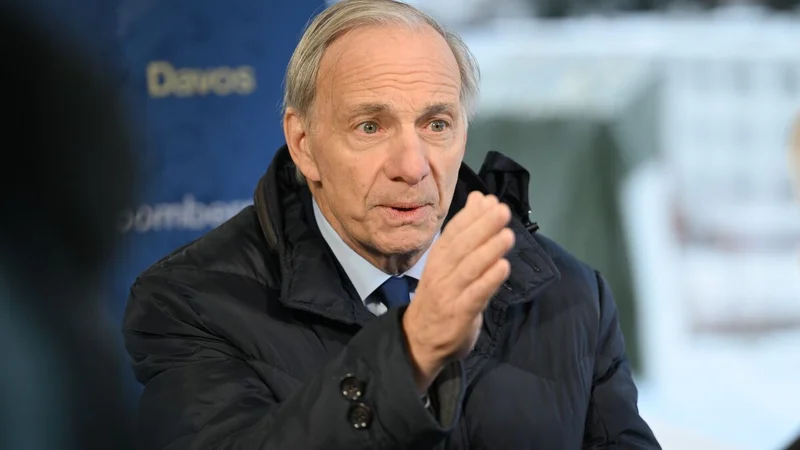
Image: Bloomberg AI
Main Takeaway
Billionaire investor Ray Dalio says the AI market is in an 80% formed bubble that will burst when wealth converts to money, but investors should not sell.
Jump to Key PointsSummary
How close the bubble is to popping
Ray Dalio pegs the current AI market at roughly 80% of the way to a full bubble, according to Fortune's reporting of his remarks. The Bridgewater Associates founder has been tracking this trajectory publicly since at least October 2025, when he told CNBC that bubbles do not pop until specific conditions align. His latest assessment, delivered in June 2026, sharpens the warning while adding a counterintuitive caveat for investors.
The bubble's fuel is speculative wealth pouring into AI-linked names, particularly Nvidia, which has seen volatile trading directly tied to Dalio's comments. When he speaks, markets move. That alone signals how tightly wound investor psychology has become around AI narratives.
Why Dalio says don't sell everything
Despite the bubble warning, Dalio explicitly counsels against dumping stocks purely out of bubble fear. Business Insider reports his view that exiting too early means missing the final, often lucrative, phase of a bubble's expansion. This is not merely theoretical for him; he has managed through multiple cycles where the last 20% of a bubble's ascent generated outsized returns.
The advice creates a tension that defines current market positioning: the knowledge of danger coexisting with the rationality of riding momentum. Dalio's framework treats bubbles as predictable phenomena with predictable endings, not as reasons for panic. He wants investors timed, not terrified.
What actually pops bubbles
The trigger mechanism matters more than the bubble itself, and Dalio has been consistent about this. He told CNBC in October 2025 that bubbles burst when central banks tighten monetary policy, not merely when valuations look stretched. The Federal Reserve's current posture thus becomes the critical variable, more so than any AI-specific metric.
This monetary dependency means AI stock performance is tethered to interest rate decisions in ways that pure technology analysis misses. Dalio's wealth-to-money conversion concept refers to the moment paper gains must be realized, creating selling pressure that monetary tightening exacerbates. The physics are: easy money inflates, tight money deflates.
The profit paradox eating the boom
Dalio warns that AI is "eating everything" but could "eat itself" if spending outruns returns, per Business Insider. Companies are deploying massive capital without corresponding profit generation, a mismatch he discussed on the "All-In Podcast." The technology's transformative potential is real; the financial engineering around it is shakier.
This creates a knife's edge for the AI trade. Nvidia and peers must show that infrastructure spending translates to customer revenue, not just more infrastructure spending. Dalio's phrasing suggests skepticism that this conversion is happening at required scale. The boom sustains itself only while capital remains cheap and optimism boundless.
The political explosion Dalio foresees
Beyond market mechanics, Dalio predicts AI and robotics will concentrate benefits among the top 1% to 10%, necessitating what he calls "redistribution policy." Fortune reports him describing a future with "a limited number of winners and a bunch of losers," where technological gains become politically explosive without intervention.
This socioeconomic framing distinguishes his analysis from typical bubble commentary. He is not merely forecasting price correction but societal rupture if wealth concentration proceeds unchecked. The robots-and-AI combination, in his view, accelerates inequality past democratic tolerance. Investors who ignore this dimension, he suggests, misunderstand what ultimately terminates such cycles.
What machine thinking means for markets
Dalio's investment thesis is evolving alongside his bubble warning. In his book "How Countries Go Broke," he writes that machine thinking will "supplement or surpass human thinking in many ways," comparing the moment to past Industrial Revolutions. This is not abstract philosophy for him; he anticipates AI replacing human decision-making in investing itself.
The implication is paradoxical: the very tools fueling the bubble may eventually eliminate the human judgment currently driving it. For now, algorithmic and human speculation remain intertwined, but Dalio's longer horizon suggests a market structure transformation that current bubble dynamics merely preview. The transition, when it comes, will not be gentle.
Key Points
Ray Dalio assesses the AI market bubble at approximately 80% formation with imminent burst risk
Federal Reserve tightening policy, not overvaluation alone, will trigger the actual pop
Investors should not sell prematurely despite bubble recognition, per Dalio's advice
AI companies face a profit paradox where massive spending may not generate adequate returns
Wealth concentration from AI and robotics may trigger politically explosive inequality requiring redistribution
Questions Answered
Dalio estimates the AI market bubble is approximately 80% formed, based on his public remarks reported by Fortune and Bloomberg in June 2026.
He argues that exiting too early means missing the final expansion phase, which often generates the largest returns before the bubble actually bursts.
He identifies Federal Reserve monetary tightening as the necessary condition, stating bubbles do not pop solely from stretched valuations without policy reversal.
He refers to the risk that massive capital spending on AI infrastructure may not produce corresponding profits, creating a self-undermining cycle.
He forecasts that AI and robotics will disproportionately benefit the top 1-10%, necessitating redistribution policy to prevent societal rupture.
Source Reliability
43% of sources are trusted · Avg reliability: 71
Go deeper with Organic Intel
Simple AI systems for your life, work, and business. Each one includes copyable prompts, guides, and downloadable resources.
Explore Systems