OpenAI Adds College Planner to ChatGPT for Teens as Students Turn to AI for Applications
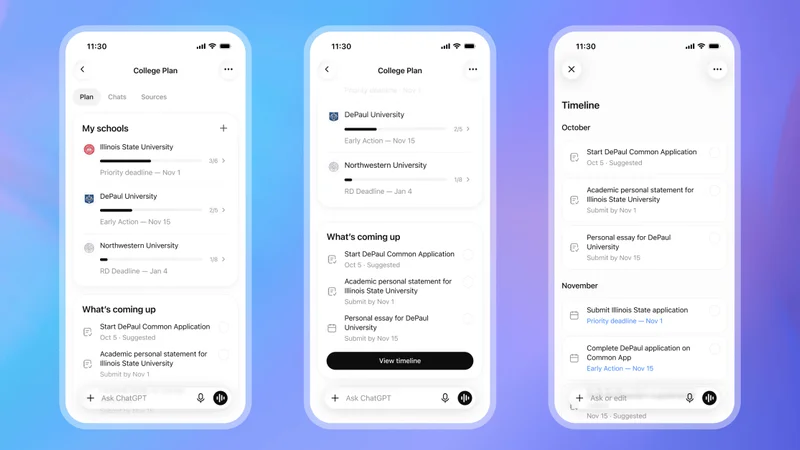
Image: The Verge AI
Main Takeaway
OpenAI is adding College Planner to ChatGPT for Teens, combining application requirements, deadlines, tasks, and financial-aid steps in one student plan.
Jump to Key PointsSummary
OpenAI brings planning into ChatGPT
OpenAI is adding College Planner to ChatGPT for Teens, turning the chatbot from an occasional college adviser into a tool for organizing applications. The feature brings application requirements, deadlines, tasks, and financial-aid steps for schools on a student’s list into one plan. Students applying to multiple colleges can return to the plan as their work progresses, according to OpenAI.
The announcement places college planning alongside new study features, including flashcards and quizzes, in a broader ChatGPT for Teens experience. The teen mode, introduced in August, includes safeguards and break reminders. The Verge described the college tools as part of OpenAI’s effort to help teenagers manage the application process, while the National Society of High School Scholars framed generative AI as a study and planning partner for students preparing for college and later work.
Why students are already using AI
AI has already entered the college search process, although adoption remains early. About 16% of college-bound high school students had used generative AI to learn about colleges in 2025, up from 12% in 2024, according to research cited by Encoura. Students use chatbots to ask about schools, majors, admissions terms, essays, financial aid, and study plans.
The appeal is access and speed. A student can ask for an explanation of a confusing admissions term, generate questions for a campus visit, compare priorities, or turn a large assignment into smaller tasks. The National Society of High School Scholars also points to research help, tutoring, organization, and critical-thinking support as common uses. ChatGPT can make the first step less intimidating, especially for families that lack an experienced counselor nearby.
The planner fills a practical gap
College Planner addresses the part of the process that a conversational answer handles poorly: keeping many connected obligations visible over time. Applications involve school-specific requirements, changing deadlines, essays, recommendation letters, forms, scholarships, and financial-aid work. A persistent plan gives students a place to track those pieces instead of rebuilding the checklist in each new chat.
That distinction matters because college planning is a sequence of decisions, not a single question. CollegeHound’s analysis argues that families need one organized place to see what matters next, preserve documents and deadlines, and coordinate decisions. Saving for College makes a similar case for pairing AI explanations with verified calculators and account information when families are weighing 529 plans, tax benefits, savings targets, and aid. The new OpenAI feature brings organization into the chatbot, but families still need authoritative college and financial sources for final decisions.
Accuracy remains the central limitation
ChatGPT can help students frame a search, but college recommendations depend on accurate, current details about costs, programs, admissions policies, deadlines, and fit. A generic prompt such as asking which colleges to apply to can produce broad or mismatched suggestions, according to Understanding FAFSA. Better results require specific information about academic interests, location, budget, selectivity, campus preferences, and personal constraints.
Financial planning raises the stakes. Saving for College advises users to verify AI-generated guidance against dependable data, particularly for 529 rules, tax treatment, investments, and financial aid. CollegeHound likewise separates quick explanations from the sustained record-keeping that application planning requires. OpenAI’s structured planner reduces organizational friction, but it doesn't remove the need to check each school’s official requirements and preserve human judgment about fit.
Teen safeguards shape the rollout
OpenAI is presenting the college planner as part of a teen-specific product rather than a general-purpose feature alone. That setting includes safeguards and break reminders, while the company is also creating a teen AI council and adding learning tools. The design reflects the fact that high school users need help with planning and studying alongside protections suited to younger users.
The University of Utah’s discussion of ChatGPT’s role in higher education places the rollout in a longer debate over academic integrity, learning, and institutional responsibility. Universities initially focused on plagiarism when ChatGPT became widely available in 2022, but students now use generative AI for research, organization, and preparation as well. That shift puts pressure on schools to explain acceptable use, teach verification, and distinguish assistance from submitting machine-written work as a student’s own.
What happens next for college search
College Planner gives OpenAI a direct position in a high-value decision that has traditionally been divided among counselors, admissions offices, spreadsheets, financial-aid websites, and family conversations. Its success will depend on data quality, ease of updating, privacy practices, and whether students keep using the plan after the novelty of the chatbot fades.
The early adoption trend indicates that AI is becoming one channel for college discovery, while the new feature makes that channel more structured. Families will still need official school information, financial tools, counselors, and direct conversations with colleges. For students, the clearest benefit is a single place to turn a scattered application process into visible next steps, with the final decisions remaining theirs.
Key Points
OpenAI is adding College Planner to ChatGPT for Teens for application deadlines, tasks, requirements, and financial aid.
College-bound students’ generative AI use for college research rose from 12% in 2024 to 16% in 2025.
ChatGPT can organize applications while students still need official college websites and verified financial information.
Teen ChatGPT combines college planning with flashcards, quizzes, break reminders, safeguards, and youth participation.
AI college recommendations improve with detailed student preferences but can still produce unsuitable or outdated guidance.
Questions Answered
OpenAI’s College Planner organizes college application requirements, deadlines, tasks, and financial-aid steps in one plan. It is designed for students applying to multiple schools and returning to their progress over time.
ChatGPT can help students brainstorm and compare colleges, but it shouldn't make the final application list alone. Recommendations improve when students provide details about academics, budget, location, campus preferences, and selectivity, then verify information with official sources.
OpenAI is adding college planning tools because students already use generative AI for college research, studying, and organization. College Planner gives those conversations a persistent structure for deadlines, requirements, tasks, and financial aid.
ChatGPT can explain financial aid and 529 concepts, but families should verify decisions with official guidance and trusted financial tools. Rules, tax benefits, investment details, and school-specific aid information require current, authoritative data.
ChatGPT’s college planning feature will need to prove that its data stays current and that students continue using its plans throughout the application cycle. Its usefulness will also depend on privacy, personalization, and how well it complements counselors and official college information.
Source Reliability
33% of sources are highly trusted · Avg reliability: 69
Go deeper with Organic Intel
Simple AI systems for your life, work, and business. Each one includes copyable prompts, guides, and downloadable resources.
Explore Systems