Bank of America and S&P Global Put Governance and Data Ahead of Faster AI Deployment
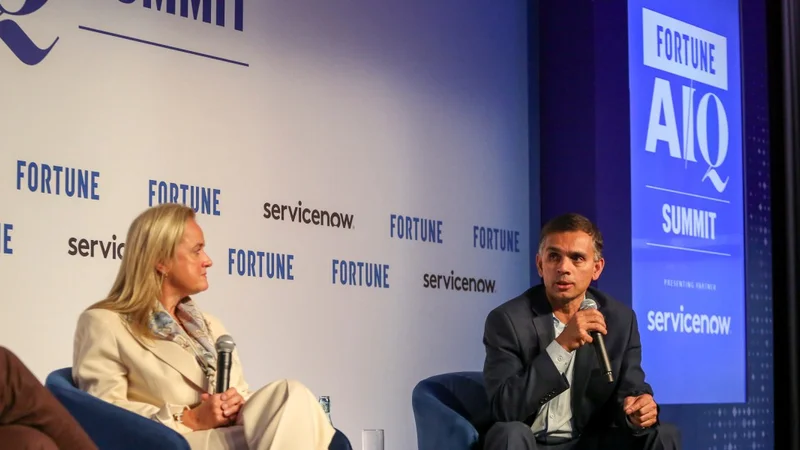
Image: Fortune AI
Main Takeaway
Bank of America plans to double its AI budget while executives warn that trusted data, governance, and clear business needs must come before deployment.
Jump to Key PointsSummary
Governance comes before scale
Bank of America plans to double its AI budget next year, but its technology chief says spending will not substitute for disciplined decision-making. Hari Gopalkrishnan, the bank’s chief technology and information officer, warned at Fortune’s AIQ Summit that companies often reach for AI before establishing whether it is the right tool for a problem.
In regulated finance, that sequence carries operational and compliance costs. Systems influence customer interactions, market information, risk assessments, and internal processes, so leaders need ownership, controls, testing, and audit trails before expanding deployment. The World Economic Forum’s financial-services playbook and Bank of America’s own governance messaging place accountability alongside technical performance.
Data determines practical value
Reliable, traceable data is the foundation for useful AI in financial services. S&P Global executive Sally Moore said organizations need to connect AI programs to a clear business purpose, while the company’s data-focused materials emphasize turning information into measurable value rather than treating models as standalone products.
That approach shifts attention from model novelty to the quality, lineage, and accessibility of the information feeding each system. S&P Global’s market-intelligence business depends on data that users can understand and defend, and the same standard applies when AI generates analysis or supports decisions. The World Economic Forum frames data governance as a central part of responsible financial-services adoption, while PwC’s responsible-AI focus reinforces the need for controls spanning data and model use.
Choosing the right tool
Bank of America’s warning is also a case for restraint: deterministic models remain suitable for many repeatable tasks. Gopalkrishnan said one of the biggest mistakes companies make is rushing to AI when conventional systems already perform well enough. That distinction helps organizations avoid adding probabilistic behavior, monitoring demands, and governance overhead where a fixed rule or established analytical model is sufficient.
The bank’s reported use of 270 AI models shows that restraint does not mean avoiding deployment. It means matching methods to jobs, then measuring whether each system improves productivity, client service, accuracy, or speed. Coverage of Bank of America’s AI playbook and workforce adoption points to an operating model built around practical gains, while S&P Global’s emphasis on reinvention asks executives to examine how work itself changes after implementation.
Productivity needs proof
AI adoption at Bank of America is tied to workforce productivity and client service, giving the bank concrete measures for judging expansion. Those outcomes matter because a larger model inventory alone says little about whether deployment benefits employees or customers.
The bank’s planned budget increase signals confidence that governed AI can produce enough value to justify further investment. It also raises the standard for evidence: each new system needs a defined owner, a business case, reliable inputs, and performance checks after launch. S&P Global’s focus on data value supplies a parallel benchmark for a company whose products support financial analysis, while governance guidance from Bank of America and the World Economic Forum places operational safeguards around those gains.
Reinvention shapes the next phase
The next phase of financial-services AI will be defined by operating redesign, not model counts alone. Moore described the central question as whether organizations are ready to reinvent how work is done, while Gopalkrishnan’s comments set a boundary around that ambition: reinvention still begins with a specific problem and an appropriate technical solution.
That combination gives large financial institutions a demanding checklist. They must decide where AI adds value, preserve deterministic systems where they work, document data origins, assign accountability, and monitor systems in production. The World Economic Forum’s industry guidance, S&P Global’s data strategy, and Bank of America’s governance and adoption efforts all point toward staged deployment tied to trust. The bank’s budget expansion makes that discipline more consequential, because a larger program magnifies both its benefits and its failures.
Key Points
Bank of America plans to double AI spending while prioritizing governance, data quality, and defined business needs.
S&P Global says AI programs should support organizational reinvention and produce measurable value from trusted data.
Bank of America operates 270 AI models across operations, linking adoption to productivity and client service.
Financial institutions should retain deterministic models when they solve repeatable problems effectively and transparently.
Responsible AI requires data lineage, accountable ownership, monitoring, testing, and controls throughout deployment.
Questions Answered
Bank of America is doubling its AI budget to expand systems tied to productivity and client service. The bank’s technology leadership says growth must remain connected to governance, reliable data, and clear business outcomes.
Bank of America warned that companies often choose AI before defining the problem it needs to solve. Hari Gopalkrishnan said deterministic models are still sufficient for many repeatable tasks.
S&P Global says AI success requires trusted data and a clear connection to business value. Sally Moore also framed adoption as a question of reinventing how organizations work.
Bank of America runs 270 AI models across its operations, according to CIO Dive coverage. The figure reflects broad deployment, while the bank’s governance messaging focuses on accountability and performance.
Governance matters because financial-services AI can affect customers, markets, and economic decisions. Controls for ownership, data lineage, testing, monitoring, and auditability help institutions manage those systems responsibly.
Source Reliability
33% of sources are highly trusted · Avg reliability: 74
Go deeper with Organic Intel
Simple AI systems for your life, work, and business. Each one includes copyable prompts, guides, and downloadable resources.
Explore Systems