NVIDIA and Doosan Group Expand Partnership to Build Physical AI and AI Factory Infrastructure
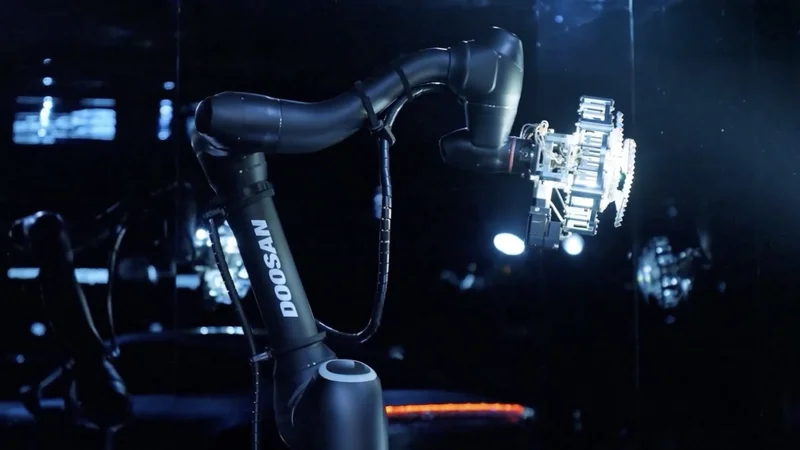
Image: NVIDIA Blog
Main Takeaway
NVIDIA and Doosan Group expanded their collaboration to develop physical AI, robotics, and AI factory infrastructure across multiple Doosan subsidiaries.
Jump to Key PointsSummary
What the partnership covers
NVIDIA and Doosan Group are expanding their collaboration to advance physical AI, robotics, and AI factory infrastructure. The partnership spans four key Doosan subsidiaries: Doosan Robotics, Doosan Bobcat, Doosan Enerbility, and Doosan Corporation Electro-Materials BG.
The collaboration combines NVIDIA's full-stack accelerated computing platforms with Doosan Group's expertise in industrial automation, power generation, and advanced electronics materials. According to Digitimes, this expanded tie-up specifically targets robotics and AI factory infrastructure as growth areas for both companies. The scope is notably broad, touching everything from intelligent robotics systems to large-scale power solutions and advanced materials for AI data center equipment.
Doosan Group's businesses cover multiple layers of the AI factory ecosystem. This vertical integration, from hardware components to finished robotic systems, is what makes the partnership structurally significant rather than merely a vendor-customer arrangement.
Why physical AI matters now
Physical AI, the intersection of artificial intelligence with physical systems like robots and industrial machinery, represents a major frontier for NVIDIA. The company's physical AI stack, including NVIDIA DSX, is central to how it plans to extend its dominance beyond data centers into the physical world.
The timing aligns with broader industry momentum. NVIDIA has been aggressively expanding its physical AI partnerships, including a separate announcement with LG Group to build an AI factory for robotics, autonomous driving, and GPU cloud services. According to NVIDIA's blog, the LG collaboration connects AI model development, physical AI data generation, robot simulation, training, edge deployment, and factory-scale digital twins into a unified workflow. This suggests NVIDIA is standardizing its physical AI platform across multiple Korean industrial conglomerates, treating them as beachheads for different application domains.
The Korean market offers particular advantages: dense manufacturing ecosystems, government support for AI and robotics, and industrial giants with both the capital and vertical integration to deploy at scale.
Doosan's strategic positioning
Doosan Group brings unusual breadth to this partnership. Doosan Robotics manufactures collaborative and autonomous robots for industrial and service applications. Doosan Bobcat, known for compact construction equipment, provides a pathway for autonomous heavy machinery. Doosan Enerbility contributes power generation and energy infrastructure, critical for AI factory operations given the enormous electricity demands of modern data centers. Doosan Corporation Electro-Materials BG supplies advanced electronics materials used in semiconductor and data center equipment.
This portfolio means Doosan can contribute to nearly every layer of AI factory infrastructure, from the chips and materials inside servers to the robots that will build and maintain them, to the power systems keeping everything running. For NVIDIA, this is an efficient way to penetrate industrial markets without building vertical capabilities itself.
The partnership structure also reflects Korean industrial organization. Chaebol like Doosan and LG maintain extensive internal supply chains and cross-subsidiary coordination that Western conglomerates rarely match.
The energy and materials angle
AI factory power requirements are becoming a binding constraint on industry growth. Training runs for frontier models now consume tens of megawatts, and inference at scale multiplies this demand. Doosan Enerbility's involvement signals that this partnership is not merely about software and robots but about the fundamental infrastructure needed to sustain AI expansion.
Doosan Corporation Electro-Materials BG adds another underappreciated dimension. Advanced electronics materials, including substrates, thermal management materials, and specialized components, are increasingly bottlenecks in AI hardware supply chains. NVIDIA's data center products depend on materials innovation that often receives less attention than chip design. By collaborating directly with a materials supplier, NVIDIA may be securing supply chain resilience and co-development pathways for future generations of its hardware.
This dual focus, energy and materials, distinguishes the Doosan partnership from NVIDIA's more software-centric collaborations.
Competitive implications
NVIDIA's parallel announcements with Doosan and LG reveal a deliberate strategy to anchor its physical AI ecosystem in Korean industry. Both partnerships share structural similarities: full-stack NVIDIA platforms, multi-subsidiary industrial groups, and coverage of robotics plus infrastructure. This creates network effects and learning spillovers across partners.
For competitors, this is concerning. NVIDIA is not merely selling GPUs but embedding itself as the platform layer for how industrial companies develop, simulate, and deploy physical AI. AMD and Intel lack comparable physical AI software ecosystems. Cloud providers like AWS and Google Cloud are building robotics platforms but without NVIDIA's unified simulation-to-deployment stack. Specialized robotics companies like Boston Dynamics or Figure AI may find themselves squeezed between NVIDIA's platform and the industrial scale of partners like Doosan.
The risk for NVIDIA is execution complexity. Managing partnerships across multiple chaebol subsidiaries, each with distinct priorities and governance, requires organizational capabilities that differ from its core chip business.
What happens next
Short-term, expect pilot deployments and joint development projects across Doosan Robotics' product lines and Doosan Bobcat's equipment. The Enerbility and Electro-Materials collaborations likely have longer timelines given infrastructure development cycles.
Medium-term, this partnership will test whether NVIDIA's physical AI platform can deliver productivity gains in industrial settings that justify its cost. Doosan's global customer base provides a distribution channel if pilots succeed. The LG partnership, with its focus on consumer-facing applications and GPU cloud services, offers a useful comparison point for which physical AI domains mature fastest.
For the broader industry, NVIDIA's Korean partnerships establish a template it will likely replicate with industrial conglomerates in Japan, Germany, and the United States. The company appears to be building physical AI in the same pattern it built AI training: platform first, ecosystem second, market dominance third.
Key Points
NVIDIA and Doosan Group expanded their partnership across four subsidiaries to develop physical AI and AI factory infrastructure.
The collaboration combines NVIDIA's computing platforms with Doosan's industrial automation, power generation, and electronics materials expertise.
Doosan Enerbility and Electro-Materials address critical AI bottlenecks: energy consumption and advanced materials for data center hardware.
A parallel NVIDIA-LG partnership reveals a strategy to anchor physical AI ecosystems in Korean industrial conglomerates.
The partnership tests whether NVIDIA's unified physical AI platform can deliver productivity gains across diverse industrial applications.
Questions Answered
NVIDIA is partnering with four Doosan Group subsidiaries: Doosan Robotics, Doosan Bobcat, Doosan Enerbility, and Doosan Corporation Electro-Materials BG. Doosan Robotics makes collaborative and autonomous robots. Doosan Bobcat manufactures compact construction equipment. Doosan Enerbility provides power generation and energy infrastructure. Doosan Corporation Electro-Materials BG supplies advanced electronics materials for semiconductor and data center equipment.
NVIDIA is using Korean industrial conglomerates as strategic anchor points for its physical AI ecosystem. Korean chaebol offer dense manufacturing ecosystems, government AI support, and vertically integrated subsidiaries that can deploy at scale across robotics, energy, and materials. The parallel LG and Doosan partnerships create network effects and learning spillovers while establishing a template NVIDIA can replicate globally.
Physical AI is the application of artificial intelligence to physical systems like robots, autonomous vehicles, and industrial machinery. It matters for NVIDIA because it represents a major growth frontier beyond data center AI training. NVIDIA is building a full-stack platform spanning simulation, training, and deployment for physical AI, with its physical AI stack and NVIDIA DSX as core components.
Doosan Enerbility's involvement brings power generation and large-scale energy infrastructure expertise to the partnership. AI factories require enormous electricity for training and inference workloads. Doosan's capabilities in power solutions help address what has become a binding constraint on AI infrastructure expansion, distinguishing this collaboration from more software-focused partnerships.
The partnership strengthens NVIDIA's platform position against AMD and Intel, which lack comparable physical AI software ecosystems. It also challenges cloud providers and specialized robotics companies by embedding NVIDIA as the unified platform layer for industrial AI development, simulation, and deployment across multiple sectors.
Source Reliability
36% of sources are established · Avg reliability: 57
Go deeper with Organic Intel
Simple AI systems for your life, work, and business. Each one includes copyable prompts, guides, and downloadable resources.
Explore Systems