Korean AI Stocks Surge Past Japan Before Cooling as Market Mania Fades
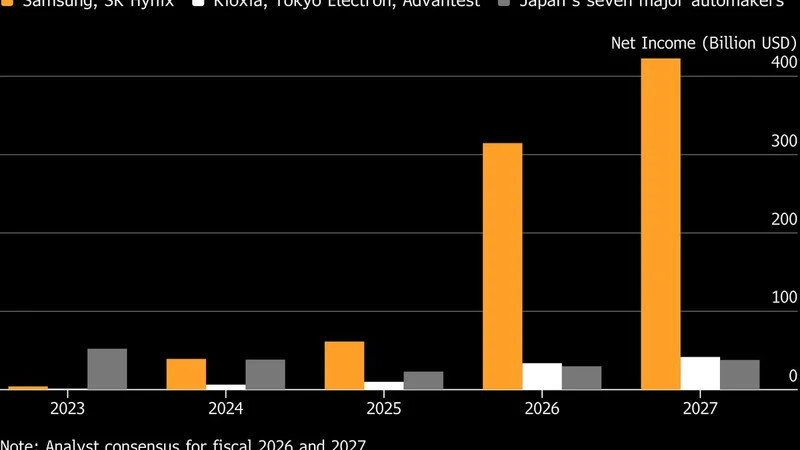
Image: Bloomberg AI
Main Takeaway
South Korea's AI-driven stock market outpaced Japan's before a sharp reversal as investor enthusiasm for artificial intelligence cooled globally.
Jump to Key PointsSummary
Why Korean stocks led the AI charge
South Korea's stock market surged ahead of Japanese rivals in early June, fueled by expectations that artificial intelligence demand would supercharge profits at the nation's leading technology companies. Bloomberg reported that the country's top listed firms were on track to generate substantially higher earnings, with AI serving as the primary catalyst for investor optimism. The Kospi index approached the psychologically significant 8,000 level, according to Tradingkey, reflecting intense market interest in semiconductor and hardware makers positioned to benefit from the global AI buildout.
The rally wasn't uniform across Asia. While Korean shares soared, Japanese equities lagged, creating a notable divergence between the region's two largest developed markets. Calcalistech characterized the phenomenon as Korea's AI stock frenzy leaving global markets behind, suggesting the concentration of memory chip manufacturers and AI component suppliers in South Korea gave it a structural advantage over its neighbor.
How the AI trade reversed within days
The momentum proved fragile. By June 5, US equity futures declined alongside Asian stocks as enthusiasm for the AI trade cooled after driving markets to record highs, Bloomberg's Opening Trade reported. Nasdaq 100 futures dropped 1%, signaling a third consecutive day of losses as investors rotated out of technology positions. The reversal was sharp enough that NBC News framed it as spreading concerns about AI and tech company valuations, not merely a routine pullback.
Asian shares traded mixed as the excitement faded, with Yahoo Finance noting that geopolitical worries compounded the pressure on tech stocks. The speed of the reversal caught many observers off guard, erasing a significant portion of the gains that had positioned Korean equities as the standout performers of 2026.
What Inc. claimed about Korea's AI dominance
Inc. magazine took an unusually assertive stance on the phenomenon, publishing a piece headlined South Korea Stocks Drive Entire AI Boom. The publication suggested that Korean companies weren't merely participating in the AI rally but were effectively carrying it, a claim that stood in stark contrast to the more measured analysis from financial news outlets. The editorial framing implied that without Korean semiconductor and memory chip production, the global AI infrastructure buildout would stall.
This perspective, while contested, highlighted the degree to which Samsung Electronics and SK Hynix have become embedded in AI supply chains. Their dominant positions in high-bandwidth memory and advanced DRAM make them difficult to displace, giving Korean equities genuine fundamentals beneath the speculative froth. Whether this structural advantage justifies the claim that Korea drives the entire boom remains an open question, but the dependency of AI training systems on Korean memory technology is real.
Why volatility signals deeper market questions
The whipsaw in Korean AI stocks raises fundamental questions about how markets are pricing artificial intelligence adoption. The initial surge reflected genuine earnings potential, companies like Samsung and SK Hynix are shipping record volumes of HBM3E memory to Nvidia and other AI chip designers. Yet the rapid reversal suggests much of the near-term upside was already embedded in share prices, with marginal buyers exhausted and valuation concerns emerging.
The contrast between Japan's relative underperformance and Korea's volatility also illuminates different industrial structures. Japan's technology sector is more diversified across industrial automation, materials, and legacy electronics, providing less concentrated AI exposure but also less dramatic swings. Korea's economy, by contrast, is heavily weighted toward memory chips and displays, making it a purer, more volatile play on AI capex cycles. Investors seeking AI leverage gravitate toward Korea; those seeking stability look elsewhere.
What happens next for AI-exposed markets
The cooling of AI enthusiasm doesn't resolve the underlying supply and demand dynamics. Data center construction continues at record pace, and the memory content per AI server is multiples higher than conventional servers. Korean manufacturers remain the indispensable suppliers for this buildout, even if their stock prices overshot in the near term. Analysts will watch second-quarter earnings guidance closely for confirmation that profit growth matches the earlier optimism.
For broader market implications, the Korean experience offers a template. AI-related equities in concentrated supply chain positions may continue to outperform on fundamental grounds but with heightened volatility as sentiment shifts. The challenge for investors is distinguishing between durable competitive advantages and cyclical hype. Korean stocks demonstrated both in rapid succession.
Key Points
South Korean AI stocks outperformed Japanese rivals before a sharp reversal in June 2026.
Samsung and SK Hynix dominate high-bandwidth memory supply chains for AI servers.
Kospi index approached 8,000 before cooling as AI trade enthusiasm faded globally.
US Nasdaq 100 futures dropped 1% signaling broader tech valuation concerns.
Korea's concentrated chip exposure amplified both gains and volatility versus Japan.
Questions Answered
Korean stocks surged because Samsung and SK Hynix dominate the high-bandwidth memory market critical for AI servers, giving them direct exposure to surging data center demand. Japan's more diversified technology sector offered less concentrated AI leverage.
Investor enthusiasm for AI trades cooled globally by June 5, triggering rotation out of technology positions. Nasdaq 100 futures dropped 1% for a third consecutive day, spreading valuation concerns across Asian markets.
Inc. magazine made this claim, citing Korean companies' indispensable role in memory chip supply chains. While Samsung and SK Hynix are critical suppliers, the global AI boom involves many companies across chip design, cloud computing, and software.
Korea's market is heavily concentrated in memory chips and displays, making it a purer but more volatile AI play. Japan's technology sector spans industrial automation, materials, and legacy electronics, offering more diversification and stability.
Second-quarter earnings guidance from Samsung and SK Hynix will indicate whether profit growth matches earlier market optimism. Analysts are also monitoring data center capex trends and memory pricing for signs of sustained demand.
Source Reliability
50% of sources are trusted · Avg reliability: 76
Go deeper with Organic Intel
Simple AI systems for your life, work, and business. Each one includes copyable prompts, guides, and downloadable resources.
Explore Systems