India’s AI Ambitions Put Data Centers, Electricity and Water Infrastructure Under Pressure
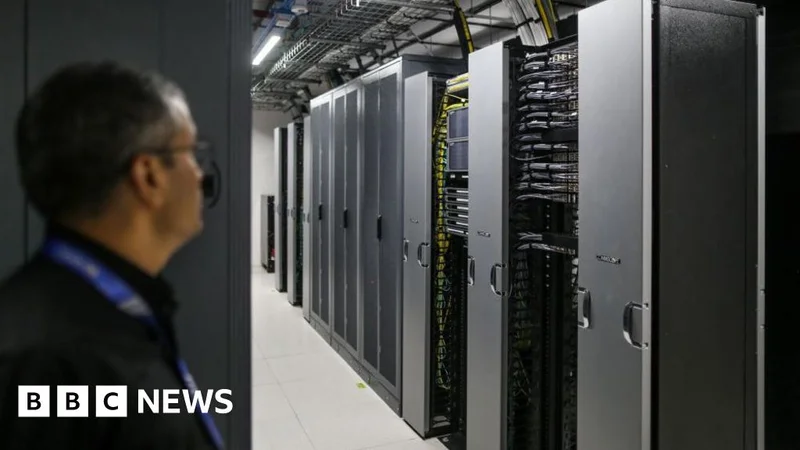
Image: Bbc
Main Takeaway
India’s AI expansion is driving rapid data-center investment while forcing a harder debate over electricity supply, grid capacity, water use and cleaner power.
Jump to Key PointsSummary
India’s AI buildout needs power
India’s AI expansion is turning electricity infrastructure into a central condition of digital growth. Data centers host the servers, networking equipment and cooling systems behind cloud services, generative AI and other applications, and their demand rises as computing deployments expand. India’s data-center capacity is projected to increase from 1.4 gigawatts in 2025 to 9 gigawatts by 2030, according to the Institute for Energy Economics and Financial Analysis.
Investment is moving in parallel. Colliers India estimates that data centers could attract $20 billion to $25 billion over the next 5 to 6 years, while the Indian AI market is projected to exceed $17 billion by 2027, according to figures cited by Nuclearbusiness-platform. The power-solution market serving these facilities is forecast to grow from $1.18 billion in 2024 to $3.16 billion by 2030, Nextmsc says.
Demand is colliding with grid limits
India’s challenge is matching fast, concentrated loads with a power system that must also serve households, factories and transport. The projected 9 GW of data-center capacity would consume about 3% of national electricity by 2030, according to IEEFA. Bloomberg’s Emerging podcast frames the issue as a strategic infrastructure question, with Tata Power CEO Praveer Sinha and India Energy & Climate Center expert Mohit Bhargava discussing whether supply can keep pace.
Grid congestion raises the cost of delay. Research published through ScienceDirect finds that adequate infrastructure can keep AI’s effect on electricity prices below 1%, while constraints can sharply amplify price increases in other markets. That finding gives India a practical test: generation alone won't solve the problem without transmission, substations, backup systems and reliable connections near major computing hubs. Forbes describes the competition as a shift toward the power grid, where access and reliability increasingly shape AI investment.
Water is an equally hard constraint
Data centers also place pressure on water supplies, especially where cooling systems rely on evaporation. BBC reports that India’s data-center capacity is projected to surge 77% by 2027 and that facilities backed by Google, Meta and Amazon face scrutiny over energy use and water consumption. The concern is acute in areas already exposed to heat, drought or competing industrial demand.
Cooling choices connect local resource policy to national AI strategy. Facilities can reduce freshwater use through air cooling, recycled water and more efficient designs, but each option carries cost and performance tradeoffs. 360info identifies jobs, electricity and water availability as issues that India must address alongside its push to adopt AI. The question therefore reaches beyond whether developers can obtain enough power: projects also need acceptable local resource footprints and credible community safeguards.
Cleaner generation will shape the outcome
India’s AI infrastructure will intensify the need for dependable, lower-carbon electricity. Nuclearbusiness-platform presents nuclear power, including small modular reactors and other advanced designs, as a source of round-the-clock supply for data centers. That approach addresses reliability, but deployment timelines, regulation, financing, waste management and grid integration determine whether nuclear capacity can serve near-term demand.
Renewables remain central to the expansion, though intermittent output requires storage, firming capacity or contracted backup. Research summarized by ScienceDirect finds that feed-in tariffs can reduce AI-driven emissions by 24% compared with current policy. A separate analysis argues that AI’s electricity demand is compressing the timetable for energy investment, turning data-center growth into another reason to build generation and transmission faster. India’s policy choices will decide whether the boom adds coal-heavy demand or accelerates cleaner power procurement.
Companies are competing for capacity
Hyperscalers, cloud providers, telecom operators and domestic industrial groups are competing for sites, electricity contracts and network access. Tata Power’s involvement in the national discussion reflects the role of utilities and infrastructure companies, while Google, Meta and Amazon are among the international firms associated with India’s data-center expansion, according to BBC. Domestic technology companies bring a large software workforce and long-established delivery networks to the demand side.
India’s advantage is scale: a large digital population, a mature IT-services base and a government-backed AI push can support broad deployment. Emqqglobal highlights the role of companies such as Infosys and Tata Consultancy Services, though its investment-focused analysis carries less evidentiary weight than the energy and research reporting. The commercial opportunity remains tied to physical constraints. A data-center project without firm power, cooling access and transmission capacity is an expensive building with limited computing value.
Policy will determine who pays
India’s next step is to coordinate AI incentives with electricity, water and emissions policy. Faster approvals for data centers can attract investment, but weak planning can shift costs onto ratepayers, local communities and the wider grid. IEEFA’s demand estimates make the scale of that tradeoff visible, while Bloomberg’s discussion places responsibility on utilities, policymakers and energy experts rather than technology companies alone.
The strongest strategy combines transparent connection rules, long-term clean-power contracts, efficiency standards, water accounting and investment in transmission and storage. ScienceDirect’s modeling indicates that infrastructure planning can restrain price effects, and 360info’s wider assessment points to social and employment consequences that sit alongside resource demands. India can power an AI boom, but its success will be measured by whether computing growth strengthens the energy system instead of crowding out other users.
Key Points
India’s data-center capacity may reach 9 GW by 2030, intensifying pressure on electricity infrastructure.
Data centers could consume about 3% of India’s electricity by 2030 as AI adoption accelerates.
Water availability and cooling systems are emerging constraints for India’s data-center expansion.
Nuclear power, renewables, storage and transmission will shape the carbon profile of AI growth.
Google, Meta, Amazon and domestic technology firms are competing for reliable Indian infrastructure.
Questions Answered
India can meet rising AI power demand if generation expands alongside transmission, substations, storage and reliable connections. Data-center capacity is projected to reach 9 GW by 2030, making grid planning as important as new power plants.
India’s data centers could consume about 3% of national electricity by 2030. IEEFA projects capacity growth from 1.4 GW in 2025 to 9 GW over the same period.
India’s AI data centers need water-intensive cooling systems, creating local pressure in areas facing heat and scarcity. Recycled water, air cooling and more efficient facility designs can reduce freshwater demand.
Nuclear power is being presented as a firm, lower-carbon option for India’s AI infrastructure, including small modular reactors. Deployment depends on regulation, financing, construction timelines, safety and grid integration.
Google, Meta and Amazon are among the international companies associated with India’s data-center expansion, while Tata Power is part of the electricity discussion. Indian technology groups such as Infosys and Tata Consultancy Services add demand through software and cloud services.
India’s next phase requires coordinated decisions on clean-energy procurement, transmission, water use, cooling efficiency and data-center siting. Those choices will determine whether AI investment raises system costs or helps accelerate cleaner infrastructure.
Source Reliability
36% of sources are trusted · Avg reliability: 67
Go deeper with Organic Intel
Simple AI systems for your life, work, and business. Each one includes copyable prompts, guides, and downloadable resources.
Explore Systems