Google Bets Shoppers Will Let AI Agents Spend Their Money With New Universal Cart
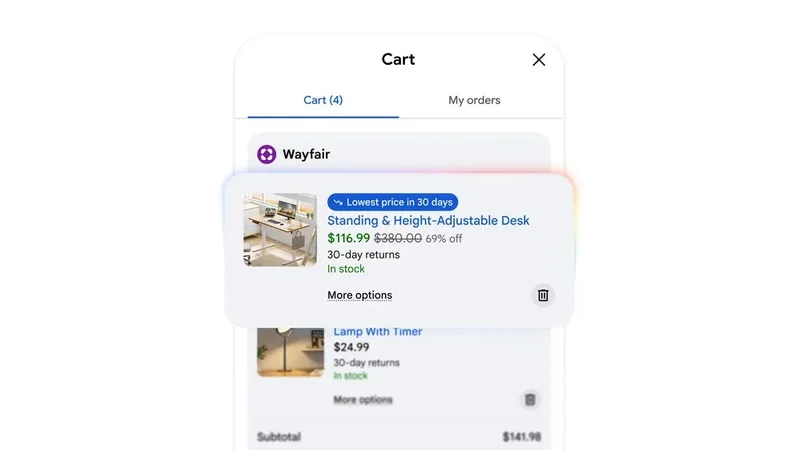
Image: TechCrunch AI
Main Takeaway
Google unveiled Universal Cart and updated its Agent Payments Protocol at I/O 2026 to let AI agents autonomously shop and pay across retailers.
Jump to Key PointsSummary
What Google built
Google introduced Universal Cart at its I/O 2026 conference, an AI-powered shopping hub that tracks products, prices, and inventory across multiple retailers from a single interface. The cart works across Search and Gemini now, with planned expansion to YouTube and Gmail, according to The Verge. Users can add items while browsing or chatting, then check out through Google Wallet, which automatically recommends the best saved payment method for maximum rewards.
The system doesn't just aggregate. It actively monitors price drops, sends restock alerts, and flags problems like incompatible PC components before purchase. Google explicitly positioned this as moving AI assistants from passive recommendation engines to active participants in commerce, per TechCrunch. That is a significant shift in how the company views its AI role in the consumer's life.
How the payment agent works
The updated Agent Payments Protocol, or AP2, lets users authorize software agents to complete purchases on their behalf. This goes beyond simple checkout automation. The agent can make decisions about when to buy based on price thresholds, availability, and user-defined preferences, according to TechCrunch. Google teased this would roll out to Google products in coming months, suggesting tight integration with existing services rather than a standalone app.
This raises immediate questions about liability and verification. If an agent buys the wrong item, or misses a better deal, the recourse is unclear. Google's blog post cited by PCMag focused on the convenience narrative, calling the service "superpowers" for shoppers. The company is clearly betting that friction reduction outweighs these concerns for mainstream users.
The open standard behind it
Google also published documentation for the Universal Commerce Protocol, an open standard designed to let third-party AI agents execute transactions across participating retailers. This matters because it signals Google's attempt to become the infrastructure layer for agentic commerce, not just the consumer-facing interface. Retailers can connect inventory through Google's Merchant Center, and agents can query live catalogs and integrate loyalty programs, according to reporting on the UCP update.
The protocol creates a standardized language for AI transactions, which forces retailers into a difficult position. They can join Google's ecosystem and gain visibility, or risk being excluded from agent-driven shopping entirely. Smarter Ecommerce noted this pushes advertisers away from keyword-based strategies toward what they termed "high-density data hygiene" to ensure AI agents prioritize their products. That is a fundamental restructuring of how ecommerce discovery works.
Competitive positioning
Google's timing is notable. The Verge reported that some competitors are backing off from AI-driven shopping, creating an opening for Google to define the category. Amazon, Walmart, and Nike are already integrated into Universal Cart as retail sources, per Android Central, suggesting Google has lined up major partners despite potential competitive tension.
This is not Google's first universal cart attempt. Engadget reported on a similar 2019 feature that worked across Search, Assistant, and Shopping. The new version is substantially more ambitious because of the AI agent layer and autonomous payment capability. The earlier iteration was essentially a centralized checkout; this one makes purchasing decisions on the user's behalf. That difference in agency is what transforms it from a convenience feature to a potential market structure shift.
What retailers and developers face
For retailers, the UCP update introduces both opportunity and risk. The simplified onboarding through Merchant Center lowers technical barriers to entry, but participation means ceding some control over how products are presented and priced. Agents optimizing for user savings may favor retailers with better data feeds over those with better actual products, creating a new optimization game.
Developers building commerce applications now have a major platform decision. Google's open standard offers distribution but creates dependency. Independent price tracking tools like CamelCamelCamel face direct competition from a free, integrated alternative backed by Google's data and AI infrastructure. The long-term question is whether agentic commerce centralizes around Google's protocol or fragments across multiple competing standards from Amazon, Apple, or open-source alternatives.
Consumer trust as the real barrier
The headline question from The Verge, whether users will let robots spend their money, remains unresolved. Google's technology is technically capable, but cultural acceptance lags. The company is addressing this gradually, starting with price tracking and deal alerts before full autonomous purchasing. This stepping-stone approach mirrors how credit cards and one-click checkout first built trust through incremental convenience.
Privacy concerns also loom. Universal Cart requires extensive tracking across devices and retailers to function, precisely the kind of cross-site monitoring that has drawn regulatory scrutiny. Google's existing data advantages in search, browsing, and payments make it uniquely positioned to deliver this experience, but also uniquely vulnerable to antitrust complaints about self-preferencing. How regulators view AI agents that both recommend and purchase products will shape whether this initiative reaches its potential.
Key Points
Google's Universal Cart aggregates products and tracks prices across multiple retailers in one interface
Updated Agent Payments Protocol lets AI agents autonomously complete purchases with user authorization
Universal Commerce Protocol creates open standard for third-party AI transaction agents
Major retailers Amazon, Walmart, and Nike already integrated into the system
Planned expansion from Search and Gemini to YouTube and Gmail
Questions Answered
It tracks prices, monitors stock, suggests discounts, checks product compatibility, and lets AI agents complete purchases across retailers from a single cart.
The 2019 version centralized checkout across Google services; the 2026 version adds AI agents that can make purchasing decisions and pay autonomously on the user's behalf.
Amazon, Walmart, Nike, and thousands of other merchants are integrated, with checkout processed through Google Wallet.
It is an open standard Google published that lets third-party AI agents query live product catalogs, manage carts, and execute transactions with participating retailers.
Google teased it would roll out to Google products in coming months after the I/O 2026 announcement.
Source Reliability
38% of sources are trusted · Avg reliability: 64
Go deeper with Organic Intel
Simple AI systems for your life, work, and business. Each one includes copyable prompts, guides, and downloadable resources.
Explore Systems