Conan O'Brien Tells Harvard Grads to Make Their Degree the 'Least Important Thing' About Them
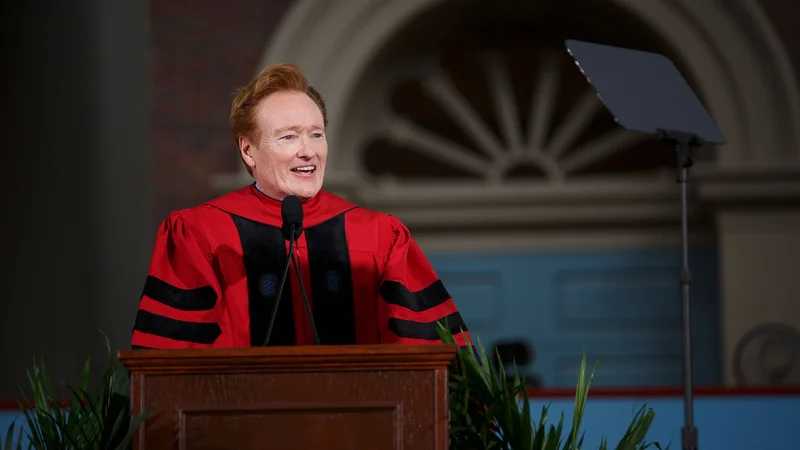
Image: News.harvard
Main Takeaway
Conan O'Brien urged Harvard's Class of 2026 to embrace humility and let their Ivy League credential become the least notable fact about their lives.
Jump to Key PointsSummary
Why a Harvard degree can become a burden
Conan O'Brien delivered a blunt message to Harvard's Class of 2026 during the university's 375th Commencement: your prestigious degree is not your identity. The comedian, who graduated from Harvard College in 1985 before leading The Harvard Lampoon, told graduates he wanted their alma mater to become "the least important thing people know about you." His reasoning drew from personal experience. O'Brien noted that a Harvard education can be double-edged, with many people happy to mistake "the lucky poker hand for their own brilliance." The warning carried extra weight coming from someone who had spent decades building a career largely outside the credential's shadow.
Fortune reports that O'Brien's advice dovetailed with a broader cultural critique. He urged graduates to embrace being "bad at things" and to resist what he described as the "extreme narcissism" of contemporary times. For students who had just spent four years and approximately $250,000 in tuition, the message was deliberately counter-programming against the instinct to lead with institutional prestige.
How politics shaped this year's ceremony
The 2026 Harvard commencement unfolded under unusual political pressure. The Trump administration had placed the Ivy League school in its crosshairs, creating a charged atmosphere that O'Brien acknowledged directly. According to PBS and the Associated Press, he quipped about "Justice Department spies" being in attendance while also defending international students, a group particularly targeted by recent federal policy changes.
Boston.com noted that O'Brien's 25-minute speech blended humor, humility, and pointed commentary. He joked that Harvard had produced "more Nobel laureates or white-collar criminals" than any other American university, adding: "So whether you choose good or evil, know that you are among the very best." The line drew laughs while also serving as a reminder that institutional pedigree guarantees nothing about character or outcome. His political barbs were specific enough to register but restrained enough not to overshadow the graduates' day.
What O'Brien learned about credentials and creativity
O'Brien's career trajectory informed every word of his advice. After studying history and literature at Harvard, he rose to prominence as a writer for Saturday Night Live and The Simpsons, earning an Emmy before becoming the host of Late Night with Conan O'Brien in 1993. Harvard President Alan M. Garber, in announcing the selection months earlier, had praised O'Brien's work as "deeply rooted in close listening and keen observation" that "creates joyful connections between and among ideas and people."
Yet O'Brien's own breakthrough came from willingness to be amateurish and to fail publicly. He has spoken before about how his Harvard education sometimes hurt his career, creating expectations he then had to subvert. The through-line of his commencement address was that genuine accomplishment requires shedding the protective armor of elite credentials and becoming vulnerable to incompetence again. For graduates entering a job market increasingly skeptical of pedigree, the timing was fortuitous.
The message for a generation rethinking achievement
O'Brien's advice lands as Gen Z already shows signs of credential fatigue. Fortune notes that young workers are increasingly questioning whether expensive degrees deliver commensurate returns, even at the apex of the prestige hierarchy. O'Brien's framing, that Harvard should become "the least important thing people know about you," offered graduates permission to build identities independent of their admissions status.
The humility he advocated was not self-deprecation but strategic. By making Harvard unimportant, graduates free themselves to be defined by what they build, create, or contribute rather than where they spent four years. It is a psychological reframing with practical consequences. Research consistently shows that excessive identification with elite credentials can limit risk-taking and experimentation, the very activities that produce breakthrough work.
What this signals about commencement speech evolution
Commencement addresses have become cultural flashpoints, and O'Brien's selection reflected Harvard's calculation that a beloved alum with cross-generational appeal could navigate the moment. The university chose someone who could deliver political substance without being a politician, humor without triviality, and advice that sounded personal rather than platitudinous.
The speech also illustrated how comedy has become a vehicle for serious cultural commentary in an era of political polarization. O'Brien's absurdist sensibility allowed him to critique both the institution hosting him and the political forces pressuring it, while still delivering a message graduates could apply individually. His performance demonstrated that the most effective commencement speeches now function as cultural commentary as much as personal inspiration, speaking to audiences far beyond those physically present. The video of his address circulated widely within hours, extending Harvard's reach while also, paradoxically, reinforcing the platform that O'Brien was urging graduates to eventually outgrow.
Key Points
O'Brien told Harvard's Class of 2026 to make their degree their least notable attribute
The speech mixed political humor with advice about humility and resisting narcissism
He defended international students amid Trump administration pressure on Harvard
O'Brien drew from his own post-Harvard comedy career to argue credentials can limit growth
The address reflected growing Gen Z skepticism about elite degree value
Questions Answered
He urged them to make their Harvard degree the least important thing people know about them, embracing humility and willingness to be bad at things.
He graduated from Harvard College in 1985, where he studied history and literature and served as president of The Harvard Lampoon humor magazine.
His success in comedy writing and late-night television came from subverting expectations and embracing amateurishness, not from leaning on his elite credential.
Gen Z workers are increasingly questioning whether expensive degrees deliver sufficient returns, making O'Brien's credential-skeptical message especially timely.
Source Reliability
40% of sources are highly trusted · Avg reliability: 68
Go deeper with Organic Intel
Simple AI systems for your life, work, and business. Each one includes copyable prompts, guides, and downloadable resources.
Explore Systems