Broadcom Stock Slumps as AI Chip Outlook Fails to Match Soaring Investor Hype
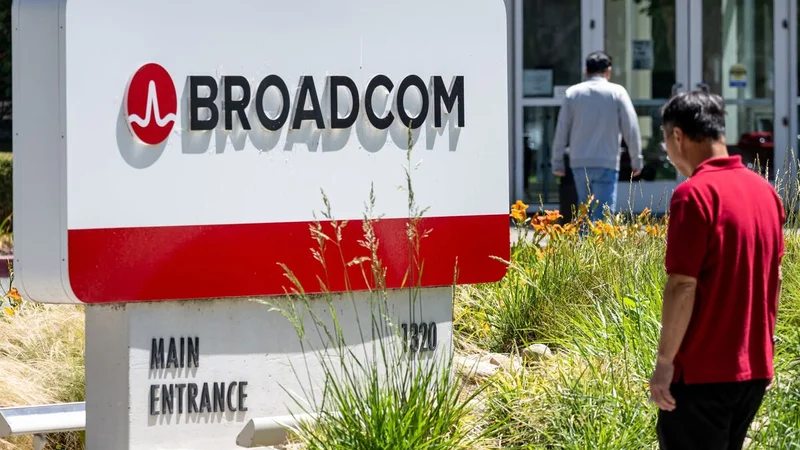
Image: Bloomberg AI
Main Takeaway
Broadcom shares plunged after the chipmaker's AI revenue forecast disappointed investors expecting a blowout quarter.
Jump to Key PointsSummary
Why the market punished a solid quarter
Broadcom reported fiscal second-quarter results that beat Wall Street estimates for both earnings and revenue, yet the stock cratered in extended trading and continued falling. The disconnect stems from a market addicted to AI acceleration stories and primed for explosive upward revisions. When CEO Hock Tan left the full-year AI chip forecast unchanged rather than raising it, traders treated the stability as stagnation. Bloomberg reports that investors had priced in a significant beat after Broadcom added more than $280 billion in market value in just four sessions leading into earnings. That run-up created a bar no executive could clear. The punishment was swift and severe, with shares tumbling double digits despite fundamentals that would qualify as strong in any other sector.
What Tan actually said about AI demand
The unchanged forecast does not mean demand disappeared. Broadcom continues to ship custom AI accelerators to major cloud customers and maintains its projection for AI chip revenue to exceed $10 billion annually. The company has six strategic customers ramping production, including a high-profile but troubled deal with OpenAI that hit an $18 billion financing snag earlier in the quarter, according to The Information via Tikr. Tan has repeatedly emphasized that Broadcom's custom silicon approach, designing chips tailored to specific customer workloads rather than selling general-purpose GPUs, builds stickier and more profitable relationships. The model requires longer design cycles, however, which means revenue recognition arrives in lumpy bursts rather than smooth quarterly escalations.
How software weakness compounded chip skepticism
Beneath the AI headline, Broadcom's traditional software business showed cracks that amplified investor anxiety. The company has spent years building a diversified revenue base through acquisitions like VMware, and any softness in that segment feeds fears that Broadcom is over-relying on hardware cyclicality. Yahoo Finance notes that backlog figures also disappointed, suggesting future order visibility is narrowing. When combined with the flat AI outlook, this created a narrative of deceleration rather than the acceleration story that drove the pre-earnings rally. The market's reaction reflects how sensitive valuation multiples have become to any hint that the AI infrastructure build-out might be normalizing.
The broader chip trade under pressure
Broadcom was not alone in facing investor wrath. The selloff extended to Oracle, Nvidia, and AMD as part of a broader reassessment of AI infrastructure plays. CNBC documented a similar pattern in December 2025, when Broadcom shares plunged 11% despite blockbuster earnings as AI angst swept the sector. This recurring dynamic, strong operational performance met with stock punishment, suggests the market has built in unsustainable growth expectations across the semiconductor space. The December episode and the June repeat point to a pattern: any data point that fails to confirm infinite exponential growth triggers violent repricing, even when the underlying business remains healthy.
What this means for custom silicon vs. generic GPUs
Broadcom's strategic bet on custom AI chips for hyperscalers now faces a critical perception test. The company argues that its approach delivers better performance per watt and total cost of ownership for large-scale deployments, a compelling pitch as data center power constraints bite. Nvidia's dominance in general-purpose GPUs has defined the AI boom, but Broadcom, Marvell, and others are pushing custom alternatives that could carve out meaningful share. The OpenAI deal turbulence, however, illustrates the risks of customer concentration and long development timelines. If major partners delay or downsize projects, Broadcom lacks the broad customer base that insulates Nvidia from individual account volatility.
Where the stock goes from here
Analyst price targets suggest significant upside from current levels, with Tikr noting a median target near $1,125 against prices around $413. The gap between street optimism and market pessimism creates a volatile setup for the next several quarters. Broadcom's challenge is proving that its AI revenue pipeline is deepening even if quarterly guidance remains measured. The June earnings reaction will likely force management toward more explicit long-term AI revenue targets or risk continued valuation compression. For investors, the episode is a reminder that in AI infrastructure, beating estimates is no longer enough; the market demands guidance that raises the ceiling.
Key Points
Broadcom stock crashed despite beating quarterly earnings and revenue estimates handily
CEO Hock Tan left full-year AI chip forecast unchanged, triggering investor disappointment
Shares had surged $280 billion in four sessions before earnings, creating unsustainable expectations
OpenAI custom chip deal reportedly hit an $18 billion financing obstacle earlier in quarter
Software segment weakness and disappointing backlog figures compounded investor concerns
Questions Answered
Investors expected an increased full-year AI chip forecast and punished the stock when guidance remained unchanged, especially after a $280 billion pre-earnings rally.
Broadcom designs custom AI accelerators tailored to specific cloud customer workloads rather than selling general-purpose GPUs, aiming for stickier and more profitable relationships.
A similar pattern occurred in December 2025, when shares plunged 11% despite blockbuster earnings as broader AI sector anxiety triggered selling.
According to The Information, the custom chip deal hit an $18 billion financing roadblock, though Broadcom has five other strategic customers ramping production.
Median analyst targets are around $1,125 according to Tikr, suggesting substantial upside from current trading levels near $413.
Source Reliability
43% of sources are trusted · Avg reliability: 75
Go deeper with Organic Intel
Simple AI systems for your life, work, and business. Each one includes copyable prompts, guides, and downloadable resources.
Explore Systems