BlackBerry CEO Declares Turnover Complete, Bets Growth on QNX and AI-Resistant Safety Software
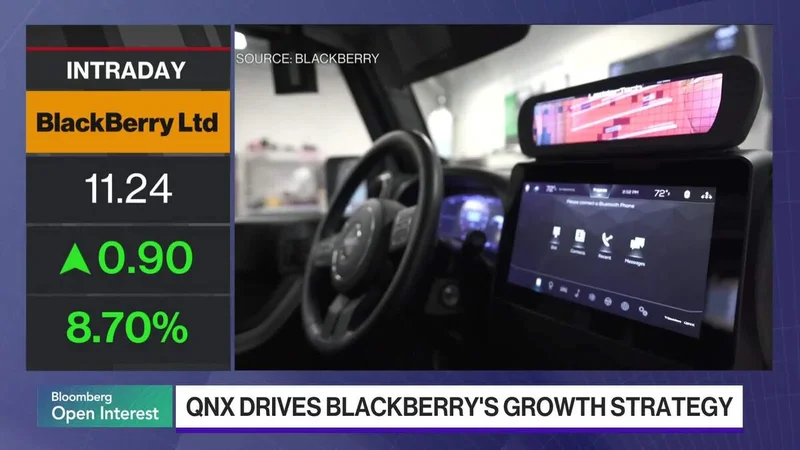
Image: Bloomberg AI
Main Takeaway
BlackBerry CEO John Giamatteo says QNX now powers 275 million vehicles and the company's turnaround is finished.
Jump to Key PointsSummary
Why QNX became BlackBerry's growth engine
BlackBerry CEO John Giamatteo has declared the company's turnaround complete, shifting narrative focus from survival to expansion. The pivot centers on QNX, the company's embedded operating system, which now runs in over 275 million vehicles worldwide according to company data. This installed base gives BlackBerry recurring royalty revenue and deep relationships with automakers and Tier 1 suppliers that competitors struggle to replicate.
The automotive software market is accelerating as vehicles become computers on wheels. QNX holds safety certifications that generic operating systems cannot easily obtain, creating a moat against newer entrants. Giamatteo highlighted that QNX delivered what he called a "rule of 40 quarter," meaning combined revenue growth and profit margins exceeded 40 percent, a benchmark popular among software investors. The backlog, he noted, provides "line of sight" into future revenue.
How AI resistance protects BlackBerry's market position
Giamatteo offered a direct rebuttal to concerns that generative AI would displace traditional software providers: artificial intelligence is not ready to replace safety-certified embedded systems. This argument frames BlackBerry's products as structurally resistant to the disruption hitting other software categories. Regulatory requirements for automotive safety (ISO 26262, ASIL certifications) demand rigorous validation that large language models cannot currently satisfy.
The CEO's stance, reported by Bloomberg, positions QNX as infrastructure that AI will run on top of rather than replace. BlackBerry's 80-plus government certifications for secure mobility and encrypted communications extend this defensive logic beyond automotive into defense and critical infrastructure. These certification moats take years to build and cannot be shortcut by faster-moving AI competitors.
What the financial turnaround looks like
The language used by Giamatteo and echoed in financial coverage signals a deliberate rebranding. Yahoo Finance reported the CEO's declaration that "the BlackBerry story is now a growth story," a line that appeared in prepared remarks for the Q4 2026 earnings call. The emphasis on record royalty quarters suggests the company has moved past its hardware heritage and even past its earlier software struggles toward predictable, high-margin recurring revenue.
Royalty-based revenue models trade upfront recognition for long-term stability. For a company that once burned through cash selling phones, this represents a structural transformation. The "rule of 40" framing targets software investors specifically, aligning BlackBerry with SaaS valuation metrics rather than legacy tech multiples. Whether investors accept this reframing depends on sustained execution over multiple quarters.
Where cybersecurity intersects with automotive strategy
BlackBerry's communications around QNX increasingly emphasize security alongside safety. The company showcased AI-based automotive solutions intended to help OEMs and fleet managers monitor vehicle health and security, according to a past product announcement. This convergence reflects industry reality: connected vehicles face expanding attack surfaces that traditional automotive engineering did not address.
Fox Business reported Giamatteo addressing concerns about Anthropic's Mythos AI cybersecurity model, suggesting BlackBerry monitors competitive and partnership dynamics in AI security closely. The company's pitch combines QNX's real-time reliability with BlackBerry's heritage in encrypted communications. For automakers navigating regulatory pressure and consumer anxiety about hacked vehicles, this bundled positioning may resonate more than point solutions from pure-play cybersecurity vendors.
What happens next for BlackBerry's growth claims
Giamatteo's declarations set measurable expectations that will face scrutiny in subsequent quarters. The QNX backlog provides near-term visibility, but sustaining "rule of 40" performance requires both continued automotive design wins and expansion into adjacent markets like industrial and medical devices. BlackBerry's history of strategic pivots, from smartphones to enterprise software to automotive, means investors will watch for consistency.
The AI resistance argument, while technically defensible today, assumes certification requirements remain static as AI validation techniques mature. Should regulators eventually accept AI-generated safety proofs, BlackBerry's moat would narrow. For now, the company appears positioned to benefit from automotive software's increasing complexity and the regulatory barriers that complexity creates.
Key Points
BlackBerry CEO John Giamatteo declares the company's turnaround complete and positions it as a growth story.
QNX embedded software now powers over 275 million vehicles with recurring royalty revenue streams.
Giamatteo states AI cannot displace safety-certified products due to regulatory validation requirements.
QNX achieved a rule of 40 quarter with record royalties and visible backlog.
BlackBerry holds 80-plus government certifications for secure mobility and encrypted communications.
Questions Answered
John Giamatteo declared that BlackBerry's turnaround is complete and the company is now a growth story. He made this statement during Q4 2026 earnings prepared remarks, highlighting QNX's strong performance as evidence of the transformation.
QNX powers over 275 million vehicles on the road, according to BlackBerry's company data. This installed base generates recurring royalty revenue and maintains relationships with major automakers and Tier 1 suppliers.
Giamatteo argues that artificial intelligence is not ready to displace safety-certified embedded systems. Regulatory requirements for automotive safety demand rigorous validation that current AI cannot satisfy, creating structural protection for QNX.
A rule of 40 quarter means the combined percentage of revenue growth and profit margin exceeds 40 percent. Giamatteo cited this benchmark to demonstrate QNX's financial health and align BlackBerry with software investor expectations.
BlackBerry serves governments with secure communications and targets critical infrastructure sectors. The company's 80-plus certifications extend to G7 and G20 government applications, suggesting potential expansion into industrial and medical devices.
Source Reliability
50% of sources are established · Avg reliability: 71
Go deeper with Organic Intel
Simple AI systems for your life, work, and business. Each one includes copyable prompts, guides, and downloadable resources.
Explore Systems