Bain Survey Exposes AI's ROI Crisis: Companies Face Budget Reckoning as Savings Fail to Materialize
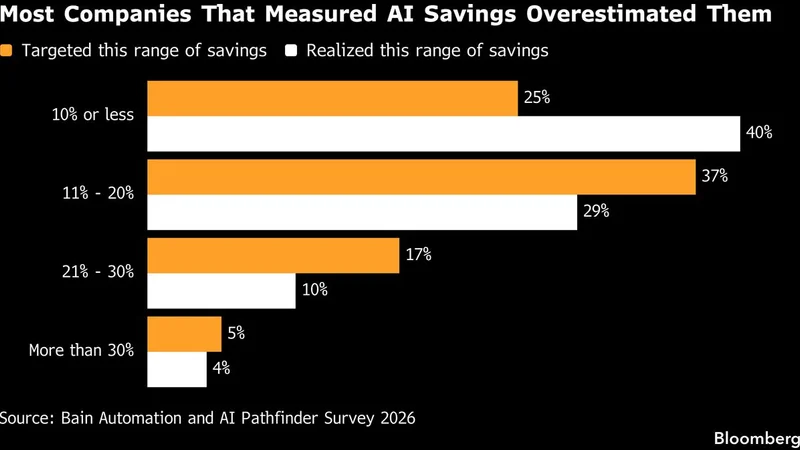
Image: Bloomberg AI
Main Takeaway
70% of companies will cut AI budgets if ROI doesn't improve this year, Bain survey finds, as promised cost savings and productivity gains largely fail.
Jump to Key PointsSummary
Why AI budgets are now on the chopping block
Nearly 70% of companies are prepared to slash AI spending this year if projects fail to deliver measurable business results, according to a 2026 AI at Work Report from G-P (Globalization Partners). The survey of 2,850 business leaders across six global markets signals a sharp turn in enterprise sentiment. After two years of aggressive investment and experimentation, organizations are running out of patience with AI deployments that consume capital without producing transformational productivity gains.
The frustration is widespread and growing. Executives who greenlit massive AI budgets based on vendor promises and industry hype now face boards demanding concrete returns. The generative AI boom that began in 2023 created enormous expectations, but the operational reality has lagged far behind. Companies are discovering that deploying AI at scale is harder, slower, and more expensive than anticipated, with integration challenges, data quality issues, and workforce adaptation consuming resources that were supposed to drive savings.
What Bain's 'circular bet' diagnosis reveals
Bain and Company, in its latest global survey of large companies, concluded that corporate AI investments have become a "circular bet" based on returns that have not arrived. The firm found that cost savings from automation are broadly falling short of projections, a gap that "should be making executives uncomfortable." Bain's blunt assessment: "The technology worked. The value didn't arrive." This disconnect between technical capability and business value lies at the heart of the current crisis.
The circularity problem is particularly insidious. Companies invested in AI because competitors were doing so, because consultants recommended it, and because technology vendors promised transformative outcomes. That investment created its own justification, a self-referential loop where spending became proof of strategic seriousness rather than a calculated bet on measurable returns. Now that the bills have come due, many firms cannot demonstrate that AI has meaningfully reduced costs or increased revenue. Bain's warning that savings misses should disturb executive sleep reflects the growing recognition that this cycle cannot sustain itself.
The revenue reality gap widening beneath the hype
Bain's research points to a broader pattern of corporate optimism colliding with operational difficulty. In a separate survey across 18 industries, 42% of executives missed their revenue goals last year, a significant jump from 32% in 2024. Yet remarkably, companies are now targeting revenue growth rates approximately 20% higher than the previous year, and 91% of executives believe they will hit those targets. This persistent optimism bias may be fueling continued AI investment even as current projects underperform.
The macroeconomic context matters. Geopolitical instability, shifting trade patterns, and persistent inflation have complicated business planning, making it harder to isolate AI's contribution from other variables. But executives themselves acknowledge the problem. Bain's earlier 2025 executive survey found that while 80% of generative AI use cases met or exceeded expectations, only 23% of executives could tie those initiatives to new revenue or lower costs. The gap between perceived success and documented financial impact is where the current reckoning is focused.
Why CFOs are still pouring money into AI despite the warnings
In a striking contradiction, Bain's own survey of more than 100 CFOs globally reveals that capital commitment to AI is accelerating, not retreating. Eighty-three percent plan to increase enterprise-wide AI spending by more than 15% over the next two years, with 42% expecting to boost AI budgets by 30% or more. Finance departments specifically are increasing their AI allocations, suggesting that the function closest to the numbers sees strategic value even where immediate returns are elusive.
This divergence creates a tense dynamic within the C-suite. CFOs controlling the purse strings are simultaneously fielding demands for AI cuts from operational leaders frustrated by pilot projects and scaling challenges, while themselves increasing allocations based on longer-term competitive positioning. The finance function's own adoption of AI tools, particularly in forecasting, fraud detection, and process automation, may be creating a split perspective, one where the people managing the money see enough near-term efficiency to justify continued investment even as line-of-business projects struggle. Whether this CFO confidence can survive another year of missing targets remains an open question.
What happens when the AI spending pause arrives
The convergence of these trends suggests a potential inflection point in enterprise AI adoption. If the 70% of companies threatening budget cuts follow through, the AI vendor landscape faces a significant shakeout. Providers that have relied on pilot-to-production narratives and vague efficiency promises will confront customers demanding proof of value. This could accelerate consolidation among AI infrastructure companies, pressure pricing for large language model APIs, and force a sharper focus on use cases with demonstrable returns.
For technology buyers, the immediate risk is paralysis by analysis, a freeze on new commitments while organizations attempt to extract value from existing investments. The more productive path, suggested by Bain's research, involves ruthless prioritization of use cases with clear metrics, faster kill decisions on underperforming pilots, and greater honesty about the organizational change required to capture AI's benefits. The technology has largely worked, as Bain noted. The harder problem, still unresolved, is building the business processes and workforce capabilities that translate technical potential into financial results. Companies that solve that integration challenge will emerge with durable advantages. Those that cannot may find themselves explaining to boards why they spent millions on tools that never changed how work actually gets done.
Key Points
70% of companies will reduce AI spending if ROI does not improve measurably this year
Bain labels corporate AI investment a circular bet on returns that have failed to materialize
42% of executives missed revenue targets in 2025, up from 32% the prior year
83% of CFOs still plan to increase AI spending by over 15% in the next two years
Only 23% of executives can connect AI initiatives to new revenue or cost reductions
Questions Answered
Bain means companies invested in AI because others were doing so, creating a self-referential loop where spending became its own justification rather than a calculated decision based on demonstrated returns.
Despite operational frustrations, CFOs remain broadly optimistic, with 83% planning to increase enterprise-wide AI spending by more than 15% over the next two years.
While 80% of generative AI use cases met or exceeded expectations, only 23% of executives could tie those initiatives to new revenue or lower costs.
Bain found that 42% of executives across 18 industries missed their revenue goals in 2025, up from 32% in 2024.
If companies follow through on threats to cut budgets without measurable ROI, vendors could face consolidation pressure, API pricing declines, and customers demanding proven use cases before new purchases.
Source Reliability
43% of sources are trusted · Avg reliability: 68
Go deeper with Organic Intel
Simple AI systems for your life, work, and business. Each one includes copyable prompts, guides, and downloadable resources.
Explore Systems