Arm CEO Rene Haas Says $15 Billion AI Chip Revenue Target May Arrive Ahead of Schedule
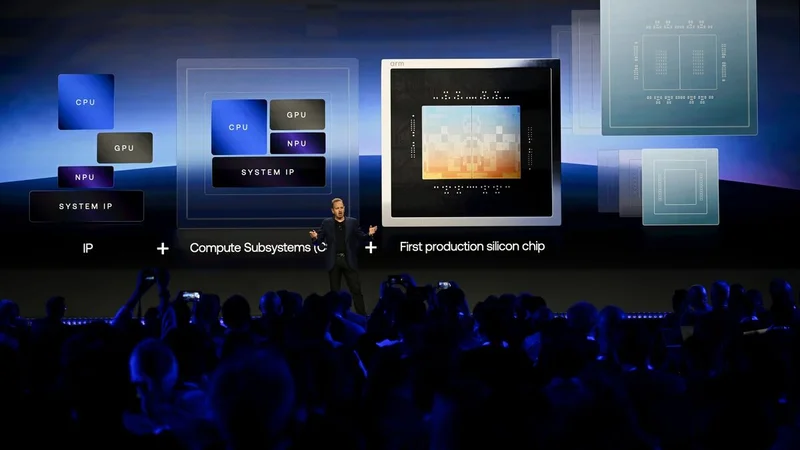
Image: Bloomberg AI
Main Takeaway
Arm CEO Rene Haas says the company may reach its $15 billion AI chip sales goal early after unveiling its first in-house processor, sending shares up.
Jump to Key PointsSummary
The accelerated timeline for Arm's chip ambitions
Arm Holdings may hit its ambitious $15 billion revenue target for its own branded chips sooner than expected. CEO Rene Haas delivered that message at the Computex trade show in Taipei, telling Bloomberg's Stephen Engle that stronger-than-projected demand from the AI boom is pulling the timeline forward. The company only just unveiled its first in-house chip, a historic move for a firm that spent 35 years licensing designs rather than selling silicon.
According to Reuters, Arm expects the new chip to add billions in annual revenue. The $15 billion figure represents a dramatic expansion for a company that built its business on royalties and licensing fees, not direct product sales. Haas framed the accelerated timeline as a reflection of market pull rather than internal ambition, pointing to insatiable AI infrastructure demand as the primary driver.
What the first in-house chip means for Arm's business model
Arm's decision to manufacture and sell its own chips marks a fundamental shift in strategy. For decades, the company operated as a neutral design house, licensing its architecture to everyone from Apple to Nvidia to Amazon. That neutrality made Arm the default choice for mobile processors and, increasingly, data center silicon. Selling a branded chip puts Arm in direct competition with its own customers.
Haas addressed this tension directly, according to multiple sources covering his Computex appearance. The CEO argued that the AI market is large enough to accommodate both Arm's licensing business and its chip sales, and that customers understand the logic of capturing more value from the AI supply chain. Forbes reported that shares soared 18% on the forecast, while CNBC pegged the jump at 16%, suggesting investors see more upside than risk in the pivot.
Wall Street reacts to the revenue forecast
The market response was swift and emphatic. Arm stock popped 8% in early trading before extending gains, with multiple outlets reporting intraday surges between 8% and 18%. Tiger Brokers noted the initial pop came immediately after Haas issued the $15 billion expectation. CMC Markets framed the question as whether Arm's pivot to chipmaking can unlock the full $15 billion opportunity, highlighting analyst debates about execution risk.
The stock movement reflects more than optimism about a single product launch. Investors are recalibrating Arm's total addressable market now that the company captures revenue at the chip level rather than just the design level. A $599 price target cited by TIKR implies analysts see room for continued appreciation even after the post-announcement rally.
The competitive warning shot at Intel and AMD
Haas didn't limit his message to revenue projections. The Motley Fool characterized his remarks as a direct warning to Intel and AMD, the two incumbents that dominate the x86 server CPU market. Arm-based processors already power the majority of cloud computing instances at AWS, and the company's entry into branded chips could accelerate adoption in enterprise data centers where x86 still holds sway.
The competitive dynamic is nuanced. Arm's licensing customers include companies that compete with Intel and AMD, but Arm itself now joins that fray. Haas appears to be betting that the AI market's growth rate makes competitive overlap manageable. The warning to Intel and AMD, as reported, centers on Arm's ability to deliver AI-optimized silicon faster than the traditional x86 roadmap allows.
Why the AI boom is compressing timelines across the industry
Arm's accelerated revenue target fits a broader pattern. AI infrastructure spending continues to outpace even the most aggressive forecasts, with hyperscalers and enterprises racing to build out training and inference capacity. Haas cited this demand environment as the reason the $15 billion goal may arrive early, according to Bloomberg's interview.
The Computex venue itself underscores the timing. Taiwan remains the epicenter of semiconductor manufacturing, and announcements made there carry weight with the supply chain partners who actually build these chips. Arm's presence and messaging at the show signal that the company is positioning itself as a first-tier silicon provider, not just an architecture licensor.
What happens next for Arm and the chip landscape
Execution now becomes the central question. Arm must ramp manufacturing, secure supply chain partnerships, and manage customer relationships with the same companies it now competes against. The revenue target, while accelerated, remains a multi-year goal, and the path from first chip to $15 billion in sales involves significant operational scaling.
Industry watchers will monitor whether Arm's licensing revenue holds steady as the chip business grows. Any sign of customer defection would complicate the narrative. For now, the market is betting that AI demand creates enough room for Arm to succeed as both a partner and a competitor, a dual role few companies have managed to sustain.
Key Points
Arm CEO Rene Haas says the $15 billion AI chip revenue target may be reached ahead of the original schedule due to surging demand.
The company unveiled its first in-house chip after 35 years as a pure architecture licensing business, marking a historic strategic pivot.
Arm stock surged between 8% and 18% following the Computex announcement, with analysts projecting a $599 price target.
Haas issued a competitive warning to Intel and AMD as Arm enters the branded data center silicon market directly.
The accelerated timeline reflects broader AI infrastructure spending that continues to outpace industry forecasts.
Questions Answered
CEO Rene Haas said Arm may reach its $15 billion annual revenue goal for its own branded AI chips earlier than originally projected, citing stronger-than-expected AI demand.
After 35 years as a pure design licensor, Arm is launching its first in-house chip to capture more value from the AI supply chain, betting that the AI market is large enough to sustain both licensing and direct sales.
Arm shares jumped between 8% and 18% on the news, with multiple outlets reporting the surge occurred immediately after Haas issued the revenue expectation at Computex.
Haas's comments were characterized as a direct warning to Intel and AMD, as Arm's entry into branded data center chips intensifies competition in the server processor market where x86 has historically dominated.
The primary risks include managing relationships with licensing customers who now compete with Arm, scaling manufacturing operations, and ensuring the licensing business remains stable as the chip business grows.
Source Reliability
33% of sources are highly trusted · Avg reliability: 73
Go deeper with Organic Intel
Simple AI systems for your life, work, and business. Each one includes copyable prompts, guides, and downloadable resources.
Explore Systems