Apollo and Blackstone Shop $36 Billion Debt Deal for Anthropic's Google TPU Purchase
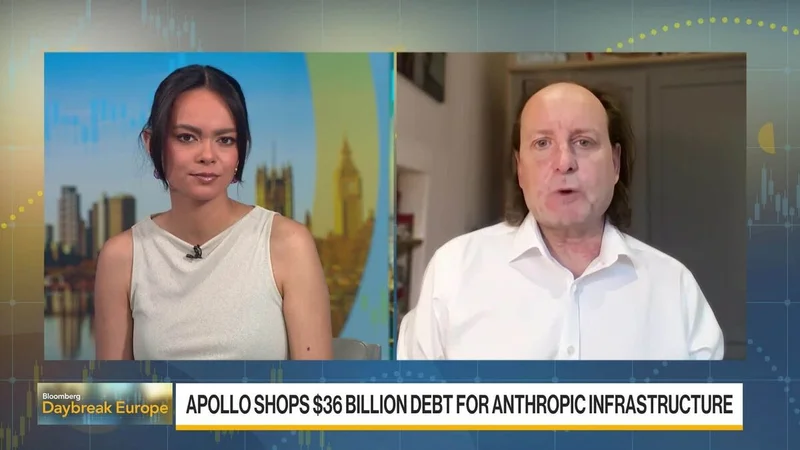
Image: Bloomberg AI
Main Takeaway
Apollo and Blackstone seek investors for a $36 billion debt deal to finance Anthropic's purchase of Google TPUs, marking one of the largest AI.
Jump to Key PointsSummary
What the deal covers
Apollo Global Management and Blackstone are assembling a roughly $36 billion debt financing package to fund Anthropic's acquisition of Google's tensor processing units, or TPUs. According to Bloomberg, the two private equity giants are actively recruiting additional investors to join the deal, which would help Anthropic build out its AI infrastructure without owning the chips directly. Anthropic will lease the TPUs rather than hold them on its balance sheet, a structure that preserves capital while securing access to critical computing power.
The deal stands out for its sheer size. At $36 billion, it rivals some of the largest infrastructure financings in corporate history and signals how capital-intensive the AI arms race has become. Bloomberg reports that Apollo and Blackstone view this as a flagship transaction that could set a template for future AI hardware financings. The structure allows Anthropic to scale compute without diluting equity holders or taking on direct asset ownership risks.
How this fits Anthropic's broader Google commitment
The TPU purchase forms part of a much larger spending plan. Yahoo Finance, citing The Information, reports that Anthropic has committed to spending $200 billion on Google's cloud services and chips over the coming years. This puts the $36 billion debt deal in perspective: it is a down payment on a multi-decade relationship that ties Anthropic's technical fate closely to Google's custom silicon.
The dependency cuts both ways. For Google, locking Anthropic into TPUs means securing a marquee customer for chips that compete with Nvidia's dominant GPUs. For Anthropic, it means betting its Claude models on an architecture that differs from the CUDA ecosystem most rivals use. The Information's reporting suggests Anthropic's leadership views Google's next-generation TPUs as competitive with or superior to alternatives for training and inference at its scale.
Why private equity is stepping in now
Traditional venture capital cannot fund infrastructure at this scale, so Apollo and Blackstone are filling a structural gap in AI finance. Bloomberg notes that both firms have been building specialized asset management teams focused on data center and compute infrastructure. The Anthropic deal lets them deploy capital into a sector with perceived counterparty risk lower than speculative startups, since Google stands behind the chip supply and Anthropic has demonstrated revenue traction.
The lease structure particularly suits private equity. Apollo and Blackstone can treat the TPUs as revenue-generating infrastructure assets, similar to how they finance aircraft or real estate. Anthropic's lease payments provide predictable cash flows, while the 3-5 year technology obsolescence cycle offers natural exit points through refinancing or asset refresh. Ng.investing characterizes this as a record-setting loan that could open floodgates for similar arrangements across the AI sector.
Competitive implications for AI chip markets
The deal sharpens the Google-Anthropic alliance against the OpenAI-Microsoft-Nvidia triangle. While OpenAI has secured preferential access to Nvidia's latest GPUs through Microsoft's Azure infrastructure, Anthropic is doubling down on Google's vertically integrated stack. This bifurcation of the frontier model ecosystem around different chip architectures could create lasting technical divergence in how models are trained and deployed.
Nvidia's market position faces a subtle but real challenge. If Anthropic can achieve comparable or better performance on TPUs, other model labs may reconsider their automatic preference for GPUs. Google has struggled to make TPUs broadly accessible outside its cloud, but a $36 billion committed purchaser gives it the demand signal to expand production and improve software tooling. Bloomberg's reporting suggests Google is treating this as a strategic priority on par with its own internal AI development.
Risks and open questions
The financing is not without hazards. Anthropic's lease obligations will strain its cash flow unless revenue scales commensurately, and the $200 billion total commitment dwarfs its current bookings. Yahoo Finance's citation of The Information implies some investors question whether Anthropic can sustain this spending trajectory without additional equity raises or a strategic acquisition by Google.
The debt structure itself introduces complexity. If AI model economics shift or training costs collapse due to algorithmic advances, Anthropic could find itself locked into expensive infrastructure. Bloomberg notes that Apollo and Blackstone are still recruiting co-investors, suggesting the deal has not yet fully cleared market appetite. The final terms, interest rates, and covenant structures will reveal how much risk the market truly prices into AI infrastructure at this scale.
Key Points
Apollo and Blackstone seek co-investors for $36 billion Anthropic chip financing
Anthropic will lease Google TPUs rather than owning them directly
Deal forms part of reported $200 billion total Google cloud and chip commitment
Private equity fills structural financing gap as VC cannot fund AI infrastructure at scale
Transaction intensifies Google TPU vs Nvidia GPU competition for AI workloads
Questions Answered
The $36 billion scale exceeds what venture capital can typically deploy. Private equity firms like Apollo and Blackstone have built specialized infrastructure teams and can structure debt instruments that preserve Anthropic's equity while funding massive capital expenditures.
OpenAI has primarily accessed compute through Microsoft's Azure, which relies heavily on Nvidia GPUs. Anthropic's Google TPU deal represents a bet on a competing architecture and a deeper vertical integration with one cloud provider.
The deal likely includes covenants and potentially parent guarantees. However, significant default risk exists if Anthropic's revenue growth stalls, which may require renegotiation, equity dilution, or strategic intervention by Google.
Not necessarily. Anthropic's commitment reflects confidence in TPU performance for its specific workloads, but GPU dominance remains broad across the industry. The deal is strategic alignment as much as technical verdict.
Source Reliability
33% of sources are highly trusted · Avg reliability: 74
Go deeper with Organic Intel
Simple AI systems for your life, work, and business. Each one includes copyable prompts, guides, and downloadable resources.
Explore Systems