Apex Raises $200M at $2.3B Valuation to Scale Ford-Style Satellite Mass Production
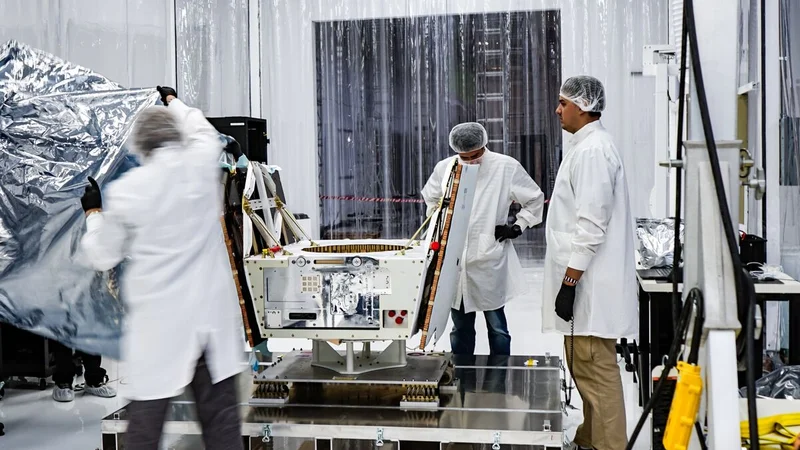
Image: Bloomberg AI
Main Takeaway
Apex doubled its valuation to $2.3 billion after raising over $200 million for satellite bus manufacturing, its third such round in 14 months.
Jump to Key PointsSummary
What makes Apex the 'Ford of satellites'
Apex CEO Ian Cinnamon explicitly compares his company to Ford, aiming to bring Henry Ford-style mass production to satellite manufacturing. The analogy centers on productized, configurable satellite bus platforms that can be churned out rapidly rather than built as bespoke craft. According to Bloomberg, Cinnamon stated Apex is the Ford of satellites, emphasizing standardized production over custom engineering. Forbes expanded on this framing, noting the company's explicit goal of transforming how satellites are manufactured at scale.
The company manufactures satellite buses, the structural and power backbone of any satellite, in two primary models: Aries and Comet. Aries handles payloads up to 150 kilograms, while Comet features a flat form factor fitting into five-meter payload fairings and generates over five kilowatts of power. This productized approach strips away the custom engineering that traditionally slows satellite production.
How the funding breaks down
Apex raised over $200 million in its latest round, led by Glade Brook Capital Partners and co-led by Washington Harbour Partners, with participation from new and existing investors. The company did not label this as a specific series, with Cinnamon noting they are raising capital as investor interest permits. This marks the third $200 million round in approximately 14 months, following a Series C in April 2025 and a Series D in September 2025.
The valuation leap from over $1 billion in September 2025 to $2.3 billion now represents near-doubling in under a year. Sacra estimates Apex generated $60 million in 2024 revenue, primarily from predelivery payments, with three satellites shipped that year and 10 planned for 2025 delivery. Projected 2025 revenue ranges from $120-200 million based on comparable per-unit economics.
Why government contracts matter
Apex has positioned itself as a strategic supplier for US government missions, including work on missile defense projects. The company's September 2025 Series D announcement explicitly stated its positioning as partner of choice for both global commercial and government customers building next-generation satellite constellations.
This dual-use strategy, serving both commercial constellations and national security applications, provides revenue diversification and aligns with broader defense priorities around proliferated satellite architectures. The company cites proven hardware in orbit and rapidly increasing production capacity as differentiators for meeting demand across communications, sensing, and national security constellations. Government work typically carries higher margins and longer contract durations than commercial satellite manufacturing.
The competitive landscape for satellite buses
Apex operates in an increasingly crowded field of satellite bus manufacturers, but its productized approach distinguishes it from traditional aerospace contractors. Most satellite builders still customize buses for each mission, extending timelines and inflating costs. Apex's standardized platforms promise faster delivery and lower per-unit costs, critical for constellation operators launching dozens or hundreds of satellites.
The company's revenue concentration in predelivery payments suggests customers are committing early, reducing Apex's manufacturing risk. However, this also ties revenue recognition to production milestones rather than recurring service income. Competitors include established players like Airbus, Thales Alenia Space, and emerging startups such as Loft Orbital and York Space Systems. Apex's rapid fundraising pace, three major rounds in just over a year, indicates investors see it pulling ahead of this pack.
What happens next for proliferated constellations
Apex's scaling plans directly serve the proliferated constellation trend, where operators replace a few large, expensive satellites with many smaller, cheaper ones. This architecture improves resilience and revisit rates but demands manufacturing at unprecedented scale. The company's 2025 target of 10 satellite deliveries, up from three in 2024, tests whether its Ford-inspired production model can execute in practice.
The $2.3 billion valuation prices Apex at roughly 11.5-19x projected 2025 revenue, a premium reflecting growth expectations but also execution risk. If production scales smoothly, Apex could become a foundational supplier for the satellite industry's next decade. Missteps in manufacturing quality or delivery timelines would quickly erode investor confidence given the company's rapid valuation ascent.
Key Points
Apex raised over $200 million at a $2.3 billion valuation, its third such round in 14 months.
CEO Ian Cinnamon compares Apex to Ford, aiming for mass production of standardized satellite buses.
The company shipped three satellites in 2024 and targets 10 deliveries in 2025 with $120-200 million projected revenue.
Apex serves both commercial constellation operators and US government missions including missile defense.
The company manufactures two primary satellite bus models: Aries and Comet, designed for rapid configuration.
Questions Answered
Apex reached a $2.3 billion valuation in its June 2026 funding round, nearly doubling from over $1 billion in September 2025. The company raised over $200 million in the round, which was led by Glade Brook Capital Partners.
CEO Ian Cinnamon uses the Ford analogy to describe Apex's goal of bringing mass production to satellite manufacturing. The company builds standardized, productized satellite bus platforms rather than custom craft for each mission, which should enable faster and cheaper production at scale.
Apex generated approximately $60 million in revenue in 2024, according to Sacra estimates. This revenue came primarily from predelivery payments for its standardized satellite bus platforms, with three satellites shipped that year.
Apex manufactures two primary satellite bus models. Aries is designed for payloads up to 150 kilograms. Comet features a flat form factor that fits into five-meter payload fairings and generates more than five kilowatts of power.
Yes, Apex works on US government missions including missile defense projects. The company positions itself as a strategic supplier for critical US government missions and national security constellations, alongside its commercial constellation business.
Source Reliability
43% of sources are trusted · Avg reliability: 61
Go deeper with Organic Intel
Simple AI systems for your life, work, and business. Each one includes copyable prompts, guides, and downloadable resources.
Explore Systems