Andreessen Partner Bets SpaceX Starship Will Power Orbital AI Computing
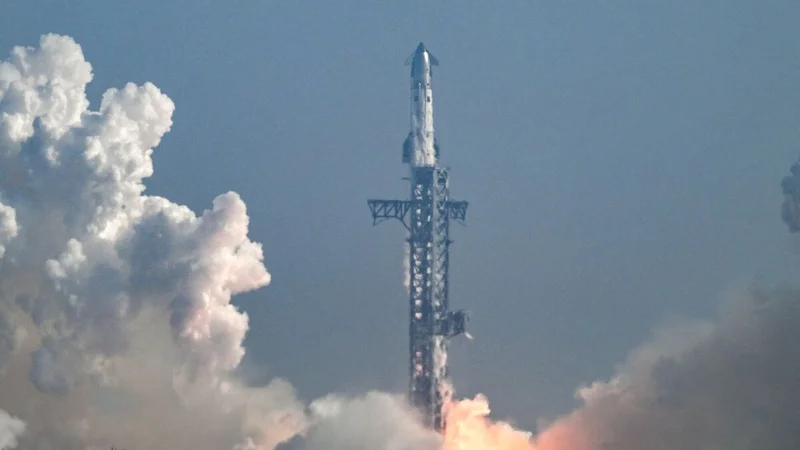
Image: Bloomberg AI
Main Takeaway
Andreessen Horowitz GP David George says SpaceX's reusable Starship rocket creates viable path for deploying AI computing infrastructure in orbit.
Jump to Key PointsSummary
Why orbital AI needs Starship's reusability
David George, a general partner at Andreessen Horowitz and early SpaceX investor, identified rapid rocket reusability as the critical enabler for orbital AI computing. Traditional single-use rockets make deploying and maintaining space-based data centers economically impossible. Starship's design goal of flying multiple times per day strips the per-launch cost down to fuel and ground operations, fundamentally changing the math for sustained orbital operations.
The concept of orbital data centers has circulated among space and AI specialists for years, but launch economics always killed it. George's assessment carries weight because Andreessen Horowitz holds actual SpaceX equity and has visibility into the company's technical roadmap. His framing connects Musk's newly public company directly to the AI infrastructure race, not just satellite launches and Mars colonization.
What changed with the SpaceX IPO
SpaceX began trading publicly on June 12, 2026, closing its first day at $160.95 per share before climbing to $166.76 in extended trading. The debut valued the company at approximately $2.2 trillion, with over 500 million shares changing hands during regular hours and another 16 million post-market. This liquidity event transformed SpaceX from a private curiosity into a publicly accountable entity with capital access for massive infrastructure bets.
The IPO timing matters for the orbital AI narrative. Public market investors now demand clear growth vectors beyond Starlink's consumer broadband and government launch contracts. Positioning Starship as the physical layer for orbital computing gives analysts a tangible AI-adjacent revenue story. The stock's 19% first-day jump suggests markets bought into this expanded ambition, or at least the version management pitched during the roadshow.
Who else is watching this convergence
Andrej Karpathy, the prominent AI researcher who co-founded OpenAI and led Tesla's Autopilot computer vision team, publicly congratulated SpaceX on its IPO. His statement on X praised the company's "story, past, present and the future," noting that observers "can think about it in 10+ different ways and continue re-blowing your mind in circles." Karpathy's perspective carries particular weight given his May 2026 move to Anthropic, placing him at the center of frontier AI development.
Karpathy's enthusiasm signals broader AI industry interest in space-based infrastructure. Ground-based data centers face physical constraints: land acquisition, power grid limitations, cooling water shortages, and regulatory friction. Orbital platforms bypass many of these bottlenecks while gaining solar energy exposure and potentially favorable thermal environments. The technical challenges, radiation hardening, latency tradeoffs, and maintenance logistics remain substantial, but the theoretical case strengthens as launch costs collapse.
The Mars missions testing Starship's reliability
SpaceX's current flight manifest provides the proving ground for George's orbital AI thesis. The company announced Chun Wang, mission commander of the polar-orbiting Fram2 flight, will command Starship's first human interplanetary mission, a two-year Mars flyby exploring beyond the Earth-Moon system. This follows a planned circumlunar commercial flight with Dennis and Akiko Tito, designed to advance deep-space systems for long-duration missions.
These aren't publicity stunts. Each mission generates operational data on Starship's performance in progressively demanding environments. The third-generation Starship and Super Heavy incorporate lessons from years of testing, including a simplified grid fin configuration and Raptor 3 engines. For orbital AI computing to materialize, Starship must demonstrate not just occasional success but airline-like reliability, rapid turnaround between flights, and the ability to precisely deploy heavy payloads to specific orbital inclinations. The commercial human spaceflight program serves as the stress test for these capabilities.
What this means for AI infrastructure competition
The orbital AI concept reframes competition among cloud providers and AI labs. Amazon, Microsoft, and Google have invested tens of billions in terrestrial data centers. An orbital layer would require entirely new capital deployment, regulatory frameworks, and technical standards. SpaceX's vertical integration, owning both the rockets and the potential computing platforms, creates advantages that terrestrial providers cannot easily replicate.
However, significant uncertainty persists. No source provided specifics on timeline, capital requirements, or technical architecture for orbital AI deployment. George's statement reads as directional conviction rather than detailed product announcement. The gap between reusable rocket capability and operational orbital data centers spans years of engineering, assuming customer demand materializes. Investors now tracking SpaceX must weigh the orbital AI narrative against nearer-term revenue drivers and the execution risk inherent in any space-based infrastructure project.
Key Points
Andreessen Horowitz GP David George says Starship reusability enables orbital AI computing.
SpaceX IPO closed at $160.95 on June 12, 2026, reaching $2.2 trillion market cap.
AI researcher Andrej Karpathy praised SpaceX's trajectory after joining Anthropic.
Starship commercial human missions to Moon and Mars test deep-space reliability.
Orbital data centers could bypass terrestrial constraints on land, power, and cooling.
Questions Answered
David George said SpaceX's Starship reusable rocket creates a viable path to deploying AI computing in orbit. He identified rapid reusability as the critical factor that makes sustained orbital operations economically feasible.
SpaceX's public listing at a $2.2 trillion valuation gives it capital access and investor accountability for massive infrastructure bets. The IPO provides a clear growth narrative beyond Starlink and government launches.
Starship's design goal of multiple flights per day strips launch costs down to fuel and ground operations. This collapses the per-kilogram cost of deploying and maintaining space-based infrastructure.
SpaceX is flying commercial human missions including a circumlunar flight and a planned two-year Mars flyby. These generate operational data on deep-space performance and payload deployment precision.
Technical challenges include radiation hardening of computing hardware, communication latency, maintenance logistics, and the gap between demonstrated rocket reusability and operational data center deployment.
Source Reliability
67% of sources are highly trusted · Avg reliability: 76
Go deeper with Organic Intel
Simple AI systems for your life, work, and business. Each one includes copyable prompts, guides, and downloadable resources.
Explore Systems