Samsung's Record Chip Profits Overshadowed by Mobile Slump and Investor Fatigue
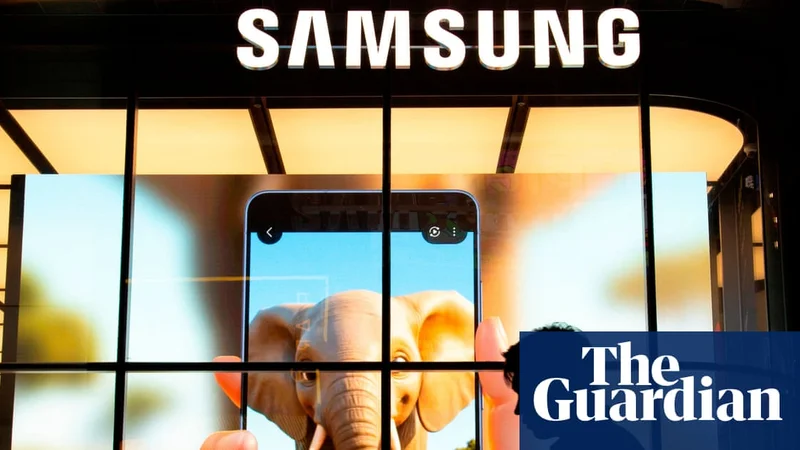
Image: Theguardian
Main Takeaway
Samsung's quarterly profit surged 756% on AI chip demand but shares fell 2.4% as mobile profits collapsed.
Jump to Key PointsSummary
Why record profits disappointed markets
Samsung Electronics posted first-quarter operating profit of 57.2 trillion won, a 756% year-over-year surge that already exceeds its entire 2025 annual total. Yet the stock touched a record 230,000 won in early trading before reversing to close 2.43% lower. According to Bloomberg, investors have grown accustomed to eye-catching growth from AI chip suppliers, and Samsung's numbers, while historic, failed to clear the towering expectations baked into its valuation. The market reaction signals a shift where beating estimates is no longer enough; the stock must demolish them.
The profit beat came almost entirely from memory chips, where operating income jumped roughly 49-fold. Samsung's chip division is riding insatiable demand for high-bandwidth memory used in Nvidia's AI accelerators. But this dependence also exposes a structural vulnerability. When one segment carries the entire company, any sign of plateau or competitive pressure triggers immediate repricing. Investors are already asking whether Samsung can sustain this pace through 2027.
The mobile business collapse
Samsung's smartphone division cratered while chips soared. TradingKey reports that mobile profits plummeted significantly, creating a stark divergence that undermines the company's identity as a balanced electronics conglomerate. The mobile decline reflects both cyclical weakness in premium handset demand and structural challenges from Chinese competitors like Xiaomi and Oppo, which have stripped market share in key regions.
This is not a new pattern. Samsung's historical results show similar cyclicality, but the current swing is more extreme. The Guardian notes that chipmakers are reallocating production capacity toward advanced AI memory, which squeezes supply of conventional chips and leaves Samsung's legacy mobile components business exposed. The company now faces a strategic bind: it cannot easily abandon mobile, yet the capital and talent required to compete in AI memory may starve the phone division of resources. Investors see this tension and are pricing it in.
The supply shortage paradox
Samsung explicitly warned that its supply falls far short of customer demand, with the shortage expected to deepen into 2027. Reuters reports that the AI datacenter buildout has created a structural mismatch between memory production capacity and demand. Samsung and peers are struggling to convert fabrication lines fast enough to produce high-bandwidth memory at scale.
Normally, supply constraints benefit producers through higher prices. But in Samsung's case, the constraint also limits volume growth and hands leverage to customers with long-term contracts. Nvidia and other AI infrastructure deployers are locking in multi-year supply agreements, which reduces Samsung's pricing power over time. The shortage helps today but may constrain flexibility tomorrow. Kim Jaejune, a Samsung executive, stated directly that customer demand far outstrips what the company can deliver, a rare admission of operational limitation from a firm known for vertical integration.
Competitive pressure from AI chip specialists
Samsung's memory profits are impressive, but the company is not the only beneficiary of AI demand. SK Hynix and Micron have also reported explosive growth, and in some cases have pulled ahead in high-bandwidth memory technology. Samsung's investor disappointment partly reflects concern that it is losing technical leadership in the most lucrative segment of the memory market.
The company's historical strength in NAND flash and conventional DRAM matters less when AI training and inference require specialized memory architectures. Samsung has invested heavily to catch up, but capital intensity in this generation of chips is unprecedented. Each fabrication facility costs tens of billions of dollars, and misalignment with the winning memory standard carries existential risk. Bloomberg's analysis suggests investors are comparing Samsung's execution against purer AI plays and finding it wanting, even at record profit levels.
What happens to Samsung's valuation
The stock's inability to hold record highs despite record profits indicates a valuation reset may be underway. Samsung trades at a discount to pure-play semiconductor companies, a traditional conglomerate discount that investors tolerated when growth was steady. With growth now lumpy and concentrated in chips, the market is applying a more critical lens.
The mobile decline removes a stabilizing earnings stream that previously justified Samsung's diversification. Without it, the company becomes a more volatile bet on memory cycles and AI capital expenditure trends. Near-term catalysts include second-quarter guidance, which will reveal whether chip momentum can offset continuing mobile weakness. Longer term, Samsung must demonstrate it can maintain technology parity in high-bandwidth memory while rebuilding its smartphone competitiveness. Neither task is trivial, and the market's initial sell-off suggests investors are skeptical both can be achieved simultaneously.
The geopolitical overlay
U.S. export controls on advanced AI chips to China create additional uncertainty for Samsung's outlook. While not the primary driver of the investor reaction, restrictions affect Samsung's ability to serve Chinese datacenter customers, a historically important market. The company must navigate between complying with American regulations and maintaining market position in China, where local memory suppliers are racing to build domestic alternatives.
Samsung's geographic diversification, once a strength, now complicates strategy. The company has manufacturing in South Korea, China, and the United States, but advanced memory production remains concentrated in Asia. Any escalation in trade restrictions could disrupt supply chains that are already strained. Investors weighing Samsung against competitors with simpler geographic footprints may view this as an additional risk factor that justifies a valuation discount, even as near-term profits surge.
Key Points
Samsung's Q1 operating profit surged 756% to 57.2 trillion won on AI chip demand.
Chip income jumped approximately 49-fold while mobile profits fell sharply.
Shares hit record 230,000 won intraday but closed 2.43% lower on investor disappointment.
Severe memory chip supply shortage is expected to deepen through 2027.
Competitive pressure from SK Hynix and Micron challenges Samsung's technology leadership.
Questions Answered
Samsung's record profit failed to impress investors because market expectations for AI chip suppliers had grown so extreme that beating estimates was no longer sufficient. According to Bloomberg, investors are accustomed to eye-catching growth from AI chip companies, and Samsung's historic numbers did not clear the elevated bar. Additionally, the company's mobile business profits collapsed, creating concern about Samsung's dependence on a single segment.
Samsung's chip profit increased approximately 49-fold in the first quarter of 2026. The Guardian and Reuters both report this dramatic surge, which was driven by explosive demand for memory chips used in AI datacenters. This increase was the primary driver behind the company's overall 756% operating profit growth.
The memory chip shortage is caused by the AI datacenter construction boom, which has spurred Samsung and other chipmakers to reallocate production capacity toward advanced memory chips. According to The Guardian, this shift squeezes supply of conventional chips while chipmakers struggle to meet demand for high-bandwidth memory used in AI accelerators. Samsung expects this shortage to continue into 2027.
Samsung's mobile business profits plummeted significantly in the first quarter of 2026. TradingKey reports that this decline reflects both cyclical weakness in premium handset demand and structural competitive pressure from Chinese smartphone makers. The mobile collapse offset chip strength and contributed to the stock's inability to hold record highs.
U.S. export controls on advanced AI chips to China create strategic uncertainty for Samsung by limiting its ability to serve Chinese datacenter customers. According to Fortune, Samsung previously projected a 56% operating profit plunge partly due to these restrictions. The controls complicate Samsung's geographic diversification and may accelerate Chinese efforts to build domestic memory alternatives.
Samsung's main competitors in AI memory chips are SK Hynix and Micron. Bloomberg notes that these companies have also reported explosive growth from AI demand, and in some cases have pulled ahead of Samsung in high-bandwidth memory technology. This competitive pressure contributed to investor disappointment despite Samsung's record profits.
Source Reliability
44% of sources are highly trusted · Avg reliability: 72
Go deeper with Organic Intel
Simple AI systems for your life, work, and business. Each one includes copyable prompts, guides, and downloadable resources.
Explore Systems