South Korea's Kospi Plunges Up to 10% as Global AI Chip Selloff Triggers Market Circuit Breakers
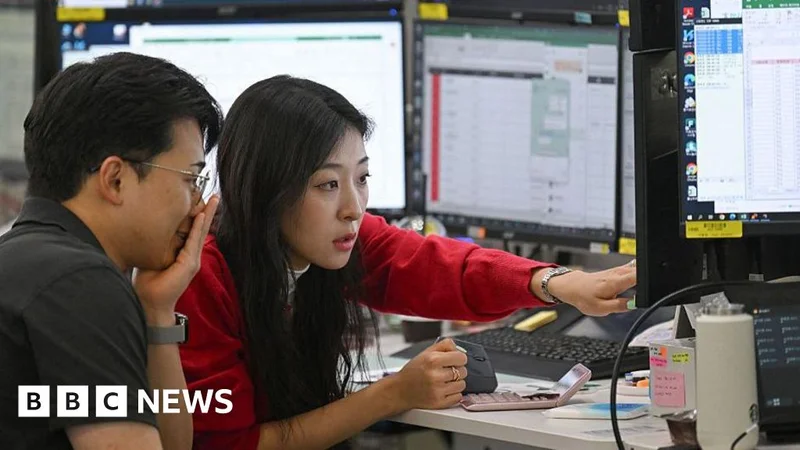
Image: Bbc
Main Takeaway
South Korea's Kospi index crashed up to 10% on July 2, 2026, as a global selloff in AI chip stocks triggered circuit breakers and wiped out billions.
Jump to Key PointsSummary
Why the Kospi crashed so hard
South Korea's benchmark Kospi index suffered its worst single-day drop in years on July 2, 2026, plunging between 7% and 10% depending on the intraday measure. The decline was severe enough that trading was temporarily halted under circuit breaker mechanisms designed to curb panic selling, according to the BBC. The index closed at 7,648 points, extending losses to its lowest level in over three weeks, per Trading Economics data. Foreign investors dumped Korean equities en masse, sending the won to a 16-year low against the dollar, the Korea Herald reported.
The crash was not an isolated event. It followed a sharp overnight rout in US semiconductor shares and spread rapidly across Asian markets. Samsung Electronics, Korea's market heavyweight, led the decline with a drop exceeding 10% in daytime trading. The speed and severity of the selloff caught many market participants off guard, though concerns about stretched valuations in AI-related stocks had been building for weeks.
What sparked the global chip selloff
The immediate catalyst was a disappointing earnings report and outlook from Broadcom, which triggered a sharp selloff in US chip stocks that quickly cascaded to Asia, the Korea Herald reported. Bloomberg noted that the selloff revived long-simmering concerns that the rally in artificial intelligence shares had gone too far, too fast. CNN Business characterized the volatility as driven by investor worries that recent jumps in share prices had become unsustainable.
The AI trade had been one of the most crowded positions in global markets, with chipmakers seeing explosive gains throughout 2025 and early 2026. When Broadcom signaled potential softness in AI infrastructure spending, it acted as a tipping point. The Korea Herald specifically tied the June 5 drop to Broadcom's earnings, while the July 2 crash represented a broader, more systemic unwinding of AI-related positions across multiple continents.
How Samsung and Korean chipmakers got hit
Samsung Electronics bore the brunt of the selling, with its shares falling over 10% during the session to close at 295,500 won, according to the Korea Herald. As the world's largest memory chip maker and a key supplier to AI data centers, Samsung had become a proxy for investor sentiment on artificial intelligence infrastructure buildouts. The company's massive market weighting meant that its decline pulled the entire Kospi index lower with it.
Foreign selling was particularly intense, as international investors who had piled into Korean tech stocks during the AI boom rushed for the exits simultaneously. The won's plunge to a 16-year low reflected not just equity outflows but a broader reassessment of Korea's export-dependent economy. With semiconductors accounting for roughly 20% of South Korea's total exports, the selloff raised concerns about economic growth prospects beyond just the stock market.
The US market contagion before Korea
The Kospi crash followed a brutal session on Wall Street that saw the tech-heavy Nasdaq drop 2.21% and the S&P 500 fall 1.44%, CNN reported. The declines represented the worst day for both indices in about two weeks and came after similar pressure in prior sessions. CNBC noted that the Nasdaq Composite had posted five consecutive losing sessions by June 26, with chip stocks leading the decline throughout that period.
Business Insider reported that global tech stocks were roiled as investors dumped high-flying chip names across multiple exchanges. The synchronized nature of the selling, hitting US, European, and Asian markets in sequence, suggested algorithmic and fund-driven selling rather than fundamental reassessment alone. The speed of contagion highlighted how interconnected global semiconductor supply chains and investor positioning had become during the AI boom.
What circuit breakers reveal about market stress
The activation of circuit breakers on the Kospi for the third time in a single week, per the BBC, signaled extreme market stress rarely seen in developed Asian equity markets. These mechanisms, designed to pause trading during periods of extreme volatility, are intended to give investors time to reassess rather than feed panic. Their repeated triggering suggested that selling pressure was sustained and overwhelming normal market-making capacity.
Circuit breaker activations are relatively uncommon in South Korea, which has developed one of Asia's more sophisticated equity market infrastructures. The fact that they were needed multiple times in one week indicated that the selloff had moved beyond ordinary correction territory into something more systemic. Market veterans drew comparisons to periods of acute stress like the 2008 financial crisis or the 2020 pandemic crash, though the broader economic backdrop remained markedly different.
What happens next for AI chip stocks
The depth of the July 2 crash raises questions about whether the AI chip trade can regain its momentum or if a more prolonged correction is underway. Bloomberg's reporting emphasized that investor concerns centered on whether AI infrastructure spending could sustain its torrid pace, a question that will be answered over subsequent earnings seasons. Goldman Sachs analysts, cited by CNBC, suggested a buy-the-dip posture, though such confidence may be tested if volatility persists.
For South Korea specifically, the won's weakness and foreign capital flight create policy challenges for the central bank and government. The Korea Herald's coverage of prior selloffs in June suggested this was not the first warning shot for Korean tech stocks. Whether the July crash proves to be a cathartic clearing event or the start of a deeper bear market in AI-related shares will depend heavily on upcoming earnings from major chipmakers and cloud computing giants that are the ultimate buyers of AI semiconductors.
Key Points
South Korea's Kospi index crashed up to 10% on July 2, 2026, triggering circuit breakers and halting trading temporarily.
Broadcom's disappointing earnings and AI outlook sparked a global selloff in semiconductor stocks that spread from US markets to Asia.
Samsung Electronics shares plunged over 10%, dragging the entire Kospi lower due to the company's massive index weighting.
Foreign investor exodus sent the South Korean won to its weakest level in 16 years against the US dollar.
Circuit breakers activated three times in one week, signaling extreme stress rarely seen in Korea's developed equity market.
Questions Answered
The Kospi fell between 7% and 10% on July 2, 2026, with intraday measures showing up to a 10% decline before the index closed at 7,648 points. The drop was severe enough to trigger automatic trading halts under circuit breaker rules.
Broadcom's disappointing earnings report and weakened outlook for AI infrastructure spending served as the immediate trigger. The results caused US chip stocks to plunge overnight, with selling pressure rapidly transmitting to Asian markets including South Korea.
Yes, Samsung Electronics shares fell over 10% during the session to close at 295,500 won. As the world's largest memory chip maker and Korea's biggest listed company by market capitalization, Samsung's decline heavily weighted the broader Kospi index lower.
Trading was halted under circuit breaker mechanisms designed to prevent panic selling during extreme volatility. The BBC reported this was the third such activation in a single week, indicating sustained and overwhelming selling pressure.
Foreign investors dumped Korean equities en masse during the selloff, triggering heavy capital outflows. This foreign selling pressure sent the South Korean won to its weakest level against the US dollar in 16 years.
The crash raised fundamental questions about whether AI infrastructure spending growth is sustainable at previous rates. Upcoming earnings from major chipmakers and cloud computing giants will be critical in determining whether this was a temporary correction or the start of a longer bear market in AI-related shares.
Source Reliability
45% of sources are highly trusted · Avg reliability: 81
Go deeper with Organic Intel
Simple AI systems for your life, work, and business. Each one includes copyable prompts, guides, and downloadable resources.
Explore Systems