Valar Atomics Powers Nvidia AI Chip With Nuclear Microreactor in US First
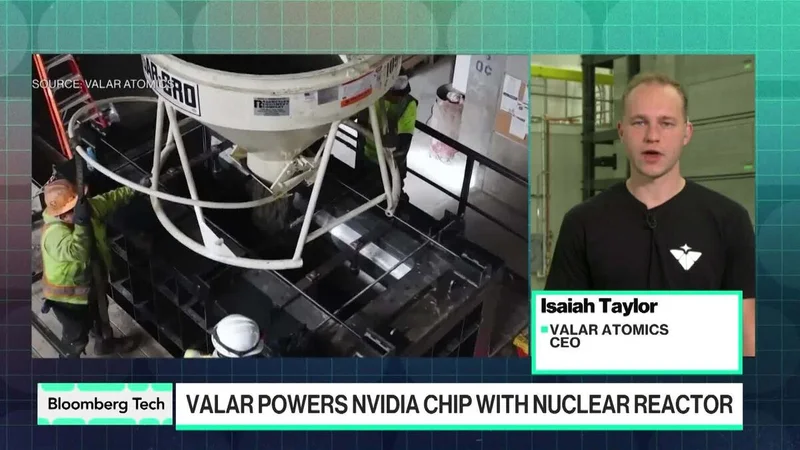
Image: Bloomberg AI
Main Takeaway
Valar Atomics generated electricity from an advanced nuclear reactor to run an Nvidia AI chip, marking the first US demonstration of its kind.
Jump to Key PointsSummary
Why this nuclear-AI milestone matters now
Valar Atomics, a California-based nuclear startup, produced power from an advanced reactor to run an Nvidia AI chip, becoming the first company in the US to demonstrate this capability with next-generation nuclear technology. The electricity generated was modest, described by Bloomberg as just a trickle, but the symbolic weight of the achievement carries far beyond the wattage. The demonstration signals that advanced nuclear reactors are moving from theoretical designs to hardware that can interface directly with the energy-hungry infrastructure of modern AI.
The timing is critical. Data center power consumption is projected to double by 2028, with AI workloads driving the bulk of new demand. Tech companies have been scrambling to secure clean, reliable baseload power, and nuclear has emerged as a favored solution. This test gives Valar a concrete proof point to show potential customers and regulators that its technology can deliver electrons to actual computing equipment, not just sit on paper.
How the demonstration worked on stage
According to Tom's Hardware, Valar activated its nuclear microreactor live on stage to power an Nvidia RTX Spark desktop PC. The theatrical staging of the event, with a reactor physically powering a visible piece of consumer-facing hardware, was clearly designed for maximum impact. The choice of an RTX Spark, rather than a server-grade GPU, suggests the company wanted to make the technology feel accessible rather than buried in an anonymous data center.
The microreactor approach differentiates Valar from larger conventional nuclear projects that take a decade or more to permit and build. Microreactors promise faster deployment, modular scaling, and the ability to site closer to power loads. For AI companies facing transmission bottlenecks and permitting delays, this portability could prove more valuable than maximum output.
The 30MW closed-loop AI factory plan
Valar is working with Nvidia to build a 30MW closed-loop AI factory that doesn't use local water, according to Tom's Hardware. This partnership structure reveals the commercial strategy behind the demonstration. A 30MW facility is modest by hyperscaler standards, single Google data center campuses can exceed 100MW, but it represents a plausible starting point for proving nuclear-powered AI at scale.
The closed-loop, water-free design addresses one of nuclear's hidden advantages for data centers: location flexibility. Traditional data centers cluster near cheap hydroelectric power or cooling water sources. A water-independent nuclear facility could theoretically sit anywhere, including arid regions with abundant land and limited regulatory complexity. This opens up siting possibilities that would be impossible for conventional thermal power or water-cooled computing.
Broader industry momentum in nuclear-AI partnerships
The Valar-Nvidia announcement arrives amid a flurry of nuclear-AI activity. Idaho National Laboratory (INL) and Nvidia have partnered to accelerate deployment of advanced reactors using AI, per Nucnet, with the lab contributing its reactor testing infrastructure and Nvidia bringing computational modeling capabilities. Separately, ANS Nuclear Newswire reported two new partnerships forged across the AI and nuclear sectors, though details were not specified in available excerpts.
Google, meanwhile, announced its first advanced nuclear reactor project with Kairos Power and the Tennessee Valley Authority, according to its AI Blog. This represents a different model: a major tech company contracting for reactor construction rather than a startup building for direct AI integration. The parallel tracks, startup-led and corporate-utility partnerships, suggest the nuclear-AI convergence is broadening rather than concentrating in a single approach.
What obstacles remain for commercial deployment
Regulatory timelines pose the most immediate challenge. The Nuclear Regulatory Commission has approved only a handful of non-light-water reactor designs, and each has required years of review. Valar's microreactor format may qualify for streamlined licensing pathways, but no advanced reactor has yet operated commercially in the US grid. The gap between demonstration and dependable commercial operation remains substantial.
Fuel supply chains for advanced reactors are another underexplored bottleneck. Many next-generation designs require high-assay low-enriched uranium (HALEU), which has limited global production capacity. Without fuel, the reactors cannot run regardless of regulatory approval. The Bulletin of the Atomic Scientists has been tracking these supply constraints, and their concerns about the AI-nuclear rush deserve attention as enthusiasm outpaces infrastructure.
What this means for data center power strategy
For AI infrastructure planners, the Valar demonstration adds nuclear microreactors to the menu of power options alongside grid expansion, on-site solar-plus-storage, and fossil fuel backup. The 30MW scale fits neatly with the modular data center designs that hyperscalers have been standardizing, allowing incremental growth matched to compute demand rather than massive upfront commitment.
The competitive implications extend to Nvidia itself. By embedding early in nuclear partnerships, the chipmaker positions its hardware as the default platform for off-grid, high-reliability AI computing. Rivals AMD and Intel have not announced equivalent nuclear collaborations, though both have sustainability commitments that would logically extend in this direction. The first-mover advantage in nuclear-AI integration may prove durable if regulatory and fuel hurdles create barriers to rapid follower entry.
Key Points
Valar Atomics generated power from an advanced microreactor to run an Nvidia AI chip, a US first for next-generation nuclear technology.
The demonstration powered an Nvidia RTX Spark desktop PC live on stage, with plans for a 30MW water-free AI factory.
Idaho National Laboratory and Nvidia partnered to accelerate advanced reactor deployment using AI modeling tools.
Google announced a separate advanced nuclear project with Kairos Power and Tennessee Valley Authority for reactor construction.
Multiple new partnerships across AI and nuclear sectors were reported, indicating broad industry convergence momentum.
Questions Answered
Valar Atomics generated a small amount of electricity from an advanced nuclear microreactor to power an Nvidia AI chip, specifically an RTX Spark desktop PC, in the first such US demonstration of next-generation reactor technology. The event was staged live, with the reactor physically powering visible computing hardware rather than a remote data center installation.
Yes, Valar is partnering with Nvidia to build a 30MW closed-loop AI factory that does not use local water. This represents a significant scaling from the single-PC demonstration to a commercial-scale facility designed specifically for AI workloads.
The Valar-Nvidia demonstration is part of a broader pattern that includes INL's partnership with Nvidia on advanced reactor deployment, Google's nuclear project with Kairos Power and TVA, and multiple other cross-sector partnerships reported in July 2026. Each represents a different model: startup direct integration, national laboratory research, and corporate-utility construction.
Valar must navigate Nuclear Regulatory Commission approval processes that have historically taken years, secure adequate HALEU fuel supply that has limited global production capacity, and bridge the gap from single demonstrations to reliable commercial operation. These challenges affect all advanced reactor developers, not just Valar.
The closed-loop, water-free design allows nuclear-powered data centers to be sited in arid regions or locations without cooling water access, dramatically expanding siting flexibility compared to conventional data centers that cluster near water sources or cheap hydroelectric power.
Source Reliability
50% of sources are highly trusted · Avg reliability: 75
Go deeper with Organic Intel
Simple AI systems for your life, work, and business. Each one includes copyable prompts, guides, and downloadable resources.
Explore Systems