Nvidia's AI Growth Expands Beyond Hyperscalers as Market Risks Mount
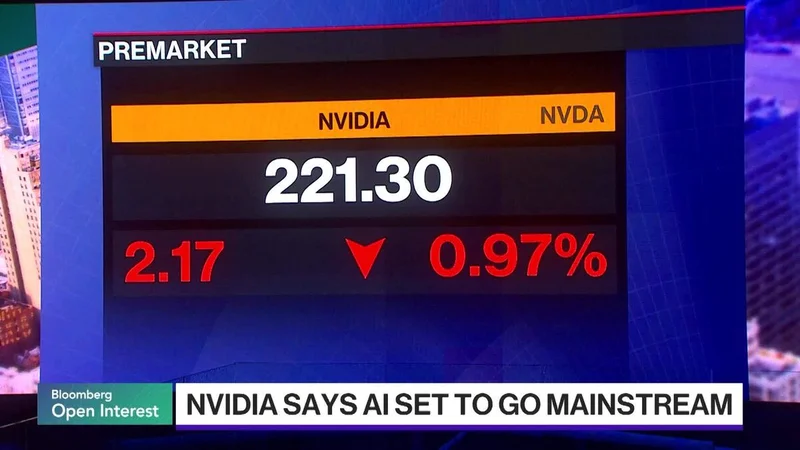
Image: Bloomberg AI
Main Takeaway
Nvidia's earnings reveal AI demand is shifting from data centers to edge computing while inflation and consumer weakness threaten the sector's momentum.
Jump to Key PointsSummary
Where Nvidia's growth is heading next
Nvidia's latest earnings signal a decisive pivot in AI demand architecture. According to Bloomberg, TD Cowen analyst Joshua Buchalter points out that hyperscalers, long the engine of Nvidia's revenue, are no longer the entire story. AI workloads are migrating beyond centralized data centers into distributed environments, factory floors, retail locations, and vehicles. This edge expansion represents a fundamentally different sales cycle, one that trades massive single orders for smaller, more numerous deployments across industrial and commercial settings.
The shift carries both opportunity and complexity for Nvidia's business model. Edge AI chips typically command lower margins than the flagship H100 and Blackwell data center GPUs that drove the company's explosive growth. Yet the total addressable market expands dramatically when every conveyor belt and checkout counter needs inference capability. Nvidia's challenge is maintaining software ecosystem dominance, CUDA's lock on developer loyalty, as hardware becomes more fragmented across use cases.
What the White House quantum bet means for chip strategy
The Trump administration's $1 billion grant to IBM for a $2 billion quantum computing foundry, reported by Bloomberg, sits awkwardly alongside Nvidia's classical AI dominance. This is not direct competition, quantum and classical computing serve different problem sets, but it signals a US industrial policy that is diversifying beyond Nvidia's CUDA-centric world. Washington is effectively hedging its bets on the future of computation itself.
For Nvidia, the quantum push introduces longer-term strategic questions. If quantum-classical hybrid systems become standard for certain optimization and simulation workloads, Nvidia's role could shift from primary compute provider to interconnect and classical co-processor supplier. The company has already begun positioning itself in this space with its CUDA Quantum platform, but government funding for IBM accelerates a timeline Nvidia would prefer to control.
Why consumer health threatens the AI rally
The market's AI enthusiasm runs on borrowed time against deteriorating consumer fundamentals, according to analysis from Fintech. Chris Versace, CIO at Tematica Research, notes that investors remain fixated on AI's multi-year growth potential while ignoring warning signs in consumer balance sheets. Retail earnings from Walmart, Target, and Home Depot this week will test whether AI investment can remain insulated from household spending pressure.
Versace's analysis highlights a tension that Nvidia cannot escape. Corporate AI spending has held firm, but it ultimately depends on consumer-facing businesses generating returns on that technology. If retailers cut technology budgets in response to squeezed margins and credit-dependent shoppers, Nvidia's new edge AI customers, the very ones Buchalter identifies as growth drivers, face demand destruction. The AI boom's second act requires healthy end consumers, a condition that current data only ambiguously supports.
How geopolitical risk reshapes chip demand
Inflation pressures and Middle East uncertainty, flagged by Versace's analysis, compound Nvidia's near-term headwinds. Geopolitical risk directly affects semiconductor supply chains and customer confidence, particularly for edge deployments that require physical installation across global markets. Unlike cloud infrastructure concentrated in politically stable regions, distributed AI hardware faces localized disruption from trade policy, sanctions, or shipping constraints.
The company's response has been geographic diversification of manufacturing, but that takes years to materialize. In the interim, Nvidia's valuation assumes continued acceleration in both data center refresh cycles and new edge adoption. Any geopolitical shock that delays corporate capital expenditure decisions hits both segments. The market's current pricing leaves minimal room for the kind of guidance caution that retail sector weakness might force.
What investors should watch this earnings season
The convergence of these forces makes upcoming earnings reports unusually consequential for Nvidia's narrative. Retail guidance will signal consumer resilience. IBM's quantum progress, backed by federal money, will frame long-term competitive positioning. Nvidia's own commentary on edge AI revenue mix will reveal whether the Buchalter thesis has reached financial materiality.
Versace's framework suggests watching same-store sales and margin compression as early indicators of technology budget stress. For Nvidia specifically, the metric that matters is non-hyperscaler revenue growth rate. If edge and enterprise segments fail to accelerate fast enough to offset any hyperscaler digestion period, the stock's premium multiple faces compression. The transition from AI's infrastructure buildout phase to its deployment and monetization phase was always going to be messy. These earnings may determine just how messy.
Key Points
Nvidia's AI demand shifts from hyperscalers to edge computing and industrial applications
White House awards IBM $1 billion grant for quantum computing foundry construction
Consumer spending weakness and inflation threaten corporate AI investment returns
Retail earnings from Walmart, Target, and Home Depot signal household economic health
Geopolitical risks in Middle East create supply chain and demand uncertainty for chips
Questions Answered
According to TD Cowen analyst Joshua Buchalter, AI workloads are expanding into edge computing, factory floors, retail locations, and vehicles, creating distributed demand beyond centralized data centers.
The $1 billion federal grant signals US policy diversification beyond classical AI chips, potentially accelerating quantum-classical hybrid systems that could shift Nvidia's role toward co-processor supplier.
Corporate AI investment ultimately depends on consumer-facing businesses generating returns; if retailers cut technology budgets due to weak household spending, Nvidia's edge AI customers face demand destruction.
Inflation, geopolitical tension in the Middle East, weakening consumer balance sheets, and potential delays in corporate capital expenditure from trade policy or shipping constraints.
Non-hyperscaler revenue growth rate, retail same-store sales and margin trends, and guidance from enterprise customers on AI deployment timelines and budgets.
Source Reliability
50% of sources are highly trusted · Avg reliability: 70
Go deeper with Organic Intel
Simple AI systems for your life, work, and business. Each one includes copyable prompts, guides, and downloadable resources.
Explore Systems