New York Times Tests AI Recipe Customization, Stirring Subscriber Concerns Over Cooking and Technology
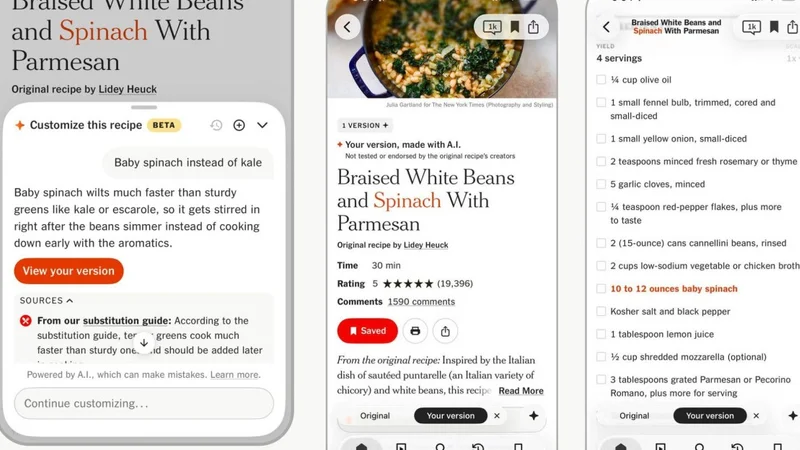
Image: The Verge AI
Main Takeaway
The New York Times is testing an AI tool that adjusts ingredients, equipment, and serving sizes in its Cooking app while subscribers debate its environmental and editorial costs.
Jump to Key PointsSummary
What the NYT feature does
The New York Times is testing an AI tool that modifies recipes for individual cooking needs, including ingredient substitutions, equipment changes, and serving-size adjustments. The feature is available to all Cooking subscribers on iOS and is being rolled out gradually before a broader release, the company says.
Users can ask the tool to adapt a recipe when ingredients or kitchen tools are unavailable. In one example, substituting baby spinach for kale prompts the system to add the spinach later because it wilts faster. Customized recipes remain private and can't be published or shared through the app. The tool also handles requests such as scaling a dish to a different number of servings or adapting it to another pan.
Why substitutions are difficult
Ingredient swaps require more than matching one food with another. Cooking time, moisture, texture, flavor, and heat tolerance all affect whether a replacement works. A sturdy green such as chard can withstand longer cooking, while spinach collapses quickly, so the timing has to change with the substitution.
That practical detail is the feature's central test. NYT Cooking senior editor Genevieve Ko said staff evaluated many examples so the chatbot's answers would align with the guidance culinary editors would give. Earlier AI features handled measurement conversions, including volume to metric weight, and adjusted recipes for half or double servings. The new system extends automation into decisions that are closer to editorial judgment and kitchen technique.
Editorial control remains central
The New York Times is presenting the tool as an aid built around its existing recipes rather than as an open-ended recipe generator. Cooking staff developed and reviewed sample answers, while the company is watching performance and usage during the staged rollout. Early requests have focused heavily on ingredient substitutions.
That distinction matters because recipe instructions carry more than ingredient data. They encode timing, technique, safety, and the intended character of a dish. The Times says the feature is grounded in its editorial standards, but subscribers are still being asked to trust an automated layer that changes instructions originally reviewed by human editors. The private-only format limits distribution of modified recipes, while leaving the original editorial product intact for users who follow it as written.
Subscribers push back
Some NYT Cooking users object to the feature because they see AI as a poor fit for a product valued for human expertise and simplicity. Comments cited by The Verge raised concerns about data-center emissions, the broader effects of adding AI to consumer software, and the possibility that automated tools will crowd out the qualities that made the service appealing.
The criticism also reflects a user-control dispute. When asked whether subscribers would be able to disable the feature, Ko replied that there was no such option at the time, while emphasizing that using the tool was optional. The Times later closed comments on the announcement after 4 days. A spokesperson said editors had used that period to answer questions and engage with readers, describing the timing as standard practice.
The broader AI trade-off
The Cooking test places a familiar product question inside a particularly tangible setting: how much automation belongs in an activity built around judgment, touch, and sensory feedback. Ko described the goal as supporting the physical pleasure of cooking and helping users produce a real meal, while acknowledging concerns about data centers, concentrated power in the AI industry, and AI safety.
For the Times, the feature offers a way to make a subscription more useful when shoppers lack an ingredient or own different equipment. For subscribers, it raises a sharper question about whether convenience justifies another AI system inside a trusted editorial product. The dispute is therefore about product design as much as recipe accuracy. Its next test will be whether modified instructions are reliable enough to earn repeat use without weakening confidence in the human work behind the recipes.
Key Points
New York Times is testing AI recipe modifications for substitutions, equipment changes, and serving adjustments.
NYT Cooking’s AI tool changes cooking timing when replacement ingredients behave differently from originals.
Cooking staff evaluated sample responses to align automated guidance with Times culinary standards.
The feature is available to iOS subscribers while the Times monitors speed, usage, and answer quality.
Subscribers criticized AI’s environmental costs and the lack of a setting to disable the feature.
Questions Answered
The New York Times AI recipe tool modifies Cooking recipes for substitutions, different equipment, and serving sizes. It can also adjust timing when a replacement ingredient cooks differently from the original.
The NYT Cooking AI feature is available to all Cooking subscribers using the iOS app. The New York Times is rolling it out gradually and plans broader availability.
The New York Times did not offer a setting to disable the Cooking AI feature when it was announced. Genevieve Ko said using the tool was optional, but the feature itself could not be turned off.
The New York Times Cooking staff evaluated many sample answers to align the system with culinary expertise and editorial standards. The company is also monitoring performance and how subscribers use the feature during its gradual rollout.
NYT Cooking subscribers are criticizing the AI tool over environmental concerns and its effect on a product built around human editorial expertise. Some also object to the lack of a feature-level opt-out setting.
Source Reliability
50% of sources are highly trusted · Avg reliability: 80
Go deeper with Organic Intel
Simple AI systems for your life, work, and business. Each one includes copyable prompts, guides, and downloadable resources.
Explore Systems