OpenAI Now Backs a 13-Page Playbook That Would Tax Robots, End Income Tax for Most Americans, and Shrink the Work Week
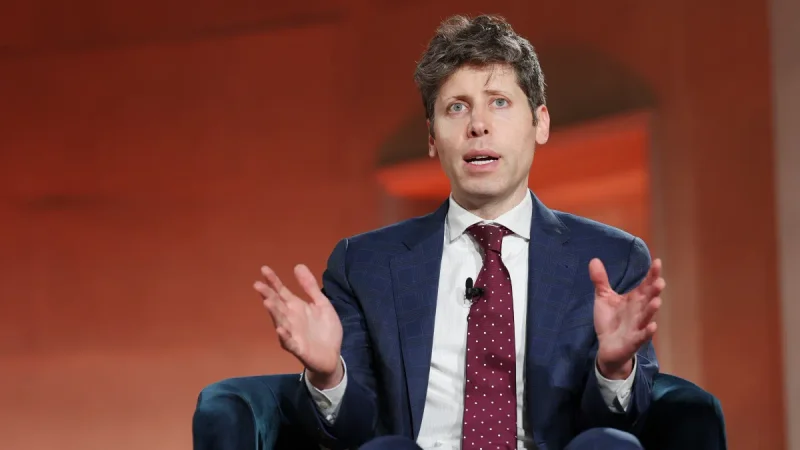
Image: Thetimes
Main Takeaway
Altman’s latest policy paper still taxes AI labor and funds 32-hour weeks, but Fortune shows he’s also endorsing Khosla’s plan to kill income taxes for earners under $100,000.
Summary
The manifesto that landed on a Monday
Sam Altman’s team published a 13-page paper titled Industrial Policy for the Intelligence Age that reads like a New Deal for the AI era. The document argues that superintelligence is “close enough” to justify sweeping economic reform and lays out three headline moves: a tax on automated labor (“robot taxes”), a national public wealth fund seeded by AI companies, and federally backed pilot programs for four-day, 32-hour workweeks at full pay. According to TechCrunch, the plan also includes automatic safety-net triggers that would flick on when unemployment spikes past preset thresholds, plus a playbook for containing rogue systems. Altman told Axios the paper is “a starting point, not a prescription,” but the timing—days after he predicted 40 percent of tasks could be automated within a few years—signals urgency.
A new Fortune feature adds another plank: Altman has publicly backed Vinod Khosla’s proposal to eliminate federal income taxes for every American earning less than $100,000 a year, replacing the lost revenue with AI-specific levies and dividends from the proposed public wealth fund. Khosla claims the swap would leave roughly 90 percent of workers with larger take-home paychecks while concentrating the tax burden on capital and high-earning AI firms. Altman’s endorsement marks the first time OpenAI has explicitly tied its redistribution plan to a zero-income-tax threshold, moving the debate from abstract safety-net design to a tangible rewrite of the tax code.
Why OpenAI wants to tax its own robots
OpenAI’s logic is blunt: if AI systems replace human workers, the displaced labor should be taxed at a level that funds retraining, cash transfers, or shorter hours without pay cuts. Fortune notes the proposal echoes ideas Altman floated in a 2021 blog post about taxing capital rather than labor. The company suggests the tax could scale with the productivity delta between human and machine, creating a feedback loop that slows job churn while generating revenue. Bloomberg reports that OpenAI’s chief global affairs officer Chris Lehane pitched the idea as “capitalism with guardrails,” arguing that without redistribution, popular backlash could stall innovation entirely.
The new Fortune piece clarifies that the robot-tax revenue would not only finance shorter workweeks but also backfill the Treasury once income taxes disappear for the bottom 90 percent. Khosla estimates the combined AI levy and wealth-fund dividends could replace roughly $1.8 trillion in personal income-tax receipts—an audacious claim that assumes sustained productivity gains from AI and broad equity stakes in leading labs. Altman calls the swap “a moral imperative” and says OpenAI would contribute “significant” shares to the public fund, though no cap table details have been disclosed.
The $100B question: how big is the public wealth fund
While the paper never names a dollar figure, Altman has previously floated a sovereign wealth fund seeded with equity stakes from AI companies that hit trillion-dollar valuations. Fortune now pegs the target at $100 billion within a decade, with Khosla suggesting initial contributions could come from a 2-5 percent equity carve-out of each major lab at IPO or Series D. The fund would behave like Norway’s oil kitty, distributing annual dividends to every citizen while compounding returns from AI royalties and compute leasing. Altman stresses the fund must be “citizen-owned, not government-run” to avoid political meddling, a stance that could complicate Congressional negotiations.
What happens next
OpenAI plans to brief Senate staffers next month on the combined robot-tax and zero-income-tax package. Insiders say the pitch leans on fresh modeling from MIT economists who project a 7-9 percent GDP bump by 2035 if AI gains are broadly shared. Critics warn the math is fragile—any slowdown in AI adoption or valuation could blow a hole in federal revenues. Still, Altman is betting that once voters taste both shorter weeks and fatter paychecks, rolling back the plan becomes political suicide.
Key Points
OpenAI now endorses eliminating federal income tax for Americans earning under $100,000.
Robot-tax revenue and a $100B public wealth fund would replace the lost IRS intake.
The 13-page playbook still calls for 32-hour workweeks at full pay.
Initial fund contributions would come from 2-5 percent equity in AI companies.
Altman and Khosla claim the swap could add 7-9 percent to GDP by 2035.
FAQs
Every W-2 or 1099 earner below that threshold would owe zero federal income tax; brackets above $100k would remain, and new AI levies plus wealth-fund dividends would fill the gap.
A levy on the productivity gap between human and AI labor, scaled per task or per robot-equivalent worker, collected quarterly from companies deploying autonomous systems.
A federally chartered, independent trust modeled on the Federal Reserve, with citizen-elected trustees and a mandate to distribute annual dividends like Alaska’s Permanent Fund.
Source Reliability
53% of sources are trusted · Avg reliability: 77
Go deeper with Organic Intel
Our AI for Your Life systems give you practical, step-by-step guides based on stories like this.
Explore ai for your life systems