CME Group to Launch World's First Computing Power Futures Market for AI Infrastructure
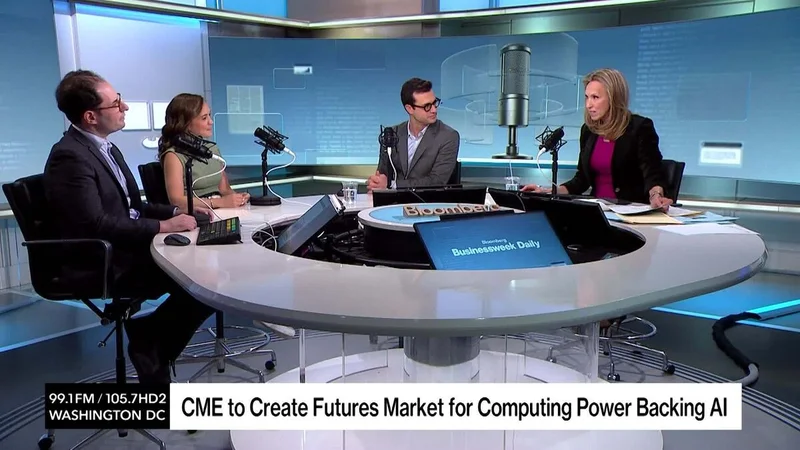
Image: Bloomberg AI
Main Takeaway
CME Group partners with Silicon Data to create futures contracts for computing power, letting traders hedge against volatile GPU and AI infrastructure costs.
Jump to Key PointsSummary
How compute futures would actually work
CME Group, the largest US derivatives exchange, is teaming up with Silicon Data to launch futures contracts based on computing power, with trading expected to begin later this year pending regulatory review. The contracts would allow market participants to hedge against price volatility in GPU rental rates and other operational costs that have surged alongside the AI boom. According to Bloomberg, the new market targets what has become a critical input for artificial intelligence development, where demand for processing capacity continues to outstrip supply. Silicon Data, backed by global trading firm DRW, brings GPU market intelligence and benchmarking capabilities to the partnership.
The mechanics draw from traditional commodity futures but apply them to a digital resource. Traders would take positions based on an index of computing power prices rather than buying physical chips. This structure mirrors how farmers hedge corn prices or airlines lock in jet fuel costs. CNBC reports the contracts can be used to hedge against rising GPU rental rates, giving AI companies a financial instrument to stabilize their largest variable cost. The index component is crucial, it provides a standardized reference point in a market currently fragmented across cloud providers, colocation facilities, and spot rental platforms.
Why the timing matters now
Computing power has become the scarce resource of the AI era, and its price volatility is creating genuine operational risk for companies building large models. CME Group's move signals that derivatives markets now view compute as sufficiently commoditized and widely traded to support standardized contracts. This is a notable shift, it treats digital infrastructure as equivalent to oil, wheat, or metals in terms of market structure. According to Markets Media, the partners believe compute could become the largest commodity in the world, a bold claim that reflects projected AI infrastructure spending trajectories.
The launch window is deliberate. AI infrastructure investment has accelerated dramatically, with cloud providers and startups alike committing billions to GPU clusters. This spending surge has created wild price swings, spot GPU availability crises, and contract terms that shift monthly. A futures market arrives precisely when participants need price discovery tools and risk transfer mechanisms. PR Newswire notes the partnership combines CME's derivatives expertise with Silicon Data's specialized market data, suggesting the product is designed for institutional participation rather than speculative retail trading. Regulatory review remains pending, which could delay launch if authorities question how to classify or supervise compute as a tradable commodity.
Who stands to gain and lose
The immediate beneficiaries are AI companies with large, ongoing compute needs. Startups training foundation models, enterprises running inference at scale, and cloud providers themselves could use futures to lock in costs and reduce budget uncertainty. This is particularly valuable for companies with multi-year model development timelines where GPU price spikes could otherwise derail funding plans. According to Moomoo's reporting on the announcement, the market aims to provide participants with a new tool to hedge against price volatility, which suggests the target user base extends beyond pure financial speculators.
Conversely, GPU manufacturers and cloud providers may face mixed incentives. Nvidia and cloud hyperscalers have benefited from opacity in compute pricing, capturing margins that fluctuate with scarcity. A transparent futures market could compress those margins by revealing true market clearing prices and enabling arbitrage across delivery mechanisms. Panewslab's coverage emphasizes this is the first computing power futures contract, implying pioneering status but also untested regulatory and operational frameworks. For traders and hedge funds, the new market opens another correlated asset class tied to AI growth without requiring direct investment in technology equities. DRW's involvement through Silicon Data backing suggests sophisticated trading firms see alpha in early participation.
What regulators must still resolve
Launching a novel derivatives product requires navigating multiple regulatory frameworks, and compute futures present unique classification challenges. The Commodity Futures Trading Commission must determine whether computing power constitutes a commodity under existing statutes, or whether new rulemaking is needed. The physical non-delivery nature of the underlying asset, compute is consumed ephemerally rather than stored, complicates traditional warehouse receipt and delivery mechanisms that underpin other futures markets. CME Group's April 2026 investor presentation, which preceded this announcement, included forward-looking statements about new product development, suggesting the exchange has been building regulatory groundwork.
Market structure questions also loom. Who ultimately settles disputes about index composition if GPU benchmarks vary across providers? How does the market handle technological obsolescence if newer chips render older generation pricing irrelevant? These are not merely technical concerns, they affect contract enforceability and market integrity. News.futunn's reporting notes the launch is currently pending regulatory review, a standard caveat that nonetheless carries weight given the novelty. If approved, the product could set precedent for other intangible commodity derivatives, potentially opening markets for data storage, bandwidth, or even carbon removal credits structured similarly.
The bigger picture for AI infrastructure finance
This development represents a maturation point for AI's economic infrastructure. When an asset class spawns its own derivatives market, it signals transition from speculative frontier to institutionalized commodity. The creation of compute futures could accelerate capital formation for AI infrastructure by giving lenders and investors risk management tools that make long-dated project financing more attractive. Gurufocus framed the announcement as an innovative power futures market amid growing AI demand, capturing the sense that financial innovation is now racing to keep pace with technical innovation.
The second-order effects may prove more significant than the product itself. Standardized compute pricing could enable securitization of GPU assets, creation of compute-backed bonds, or insurance products for AI training runs. It also creates incentives for more transparent pricing across the currently opaque cloud computing market. Bloomberg's Katherine Doherty, in the exchange's video coverage, discussed how the market will work, implying operational details are still being finalized. For now, the announcement alone has forced market participants to contemplate a future where compute is as tradable as crude oil, a conceptual shift that will reshape how AI's physical infrastructure gets financed, insured, and ultimately governed.
What happens next for traders and builders
Market participants should expect a comment period from regulators followed by pilot contract specifications and test trading. CME Group has incentive to move quickly given competitive pressure from other exchanges eyeing AI-linked products, but regulatory caution on novel derivatives has increased since the 2008 financial crisis. For AI builders, the practical timeline for hedging tools likely extends into 2027 even with a late 2026 launch, as liquidity and market maker participation must develop. According to multiple sources, the exchange and Silicon Data are targeting a launch later this year, though pending regulatory review introduces meaningful uncertainty.
Developers and infrastructure planners should monitor index methodology closely. The specific GPUs included, geographic coverage, and weighting approach will determine whether futures actually match their cost exposures. A contract heavy on consumer-grade GPUs may not hedge enterprise H100 clusters effectively. The success of this market ultimately depends on adoption by the same AI companies it aims to serve, if they find basis risk too high or contract terms too standardized, the product could languish as a niche trading vehicle rather than becoming the foundational risk management tool its architects envision. For now, the announcement itself has changed the conversation about whether compute belongs in the same financial category as soybeans and natural gas, and that reframing will persist regardless of launch timing.
Key Points
CME Group and Silicon Data are partnering to launch the first futures market for computing power, with contracts expected to begin trading later in 2026 pending regulatory approval.
The product allows hedging against GPU rental rate volatility and other AI infrastructure costs, treating compute as a tradable commodity similar to oil or metals.
Silicon Data provides GPU market intelligence and benchmarking, with backing from global trading firm DRW, while CME contributes derivatives market infrastructure and regulatory experience.
The launch faces classification challenges from regulators and operational questions about index composition, technological obsolescence, and settlement mechanisms for an ephemeral digital resource.
Success depends on adoption by AI companies with genuine compute cost exposure, and could enable broader financial innovation including securitization and infrastructure-backed bonds.
Questions Answered
It is a standardized derivatives contract that allows buyers and sellers to lock in future prices for computing power, similar to how farmers hedge grain prices or airlines manage fuel costs. The CME version will be cash-settled against an index of GPU and computing power prices rather than requiring physical delivery of chips.
Primarily institutional participants: AI companies with large compute budgets, cloud providers, financial institutions, and commodity traders. The product is designed for hedging and risk management rather than retail speculation, though qualified traders may also participate.
CME Group and Silicon Data have announced a target of later in 2026, but the launch remains pending regulatory review by the Commodity Futures Trading Commission and potentially other authorities. Historical patterns suggest novel derivatives products often face delays during review.
Specific methodology has not been fully disclosed, but Silicon Data's GPU benchmarking capabilities suggest the index will track rental rates and operational costs across major providers and chip types. The exact composition, weighting, and geographic coverage remain to be finalized.
Not directly. Compute futures provide exposure to the cost of AI infrastructure rather than the value of AI companies or models themselves. Prices may correlate with AI demand but are also affected by chip supply, energy costs, and technological improvements that reduce computing requirements.
Source Reliability
58% of sources are established · Avg reliability: 68
Go deeper with Organic Intel
Simple AI systems for your life, work, and business. Each one includes copyable prompts, guides, and downloadable resources.
Explore Systems