NVIDIA CEO Tells CMU Grads They're Entering AI's Ground Zero—And Skilled Trades May Win Biggest
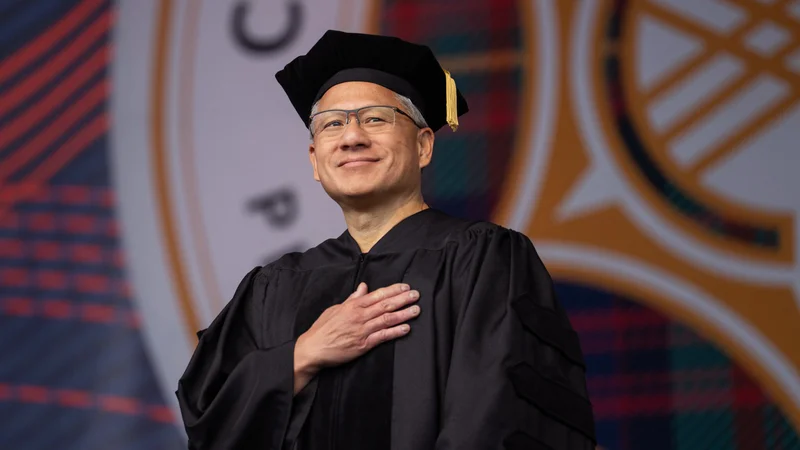
Image: NVIDIA Blog
Main Takeaway
Jensen Huang tells 2026 Carnegie Mellon graduates they're entering workforce at the dawn of AI revolution with unprecedented opportunity to shape future.
Jump to Key PointsSummary
NVIDIA founder and CEO Jensen Huang delivered a commencement address to Carnegie Mellon University's Class of 2026 on May 11, 2026, at Gesling Stadium in Pittsburgh, framing their entry into the workforce as 'the beginning of the AI revolution' with unprecedented opportunity to shape the future .
What the CEO actually said to graduates
Speaking on a rainy Mother's Day morning, Huang told assembled thousands that 'a new industry is being born' and that 'no generation has entered the world with more powerful tools, or greater opportunities, than you' . His speech positioned the graduating class—who spent their entire college experience in the post-ChatGPT era—as the first true natives of the AI age entering at what he called 'ground zero' of a fundamental revolution in how work gets done .
Why this matters beyond commencement speeches
This wasn't just another tech executive delivering platitudes. Huang's message carries weight because NVIDIA sits at the epicenter of AI infrastructure, making his framing of this moment as 'the beginning of the AI revolution' more than mere rhetoric. When the CEO of the company whose chips power virtually every major AI system tells an entire graduating class they're entering at ground zero, it's effectively an industry signal about where we are in the adoption curve. The timing is particularly notable given that these graduates represent the first cohort who spent their entire college experience in the post-ChatGPT era, making them true natives of the AI age .
What happens to traditional career paths now
According to coverage across financial and business media, Huang's address explicitly connected AI advancement to career transformation, suggesting that traditional career trajectories are being fundamentally rewritten. While specific details of his advice to students weren't fully excerpted in the available sources, the consistent framing across NVIDIA's own blog and business press coverage indicates he positioned AI not as a threat to jobs but as the foundation for new ones .
The trades angle nobody expected
In a separate May 11, 2026 Fortune interview expanding on the commencement themes, Huang specifically named electricians and plumbers as potentially the biggest winners of the AI infrastructure buildout. As tech giants pour hundreds of billions into data centers and power infrastructure, demand for skilled trades workers is soaring alongside the white-collar AI jobs typically grabbing headlines . This reframes the AI revolution's labor market impact: the people wiring and cooling the physical infrastructure may capture more stable, long-term value than many coding roles vulnerable to rapid automation. Huang's commencement optimism, it turns out, wasn't just for software engineers.
Key Points
Huang delivered CMU commencement on May 11, 2026, at Gesling Stadium in Pittsburgh
Class of 2026 framed as first 'AI native' cohort entering workforce at revolution's start
Fortune interview extends thesis: electricians and plumbers may be AI boom's biggest winners due to infrastructure demand
Positions skilled trades as undervalued beneficiaries alongside traditional tech roles
Questions Answered
On Mother's Day 2026 at Carnegie Mellon University's 128th commencement ceremony at Gesling Stadium in Pittsburgh, Pennsylvania.
He positioned them as the first generation entering the workforce at the absolute beginning of the AI revolution, with access to more powerful tools and greater opportunities than any previous generation.
He emphasized that 'we are all standing at the same starting line' and that this is 'your moment to help shape what comes next,' suggesting equal footing with experienced professionals in adapting to AI.
The implications extend to healthcare, finance, manufacturing, and any sector undergoing AI transformation, as companies across industries compete for AI-literate talent.
As CEO of NVIDIA, the company whose chips power virtually every major AI system, Huang's characterization of current AI adoption stage carries significant industry signaling weight.
Source Reliability
67% of sources are trusted · Avg reliability: 73
Go deeper with Organic Intel
Simple AI systems for your life, work, and business. Each one includes copyable prompts, guides, and downloadable resources.
Explore Systems