Anthropic's Claude Code Creator Says Developers Now Manage Thousands of AI Agents
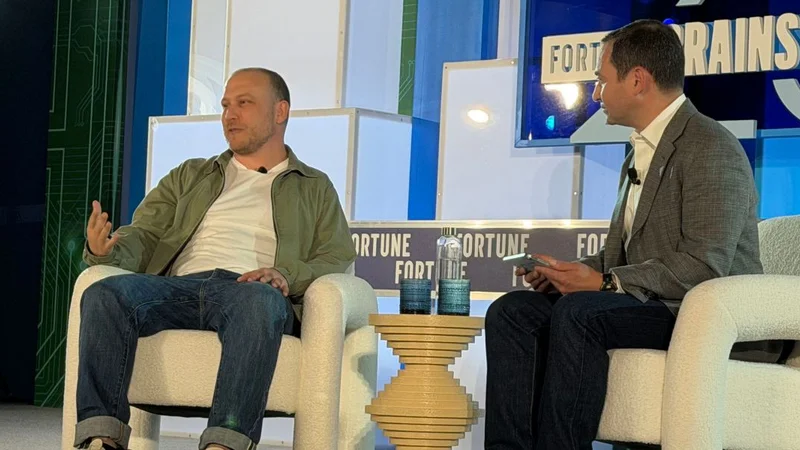
Image: Fortune AI
Main Takeaway
Boris Cherny reveals he manages tens of thousands of AI agents daily and hasn't handwritten code in eight months.
Jump to Key PointsSummary
Why cost comparisons miss the point
Boris Cherny, the creator and head of Anthropic's Claude Code, argues that companies evaluating AI investment are asking the wrong question. According to Fortune, Cherny believes the focus on per-token or per-request pricing obscures a more fundamental shift in how software gets built. The real metric, he suggests, should be output per dollar rather than input cost, because AI agents now handle entire workflows that previously required multiple human engineers.
This reframing matters because Claude Code has already reached an annualized revenue run rate exceeding $2.5 billion. At the Fortune Brainstorm Tech conference in Aspen, Cherny emphasized that this figure represents just the beginning of a broader transformation. The tool has moved from a single-terminal assistant to a system where developers orchestrate vast numbers of autonomous coding agents.
What the developer role looks like now
Cherny hasn't handwritten a line of code in eight months. During his opening session at Fortune Brainstorm Tech, he described mornings managing a few hundred AI agents and peak days handling thousands or tens of thousands. This marks a dramatic departure from eighteen months ago, when developers typically ran one Claude Code instance in a single terminal window.
The shift turns programmers into fleet managers rather than direct producers. Cherny's own workflow exemplifies this: instead of typing functions, he directs, reviews, and coordinates agent outputs. According to LessWrong, speculation has circulated that 90% of code at Anthropic may already be written by AI systems. While this figure remains unverified, it points to the scale of internal adoption that underpins Cherny's public claims about agent-driven development.
The expansion of who can build software
Cherny pointed to a radical democratization of coding capability. "In the past, there were 50 million people in the world who could code," he told Fortune AI editor Jeremy Kahn. "And now everyone in this room can code. Everyone in the world is starting to be able to code." This statement frames AI coding tools not as productivity enhancers for existing developers but as access points for a vastly larger population.
The implications extend well beyond engineering departments. As Platformer noted in its coverage, this trend raises questions about the future role of software engineers and whether traditional coding skills retain the same economic value. The transition from craft to management, from individual creation to orchestration, mirrors how other technical fields have evolved when automation tools reached sufficient sophistication.
How CFOs should rethink AI budgets
For financial officers, Cherny's message carries specific weight. The wrong comparison, he suggests, is measuring AI costs against human salary equivalents or previous software tooling budgets. The correct frame treats AI agent output as a new category of production with its own economics, one where marginal cost per unit of completed work may drop dramatically even if headline prices seem high.
Developers Digest has tracked the pricing landscape for AI coding tools in 2026, showing significant variation across providers. IntuitionLabs similarly breaks down Claude's subscription tiers and API costs. These pricing structures become more favorable, Cherny's argument implies, when evaluated against completed deliverables rather than raw usage metrics. The CFO challenge becomes building accounting systems that capture value creation rather than monitoring consumption.
What happens next for coding and competition
Anthropic's trajectory adds competitive pressure across the AI industry. The company, founded just five years ago, is reportedly preparing for what could be one of the largest IPOs in history. This financial momentum, combined with Claude Code's revenue growth, positions Anthropic as a serious challenger to OpenAI and Microsoft in the enterprise coding space.
The forum discussions at Logik Forums reflect practitioner uncertainty about how quickly to adopt these tools and how to measure their true cost. Cherny's intervention attempts to settle that debate by shifting the conversation from expense to productivity. If his framework takes hold, it could accelerate enterprise adoption by giving budget holders a cleaner justification for AI investment. The risk, as with any paradigm shift, is that early frameworks prove incomplete once the technology matures beyond its current capabilities.
The deeper question about software engineering's future
Cherny's vision stops short of declaring the end of software engineering, but it edges close. The 50 million global coders he referenced now face a toolset that amplifies their reach or potentially displaces their role, depending on how organizations choose to deploy it. The tens of thousands of agents he personally manages suggest a future where human attention, not human labor, becomes the constraining resource.
Platformer's framing of this as "the end of the software engineer" captures the existential undertone, even if Cherny himself avoids such stark declarations. What remains unclear is whether this transition creates more engineering-adjacent roles or simply concentrates power among those who control agent fleets. The historical pattern of technological displacement suggests both outcomes occur simultaneously, with winners and losers determined by adaptation speed rather than inherent skill.
Key Points
Boris Cherny manages tens of thousands of Claude Code agents daily without writing code himself.
Claude Code has reached an annualized revenue run rate exceeding $2.5 billion.
Cherny argues AI costs should be measured by output value, not input pricing metrics.
AI coding tools expand software creation from 50 million coders to potentially everyone globally.
Developers now function as fleet managers rather than direct code producers.
Questions Answered
Boris Cherny manages between a few hundred and tens of thousands of AI agents daily, depending on workload. He revealed at Fortune Brainstorm Tech that peak days involve orchestrating thousands or tens of thousands of Claude Code instances.
Cherny believes companies focus on per-token or per-request pricing rather than measuring output value per dollar spent. He argues AI agent economics should be evaluated based on completed work deliverables, not raw consumption metrics.
Claude Code has reached an annualized revenue run rate exceeding $2.5 billion. This figure was disclosed during Cherny's appearance at the Fortune Brainstorm Tech conference in Aspen, Colorado.
Yes, Anthropic is reportedly preparing for what could be one of the largest IPOs in history. The company was founded five years ago and has seen rapid growth through products like Claude Code.
Developers have shifted from writing code directly to managing fleets of AI agents. Cherny himself has not handwritten code in eight months, instead directing, reviewing, and coordinating autonomous coding agents.
Source Reliability
33% of sources are trusted · Avg reliability: 54
Go deeper with Organic Intel
Simple AI systems for your life, work, and business. Each one includes copyable prompts, guides, and downloadable resources.
Explore Systems