Alibaba Shares Crash to 16-Month Low After Anthropic Accuses Chinese Giant of AI Model Theft
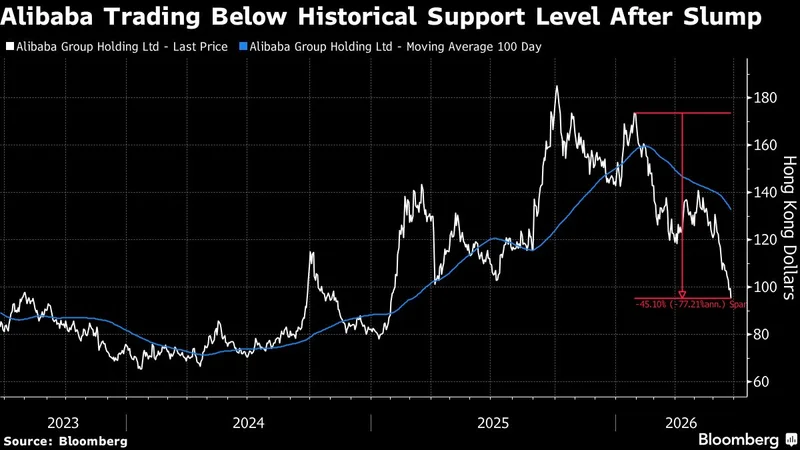
Image: Bloomberg AI
Main Takeaway
Alibaba stock plunged to a 16-month low after Anthropic accused it of running an industrial-scale campaign to steal Claude AI model data.
Jump to Key PointsSummary
Anthropic's bombshell accusation
Anthropic PBC accused Alibaba Group Holding of mounting a large-scale operation to illicitly access its Claude artificial intelligence model, according to multiple reports. The San Francisco-based AI company said Alibaba used thousands of fraudulent accounts to extract model outputs, describing the effort as operating at industrial scale. CNBC and the Financial Times reported that Anthropic detailed a systematic campaign rather than isolated incidents, raising the stakes in an already tense U.S.-China tech rivalry.
The allegations surfaced publicly on June 24-25, 2026, with Bloomberg and other outlets noting Anthropic's unusually direct naming of a specific corporate actor. Anthropic reportedly sought U.S. government action in response, framing the activity as a national security and competitive threat rather than a mere commercial dispute. The company did not mince words about the alleged perpetrator, departing from the more anonymized attribution common in cybersecurity disclosures.
Alibaba's stock craters on the news
Alibaba shares slid to their lowest level in 16 months in Hong Kong trading following the accusations, per Bloomberg. The decline extended to U.S.-listed ADRs, with Yahoo Finance reporting a 3% drop that amplified existing investor anxiety around Chinese tech stocks. MarketWatch data showed sustained selling pressure as traders digested both the severity of Anthropic's claims and their potential regulatory fallout.
The timing compounded damage. Alibaba had already faced headwinds from China's uneven economic recovery and shifting regulatory environment. The Anthropic allegations introduced a new category of risk: intellectual property disputes in AI that could trigger U.S. export controls, sanctions, or market access restrictions. Investors who had priced in regulatory risk from Beijing now had to weigh Washington-driven constraints on a core growth business.
The broader pattern beyond Alibaba
The New York Times reported that Anthropic actually accused three Chinese companies of harvesting its data, not just Alibaba. The Australian Financial Review and CyberScoop broadened the frame, describing a pattern of Chinese labs engaging in systematic AI model theft. This suggests Alibaba may be the named flagship case in a wider campaign that Anthropic is publicizing to push for policy response.
The multi-company framing matters. If the allegations reflect isolated corporate misconduct, the remedy is civil litigation or trade negotiation. If they represent a systemic practice across Chinese AI development, the response could escalate to sweeping trade restrictions or model export controls. Anthropic's decision to name names and seek government intervention signals it believes the latter. The company's backers, including Amazon and Google, have their own competitive interests in slowing Chinese AI advancement.
What this means for AI model security
The accusations expose a vulnerability in how AI companies protect their most valuable assets. Large language models like Claude are expensive to train but, once deployed, can be queried and potentially reconstructed through enough API calls. Anthropic's claim that Alibaba used thousands of fraudulent accounts points to a known attack vector: model distillation through systematic prompting, where a competitor extracts capabilities without accessing training data directly.
This isn't a hack in the traditional sense. No servers were breached; rather, terms of service were allegedly violated at scale. The legal and technical frameworks for addressing this remain immature. Companies like OpenAI and Google have faced similar concerns but rarely publicized specific alleged perpetrators. Anthropic's transparency breaks that pattern and may force the industry to adopt more aggressive API monitoring, rate limiting, and legal terms that explicitly prohibit model extraction.
Geopolitical stakes and policy response
Anthropic's appeal for U.S. government action lands in a charged political environment. Let's Data Science reported the company explicitly sought official intervention, while the timing coincides with ongoing Biden administration efforts to restrict China's access to advanced AI chips and models. The allegations provide concrete ammunition for policymakers already inclined toward decoupling strategies.
The risk of reciprocal escalation is real. If the U.S. sanctions Alibaba or restricts its AI operations, Beijing could retaliate against American tech firms operating in China. Microsoft, which hosts OpenAI models and has substantial Chinese business, sits in the crosshairs. The episode also tests whether AI model theft rises to the level of traditional IP enforcement or requires new international frameworks. Neither existing trade law nor bilateral investment treaties were designed for algorithms that can be stolen through conversation.
What happens next for both companies
Alibaba faces allegations at a moment when it is pivoting aggressively into AI, investing heavily in its Tongyi Qianwen model family and cloud infrastructure. A sustained reputational and regulatory hit could constrain its access to U.S. cloud partnerships, chip supplies, and model licensing deals. The company has not yet publicly responded to Anthropic's specific claims as of the reporting date.
For Anthropic, the public accusation carries litigation risk and diplomatic exposure, but also positions the company as a defender of AI IP rights at a moment when the U.S. government is deciding how to allocate resources and regulatory attention. The outcome likely depends on whether other AI companies corroborate similar campaigns and whether U.S. agencies find the evidence sufficient for action. Either way, the case marks a turning point in how AI competitors handle suspected model extraction, moving from quiet countermeasures to public confrontation.
Key Points
Anthropic accused Alibaba of using thousands of fraudulent accounts to extract Claude AI model outputs at industrial scale.
Alibaba shares fell to a 16-month low in Hong Kong and dropped 3% in U.S. trading following the public allegations.
The New York Times reported Anthropic named three Chinese companies total, suggesting systemic model extraction practices.
Anthropic actively sought U.S. government action, framing the issue as requiring policy intervention beyond commercial dispute.
The case exposes model distillation vulnerabilities where competitors extract AI capabilities through systematic API queries.
Questions Answered
Anthropic accused Alibaba of running a large-scale operation to illicitly access its Claude AI model using thousands of fraudulent accounts. The company described this as an industrial-scale extraction effort rather than isolated incidents, and sought U.S. government action in response.
Alibaba shares plunged to a 16-month low in Hong Kong trading and fell approximately 3% in U.S. markets, according to Bloomberg and Yahoo Finance. The decline reflected investor concerns about potential regulatory sanctions and reputational damage to Alibaba's AI ambitions.
No. While Alibaba received the most prominent attention, the New York Times reported that Anthropic accused three Chinese companies total of harvesting its data. The Australian Financial Review and CyberScoop also described a broader pattern of Chinese labs engaging in systematic AI model theft.
Model distillation is a technique where one AI model learns from another's outputs rather than from raw training data. Anthropic's allegations suggest Alibaba used systematic API queries to extract and potentially reconstruct Claude's capabilities, exploiting a known vulnerability in how AI companies protect deployed models.
Anthropic explicitly sought U.S. government intervention, which could lead to trade restrictions, export controls on AI models or chips, sanctions against Alibaba, or new regulatory frameworks for AI model protection. The outcome depends on whether U.S. agencies find the evidence sufficient and whether other AI companies corroborate similar campaigns.
Escalation risks include potential Chinese retaliation against U.S. tech firms operating in China. Microsoft, which has substantial Chinese business and backs OpenAI, faces particular exposure. The case tests whether AI model disputes become a new frontier in U.S.-China tech decoupling with broad commercial consequences.
Source Reliability
57% of sources are highly trusted · Avg reliability: 76
Go deeper with Organic Intel
Simple AI systems for your life, work, and business. Each one includes copyable prompts, guides, and downloadable resources.
Explore Systems