A Bezos-backed startup thinks your video game data holds the secret to AGI and smarter robots
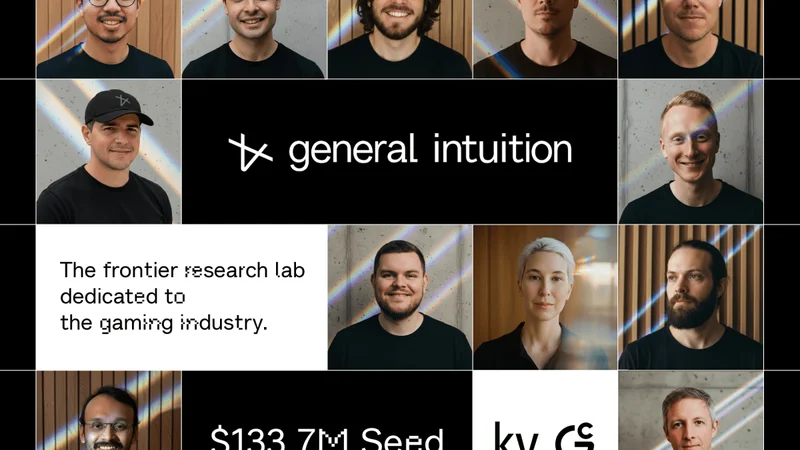
Image: TechCrunch AI
Main Takeaway
General Intuition raised $320 million at a $2.3 billion valuation to train physical AI foundation models using millions of hours of gaming data instead.
Jump to Key PointsSummary
The bet on gaming data over internet text
General Intuition, a New York startup backed by Jeff Bezos, just closed a $320 million funding round at a $2.3 billion valuation. Coatue, Eric Schmidt, and researchers from MIT and Google DeepMind joined the investor list. The company's core thesis is blunt: large language models trained on internet text don't understand how objects move through physical space and time, and that gap is what separates today's chatbots from genuine artificial general intelligence.
CEO Pim de Witt argues that millions of hours of video game data can fill that void. Games capture physics interactions, spatial navigation, and cause-and-effect sequences that text corpora simply cannot represent. On TechCrunch's Equity podcast, de Witt explained that gaming data offers a structured, richly labeled environment where agents learn intuitive physics, a prerequisite for intelligence that generalizes across the real world. The company is betting this approach gives embodied AI its own foundation model moment, analogous to what GPT-3 did for language.
Why robotics needs its ChatGPT moment
Before GPT-3, companies built specialized natural language processing models from scratch, training each on task-specific data. That fragmented approach collapsed once general-purpose foundation models arrived. De Witt sees the same pattern looming for physical AI. Robotics companies today collect enormous real-world datasets for each specific machine and task. General Intuition wants to replace that with a single foundation model trained on gaming data that transfers intuition about movement and interaction across any environment.
A lot of companies right now are doing lots of specialized work focused on individual robots and narrow tasks, de Witt told TechCrunch. He contends the industry should redirect effort toward higher-quality datasets that produce models capable of broad generalization. The pitch is that a robot trained primarily in simulated game worlds will need minimal real-world fine-tuning to operate in factories, homes, or warehouses. This mirrors how developers now start with GPT or Claude and prompt-engineer for specific use cases rather than training language models from scratch.
Bezos Expeditions ramps up its AI dealmaking
The General Intuition investment is part of a broader acceleration by Bezos Expeditions, the Amazon founder's family office. According to exclusive data from private wealth intelligence platform Fintrx, Bezos made five direct startup investments in June alone, representing 10 percent of all family office dealmaking that month. Bezos Expeditions is now the most active family office investor year-to-date.
CNBC reports that Bezos's summer push spans multiple AI bets. The pattern signals a conviction that AI infrastructure and novel training approaches represent the next major platform shift. General Intuition's gaming-data thesis fits squarely within that thesis: it's a bet on a new data modality that could unlock capabilities text-based models cannot reach. The round's size and the caliber of co-investors suggest institutional confidence that physical AI needs its own training paradigm, not just larger language models.
The AGI definition debate complicates the narrative
General Intuition's framing leans heavily on AGI as a destination, but the term remains notoriously slippery. Nvidia CEO Jensen Huang claimed in a March interview on the Lex Fridman podcast that AGI has already been achieved, then immediately qualified the statement by noting it depends entirely on definition. Fridman proposed a concrete benchmark: an AI that can do Huang's job, launching and running a tech company worth over a billion dollars. Huang said that capability exists now, pointing to AI systems that can already perform many CEO-like analytical and strategic tasks.
Yet Huang's claim is less a declaration of arrival than a commentary on the term's ambiguity. If AGI means human-level performance on economically valuable work, we're close. If it means a system that understands physical causality and can transfer skills across embodied domains, that's precisely the gap General Intuition is trying to close. The contrast highlights why gaming data matters: text-trained models ace boardroom analysis but fail at intuiting how a cup falls off a table.
What this means for robotics developers
If General Intuition's approach works, the economics of building physical AI shift dramatically. Robot makers currently spend months collecting and labeling real-world sensor data for each new machine. A gaming-trained foundation model would let them start with a system that already understands object permanence, gravity, friction, and spatial relationships. Fine-tuning for a specific arm or warehouse layout becomes a lightweight step rather than the entire project.
This also opens the door for smaller robotics startups that can't afford massive data collection operations. The parallel to language AI is instructive: GPT-3 democratized access to capable language models, spawning thousands of applications that would have been impossible if every team had to train from scratch. General Intuition is selling the same democratization story for the physical world. The $320 million round gives it runway to build that foundation model and prove the transfer learning thesis with partner robots.
The competitive landscape and what comes next
General Intuition isn't alone in chasing physical AI, but its gaming-data angle is distinct. Most competitors focus on scaling real-world robot data or using synthetic data generated by physics simulators. The gaming approach taps an existing, massive, and cheap data source: millions of hours of recorded gameplay with rich interaction logs. The company has not disclosed which game publishers it's working with or how it handles the intellectual property questions around using commercial game data for AI training.
The next milestone will be demonstrating a model that transfers gaming-learned intuition to a physical robot performing a task it was never explicitly trained on. De Witt's team has 150 people and offices in San Francisco, London, and Zurich, per Bezos's own comments about the portfolio. With Coatue and Schmidt involved, pressure to ship a convincing demo is high. The broader AI industry is watching to see whether gaming data becomes the next essential training corpus, the way web text and code repositories defined the language model era.
Key Points
General Intuition raised $320 million at a $2.3 billion valuation to train physical AI on gaming data instead of real-world footage.
CEO Pim de Witt argues video games capture physics and spatial reasoning that text-trained language models fundamentally lack.
Bezos Expeditions made five AI startup investments in June, becoming the most active family office investor this year.
The approach mirrors GPT-3's impact on language AI, aiming to replace task-specific robot training with a general-purpose foundation model.
Nvidia CEO Jensen Huang separately claimed AGI has already been achieved, highlighting the term's definitional ambiguity.
Questions Answered
General Intuition is a New York-based AI startup valued at $2.3 billion that believes video game data can train foundation models for physical AI and robotics. The company argues that gaming data captures spatial reasoning and intuitive physics that text-trained models cannot learn, making it a better training corpus for embodied intelligence.
General Intuition closed a $320 million funding round with investors including Coatue, Eric Schmidt, and researchers from MIT and Google DeepMind. Jeff Bezos's family office, Bezos Expeditions, is also a backer, as part of a broader push where Bezos made five AI startup investments in June alone.
CEO Pim de Witt argues that large language models trained on text are skilled at language but lack understanding of how objects move through space and time. Video games contain millions of hours of recorded physics interactions, spatial navigation, and cause-and-effect sequences that teach the intuitive physics essential for intelligence that generalizes to the real world.
Nvidia CEO Jensen Huang claimed in a March 2026 podcast that AGI has already been achieved, but immediately qualified that it depends entirely on how AGI is defined. General Intuition's thesis targets the specific gap Huang's claim sidesteps: physical reasoning and embodied intelligence that text-based models still lack.
Instead of collecting massive real-world datasets for each specific robot and task, developers would start with a gaming-trained foundation model that already understands gravity, friction, and spatial relationships. They would then fine-tune it for specific environments, dramatically reducing the cost and time required to build capable physical AI systems.
Source Reliability
40% of sources are highly trusted · Avg reliability: 74
Go deeper with Organic Intel
Simple AI systems for your life, work, and business. Each one includes copyable prompts, guides, and downloadable resources.
Explore Systems