Wayve CEO Says Tesla Is Following His AI-First Approach to Self-Driving
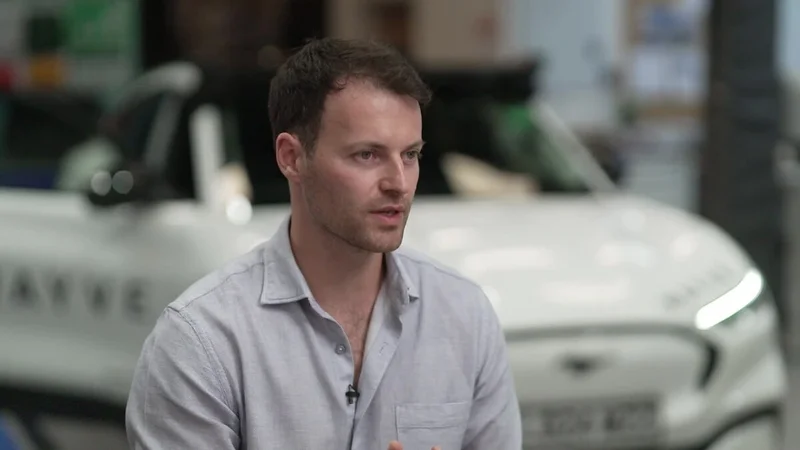
Image: Bloomberg AI
Main Takeaway
Alex Kendall claims Wayve's end-to-end AI model beats Waymo's rule-based stack and predicts licensing deals will spread autonomous tech faster than robotaxis.
Jump to Key PointsSummary
The pivot that made Musk a believer
Alex Kendall says Elon Musk once told him end-to-end neural nets "would never work" for cars. That conversation happened years ago. Now Tesla's FSD v12 ships with exactly that architecture. Kendall couldn't resist the jab: "I told you so," he told Bloomberg this week.
The irony runs deeper. Wayve, a London startup backed by SoftBank, Microsoft and Nvidia, started with the pure AI approach Tesla just adopted. While Waymo maps every curb in Phoenix and Cruise burns cash on human safety drivers, Wayve trains one model on London, Boston and Pittsburgh data, then drops it into new cities cold. Same neural net, no hand-coded rules.
Kendall frames this as autonomous driving 2.0. Version 1.0 was robotics: lidar, HD maps, explicit programming. Version 2.0 is pure machine learning. The car watches YouTube-scale driving footage, learns to predict what humans do next, then acts. No ontology of stop signs. Just pattern matching at superhuman resolution.
How Wayve's model actually works
Most self-driving stacks break the world into pieces: perception finds objects, prediction guesses their paths, planning picks a route, control steers. Each module speaks a different language. Wayve bolts these into one transformer that eats pixels and spits steering angles.
Training happens on 1,000+ cars already on UK roads. They drive normally, collecting edge cases. When the AI hesitates at a tricky roundabout, human intervention teaches it the right move. The model updates overnight. Next morning, every Wayve car handles that roundabout better.
This approach scales differently. Traditional stacks need fresh maps for each city. Wayve's neural net generalizes. Kendall claims they can deploy in a new city with 10x less data than Waymo needs for a single neighborhood. The key is diversity: train on chaotic London traffic, and Boston feels easy.
The licensing play that beats robotaxis
While Waymo builds a taxi empire and Tesla sells premium cars, Wayve wants to be the Android of autonomy. Kendall sees licensing as the fastest path to ubiquity. Car makers get Wayve's AI as software. No custom sensors, no mapping crews, just download the model.
This flips the economics. Robotaxis need 100% reliability and regulatory approval in every city. Licensed AI only needs to beat human drivers. That's a lower bar, and regulators move faster when existing automakers ask permission instead of new mobility companies.
SoftBank's $1.05B Series C, announced this week, funds this licensing push. The money scales cloud training and builds sales teams for Detroit, Seoul and Munich. Kendall won't name deals yet, but says conversations with major OEMs are "very advanced."
Why Tesla and Waymo are both wrong
Kendall positions Wayve between two extremes. Tesla's approach is pure but hardware-limited. Their cameras see fine in California sun, struggle in London fog. Waymo's approach is safe but brittle. Hand-coded rules break when construction crews repaint lanes.
Wayve splits the difference. They use cameras plus cheap radar, no lidar. The AI learns weather patterns instead of programming around them. In snow, the model learned that tire tracks show where pavement actually sits. No engineer wrote that rule. The data did.
The real bet is computational. Wayve trains on thousands of GPUs, then compresses the model to run on a single car's computer. It's the same trick that made ChatGPT possible: massive training, efficient inference. Tesla now chases this balance. Waymo doesn't.
The regulatory wildcard
UK regulators wrote the first autonomous vehicle law with Wayve's help. The Automated Vehicles Act, passed last year, creates a path for AI systems that learn continuously. US rules lag, but Europe follows the UK's lead. That's why Wayve stayed in London instead of moving to Silicon Valley.
The licensing model sidesteps another problem. When an OEM's Wayve-powered car crashes, liability flows to the automaker, not the AI startup. Traditional robotaxi companies own every accident. Kendall calls this "the Intel model" - they make the chip, Dell owns the support calls.
China's the real prize. Local regulations favor domestic players, but Wayve's software-only approach could slip through partnerships. No factory footprint, no data center, just code. Kendall hints they're exploring joint ventures with Chinese automakers already shipping to Europe.
What happens next
Wayve plans 10,000 cars on UK roads by 2027. That's tiny compared to Tesla's fleet, but each car trains the global model. Kendall's target: make Wayve AI standard on mid-tier cars by 2030. Think Honda Accord, not Mercedes S-Class.
The technical roadmap points to full autonomy, but staged carefully. First: highway driving with human oversight. Then: complex city centers. Finally: door-to-door trips with no safety driver. Each stage unlocks new licensing revenue from different car segments.
The wild card is compute cost. Training these models burns millions in GPU time. Wayve's betting that falling hardware prices and better algorithms keep them ahead of traditional stacks. If they're right, every car gets safer as the cloud model improves. If they're wrong, Waymo's mapping trucks start looking cheap.
The broader AI lesson
Wayve's story mirrors what happened in language models. Rule-based translation died when neural nets learned to predict next words. Computer vision followed. Now it's driving's turn. The pattern is consistent: when AI eats a domain, it starts with weird edge cases, then becomes obviously better.
Kendall's insight isn't technical. It's strategic. Don't fight the old rules. Change the game so old rules don't apply. That's why Musk had to pivot. That's why Waymo might need to license competitors' AI. The companies still writing if-then statements for stop signs are already obsolete. They just don't know it yet.
Key Points
Wayve's end-to-end AI approach eliminates hand-coded rules, matching Tesla's new FSD v12 architecture
Licensing model could spread autonomous tech faster than robotaxis by selling AI as software to OEMs
Training on diverse global cities (London, Boston, Pittsburgh) enables zero-shot deployment in new locations
SoftBank's $1.05B investment funds licensing push to major automakers across US, Europe and Asia
UK's Automated Vehicles Act creates regulatory framework favoring continuously learning AI systems
Questions Answered
Wayve uses pure end-to-end neural networks like Tesla's latest approach, but trains on more diverse global data. Unlike Waymo's rule-based system requiring expensive lidar and HD maps, Wayve's AI learns from camera and radar data alone, enabling faster scaling to new cities.
While Wayve hasn't announced deals, CEO Alex Kendall says conversations with major OEMs are "very advanced." The licensing model targets mid-tier vehicles from manufacturers like Honda, Hyundai and Ford rather than premium brands.
Wayve follows the "Intel model" - they provide the AI software while automakers own customer support and liability. This contrasts with robotaxi companies like Waymo that absorb all accident responsibility.
UK regulators wrote the Automated Vehicles Act with Wayve's input, creating the world's first regulatory framework for continuously learning AI systems. This gives Wayve a regulatory advantage before expanding to other markets.
Wayve targets 10,000 cars on UK roads by 2027 as part of phased rollout. Full consumer availability through OEM partners is planned for 2030, starting with highway driving assistance and expanding to full autonomy.
Source Reliability
31% of sources are trusted · Avg reliability: 70
Go deeper with Organic Intel
Simple AI systems for your life, work, and business. Each one includes copyable prompts, guides, and downloadable resources.
Explore Systems