Warsh Tells Senate: Inflation Is a Choice, Fed Independence Is Non-Negotiable
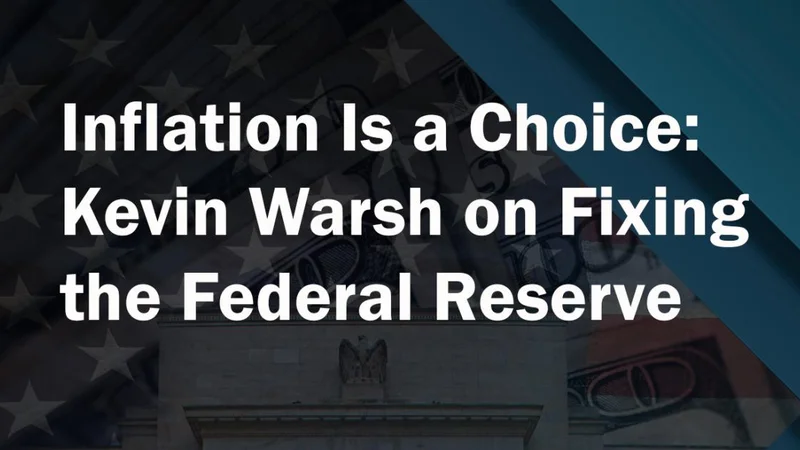
Image: Hoover
Main Takeaway
Trump's Fed nominee Kevin Warsh refuses to promise rate cuts, frames inflation as deliberate policy failure, and vows central bank independence despite.
Jump to Key PointsSummary
The core message: inflation is a choice, not an accident
Kevin Warsh walked into the Senate Banking Committee hearing with a clear message: inflation doesn't just happen. According to Fortune, he told lawmakers point-blank that "inflation is a choice" and that the central bank must take "full responsibility for it, ensuring price stability without excuse or equivocation." This framing positions recent price surges as deliberate policy failures rather than external shocks, a stance that puts him at odds with the current Fed narrative.
His prepared testimony, obtained by multiple outlets including Fox Business and Politico, doubled down on this theme. Warsh argued that the Fed's post-pandemic decisions created the inflationary mess America still faces. This isn't just rhetoric - it's a direct challenge to the monetary policy establishment that has argued inflation was transitory or supply-driven.
The implications are stark. If inflation is indeed a choice, then controlling it requires different choices. This suggests a potentially more hawkish stance than markets currently expect, especially given Trump's public pressure for rate cuts.
Independence with accountability: threading the political needle
Warsh's pledge on Fed independence walks a careful line. He told senators that "monetary policy independence is essential" while adding that this independence depends on "discipline, not politics." According to his prepared remarks reviewed by Washington Examiner, he stated clearly that opinions from presidents or lawmakers about interest rates don't actually threaten the Fed's operational independence.
This creates an interesting dynamic. While Warsh thanked Trump for his nomination - a move Fortune notes could ruffle feathers - he simultaneously rejected any notion that he'd take marching orders from the White House. His stance: political pressure is a test of independence, not a constraint on it.
The message seems designed to reassure senators worried about Trump's influence while not alienating the president who nominated him. It's a delicate balance that recognizes the reality of political pressure while asserting institutional autonomy.
The wealth factor: richest Fed chair ever?
Warsh's personal fortune has become an unexpected flashpoint. AOL reports his disclosed assets range from $135 million to $226 million, which would make him the wealthiest Fed chair in history. These holdings include significant investments in financial sector companies that the Fed directly regulates.
The optics are challenging. A central banker worth hundreds of millions arguing for tighter monetary policy while holding assets that benefit from specific Fed decisions creates inherent conflicts. His financial disclosures reveal extensive holdings in banking stocks, private equity, and hedge funds - exactly the entities most affected by Fed policy.
This wealth concentration raises questions about both perception and policy. Can someone with such extensive Wall Street ties credibly argue for policies that might hurt his own portfolio? The Senate will need to weigh his expertise against these obvious conflicts.
Rate cut gymnastics: squaring the circle
Despite Trump's public demands for lower rates, Warsh's actual stance appears more nuanced. Fortune's analysis suggests he's performing "complex economic gymnastics" to potentially justify rate cuts - but only under specific conditions. His argument: "in a way, one can afford a lower interest rate with a smaller balance sheet."
This creates a theoretical framework where rate cuts become possible, but only after the Fed significantly reduces its $7+ trillion balance sheet. It's a hawkish dove position - cuts might come, but only after substantial tightening through quantitative tightening.
The market implications are significant. Traders expecting immediate rate cuts based on Trump's pressure may be disappointed. Warsh seems to be signaling that any easing would come with strict preconditions, likely pushing actual cuts further into the future than current market pricing suggests.
What happens next: confirmation math and market implications
Confirmation isn't guaranteed. While Republicans praise him as "battle-tested" and ready for his "finest hour," Democrats led by Elizabeth Warren have labeled him a "sock puppet" for Trump and Wall Street. The Senate Banking Committee vote will likely split along party lines, making every Republican vote crucial.
The timeline matters. Markets are pricing in Fed cuts starting mid-2025, but Warsh's testimony suggests a more patient approach. His emphasis on inflation control over political accommodation could force a repricing of rate expectations across asset classes.
Most importantly, Warsh's framing of inflation as policy choice rather than external circumstance could fundamentally shift how markets interpret Fed communications. If he becomes chair, every inflation reading will be seen as a direct reflection of Fed choices - making the central bank even more politically vulnerable than it already is.
Key Points
Warsh explicitly states "inflation is a choice" and that the Fed must take full responsibility without excuses
Despite Trump demanding rate cuts, Warsh refuses to commit and instead emphasizes preconditions including balance sheet reduction
His personal wealth of $135-226 million would make him the richest Fed chair ever, creating potential regulatory conflicts
Confirmation faces sharp partisan divide with Democrats calling him a "sock puppet" while Republicans praise his readiness
Markets pricing in mid-2025 rate cuts may need to adjust expectations given Warsh's hawkish preconditions
Questions Answered
No. Warsh's prepared testimony explicitly refuses to promise rate cuts, instead arguing they might only be possible after substantial balance sheet reduction.
Warsh's disclosed assets of $135-226 million would make him the wealthiest Fed chair in history, far exceeding previous chairs' net worth.
He argues inflation results from deliberate Fed policy decisions rather than external shocks, making the central bank fully accountable for price stability.
His hawkish stance could force markets to push back rate cut expectations from mid-2025 to later dates, potentially impacting bond yields and equity valuations.
Source Reliability
40% of sources are established · Avg reliability: 58
Go deeper with Organic Intel
Simple AI systems for your life, work, and business. Each one includes copyable prompts, guides, and downloadable resources.
Explore Systems