Trump-Xi Summit Brings AI Rivalry, Chip Controls and Safety Talks to Center Stage
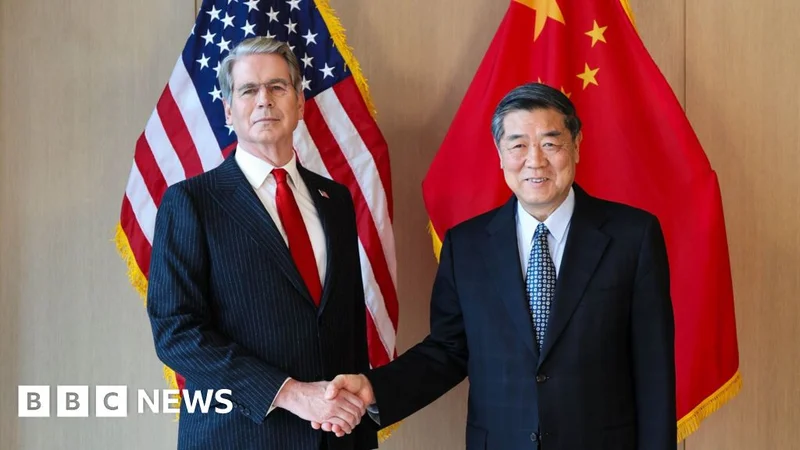
Image: Bbc
Main Takeaway
Donald Trump and Xi Jinping will discuss AI as Washington and Beijing weigh chip restrictions, supply-chain risks and a proposed mechanism for reporting dangerous incidents.
Jump to Key PointsSummary
AI moves to the summit’s center
Artificial intelligence will be a major issue when President Donald Trump and Chinese President Xi Jinping meet at the White House on Sept. 24. Washington and Beijing treat AI leadership as a source of economic strength, military advantage and national influence, making the technology a thread connecting trade, semiconductors, national security and industrial policy.
The summit agenda also includes tariffs, Taiwan, rare-earth minerals and supply chains. AI links each dispute to the others because advanced models depend on computing hardware, energy, data centers and specialized manufacturing. The meeting follows earlier Trump-Xi talks in which trade received more attention than AI, a reminder that public summit agendas don't always match the strategic weight of an issue.
Chips remain the main bargaining chip
Advanced semiconductors are the clearest point of conflict between the United States and China. Washington has restricted China's access to high-end chips and manufacturing technology, while Beijing is pushing domestic alternatives, including Huawei's effort to build a competing AI-chip ecosystem. Hardware controls therefore function as both trade measures and limits on military and commercial development.
The rivalry also exposes mutual dependence. Taiwan's semiconductor manufacturing and supplier network remain central to global AI production, giving the Taiwan Strait direct importance for American technological leadership. Any disruption would affect chip availability, AI companies and the broader electronics industry, while Chinese progress in domestic hardware would reduce the effect of US restrictions over time.
Safety talks test cooperation
US and Chinese officials have discussed creating a notification mechanism for AI incidents that could affect national security, Treasury Secretary Scott Bessent said after talks in New York. The proposal would give the 2 countries a channel for communicating about serious failures or dangerous behavior even as they compete over chips, models and military applications.
The safety discussion offers a narrower area for cooperation than a broad AI agreement. Analysts cited by The Christian Science Monitor put the chance of a comprehensive deal at a low level, while NPR described unofficial “Track Two” conversations as active. The challenge is trust: each government sees the other as a strategic competitor, and information about advanced systems can carry intelligence value.
The race carries security risks
The AI contest extends beyond commercial rankings. US officials view access to advanced computing as tied to defense capabilities, while Chinese investment in domestic chips and models reflects the same connection between technology and national power. That framing raises the cost of compromise because export controls can be presented as security safeguards in Washington and technological containment in Beijing.
The competition also creates pressure to accelerate development. Trump has argued that the United States must stay ahead of China, while technology leaders including Dario Amodei, Sam Altman and Elon Musk have raised concerns about the risks of moving too quickly. Their disagreement reflects a central tension around the summit: national competition rewards speed, while AI safety requires testing, disclosure and restraint.
Taiwan raises the stakes
Taiwan's role in AI manufacturing makes cross-strait stability a central concern for both governments. The island's supply-chain ecosystem supports the production of advanced chips used throughout the AI industry, so a crisis would affect US competitiveness, Chinese access to technology and companies worldwide.
That dependency gives semiconductor policy a geopolitical dimension that reaches well beyond tariffs. Washington must protect access to critical manufacturing while managing escalation with Beijing, and China has incentives to develop substitutes for foreign hardware and reduce exposure to Taiwan-linked production. The summit cannot resolve those structural pressures, but its handling of Taiwan, chips and technology controls will shape the risk environment for AI investment.
What happens after the meeting
The most credible near-term outcome is limited coordination rather than a sweeping settlement. The 2 governments can establish communication around serious AI incidents, keep technical discussions open and seek tactical trade concessions while leaving the core chip rivalry intact. A joint statement on safety would matter because it would create a diplomatic channel during a period of rapid deployment.
The larger contest will continue through export rules, domestic subsidies, model development and semiconductor manufacturing. Businesses will watch for changes to chip access and supply chains, while researchers and policymakers will look for evidence that safety talks produce operating procedures rather than summit language. AI has become a permanent part of US-China diplomacy, whether or not it dominates the public readout.
Key Points
Donald Trump and Xi Jinping will make AI a central issue in September 24 summit discussions.
US-China chip restrictions remain the main obstacle to broader technology cooperation and AI coordination.
Taiwan’s semiconductor ecosystem links AI competition directly to supply-chain and geopolitical risks.
US and Chinese officials discussed notifying each other about AI incidents affecting national security.
A comprehensive bilateral AI agreement remains unlikely, while limited safety channels remain possible.
Questions Answered
Donald Trump and Xi Jinping will discuss AI because both governments view leadership in artificial intelligence as central to economic and military power. The issue also connects to chips, trade, national security and supply chains.
The main disputes involve advanced semiconductor access, export controls, technology copying allegations and domestic chip production. Taiwan’s role in manufacturing and AI safety are also part of the wider strategic conflict.
The United States and China discussed a notification mechanism for AI incidents that could affect national security. Treasury Secretary Scott Bessent described the idea, but the meeting had not produced a comprehensive AI agreement.
Taiwan affects the US-China AI race because its semiconductor manufacturing ecosystem supplies critical hardware for advanced computing. A disruption in the Taiwan Strait would threaten AI production, supply chains and technological leadership.
The US-China AI rivalry will continue through chip controls, domestic semiconductor investment, model development and safety negotiations. The most immediate outcome is expected to be limited communication rather than a broad settlement.
Source Reliability
62% of sources are highly trusted · Avg reliability: 78
Go deeper with Organic Intel
Simple AI systems for your life, work, and business. Each one includes copyable prompts, guides, and downloadable resources.
Explore Systems