Tim Cook’s Final Earnings Call Shows Apple’s AI Strategy Doesn’t Need the Biggest Models to Win
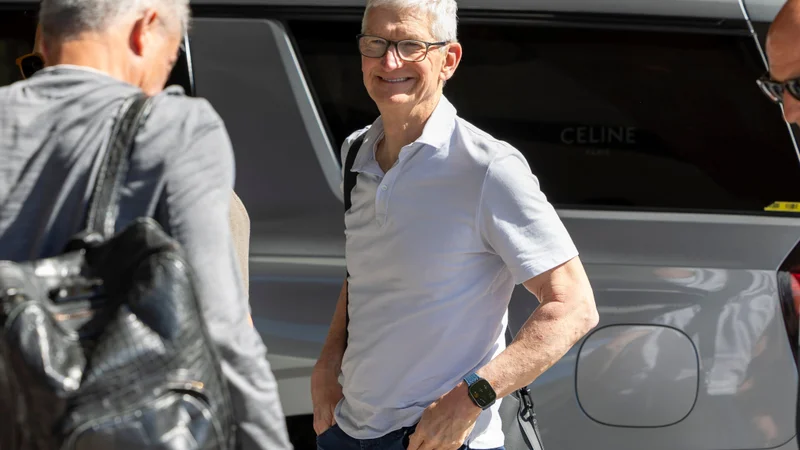
Image: Cnbc
Main Takeaway
In his last earnings call as CEO, Tim Cook framed Apple's on-device hybrid AI as a competitive weapon that will drive iCloud subscriptions, even as supply constraints and a China slowdown sent the stock down 6% after hours.
Jump to Key PointsSummary
How Tim Cook defined Apple’s AI advantage on his way out
Tim Cook used his final earnings call as Apple’s CEO to frame the company’s hybrid artificial intelligence strategy as a direct competitive advantage over rivals who depend on massive cloud infrastructure. Cook, who transitions to executive chairman on September 1, told analysts the ability to process AI requests on-device is a strategic and competitive weapon, according to CNBC. That local processing capability isn't just a privacy feature anymore. It's the economic engine for a new subscription tier.
Cook explicitly connected on-device AI to iCloud monetization. He told investors the company sees enormous opportunities ahead and plans to use AI as a selling point for iCloud subscriptions. We do believe there will be people that want to use it a lot, and so we will have some kind of upgrade possibilities on iCloud+, Cook said, as reported by CNBC. The framing ties hardware capability directly to recurring services revenue, a model Apple has perfected over the past decade.
Why Apple skipped the infrastructure arms race
Fortune’s analysis points out that Apple briefly crossed $5 trillion in market value this week, becoming only the second company in history to hit that milestone, less than a year after first surpassing $4 trillion. The valuation surge reflects a market that increasingly rewards durable business models over speculative infrastructure spending. Apple’s approach sidesteps the capital-intensive race to build ever-larger foundation models, relying instead on a hybrid system that processes AI requests locally on its silicon.
Boardroom notes that at WWDC earlier this summer, Apple unveiled plans to revamp Siri with help from Google Gemini alongside new AI tools for iOS, macOS, and iPadOS. The stock dipped after that announcement, but the broader thesis holds: Apple doesn't need to own the largest model. It needs to own the interface where hundreds of millions of users encounter AI daily. That interface is Siri, and it runs on iPhones, not server farms.
The supply chain warning that spooked investors
Apple beat Wall Street estimates on both revenue and profit for its fiscal third quarter, but the stock tumbled 6% in after-hours trading after Cook warned of very significant supply constraints, Business Insider reports. Memory chip costs, driven by the AI boom’s insatiable demand, are squeezing margins. Apple already raised prices on Macs and iPads last month, citing an unprecedented challenge for the consumer electronics industry, according to Fortune.
China revenue also disappointed, coming in at $18.8 billion, below analyst expectations. Services growth slowed alongside the iPad segment, both missing Street estimates. The combination of supply chain pressure and regional softness overshadowed what was otherwise a record quarter, with strong iPhone and MacBook sales pushing total revenue past consensus.
How human-centered framing shaped the final Cook call
AppleMagazine captured a revealing strategic theme from the call: Cook deliberately placed Siri AI alongside new child safety features in his prepared remarks, rather than discussing artificial intelligence purely as a revenue driver. That pairing reflects the leadership philosophy Cook spent 15 years embedding into Apple, where technology is judged by what it does for people, the information it protects, and the communities it serves.
This human-centered framing isn't window dressing. It’s a direct counter-narrative to competitors whose AI strategies have been defined by model scale and cloud compute. Apple’s privacy positioning gives it a differentiated lane, one that regulators and consumers alike have grown more receptive to as data concerns mount. The message is clear: Apple’s AI will live on your device, know less about you, and still be useful enough to pay for.
What happens when Siri AI meets the subscription model
Cook’s comments point toward a future where Siri AI is not free for heavy users. The monetization path runs through iCloud+, which already anchors Apple’s services revenue machine. By positioning advanced AI features as a premium upgrade, Apple creates a recurring revenue stream tied to hardware that people already own, a far more predictable model than the enterprise API pricing wars playing out among cloud AI providers.
CNBC notes that Cook sees enormous opportunities in AI, and the iCloud upsell is just the first expression of that. The Siri AI launch later this year will test whether consumers will pay monthly for an intelligent assistant that works across their devices. If they do, Apple will have turned its device install base into a subscription funnel that no competitor can replicate without building their own phone.
What the leadership transition means for Apple’s AI roadmap
Cook steps down as CEO on September 1, handing the role to John Ternus. The transition comes at a pivotal moment, right as Siri AI is set to ship. Cook used his final earnings call to frame the AI opportunity not as a departure from Apple’s DNA, but as its natural extension. The message to investors is that the strategy is baked in, not dependent on any single leader.
Business Insider reports that Cook’s warning about supply constraints also serves as a handoff note to Ternus: the AI boom is creating real cost pressure that will require managing. The incoming CEO inherits a company with a $5 trillion valuation, a hybrid AI strategy that doesn’t compete on model size, and a supply chain stretched by the very industry Apple is positioning itself to profit from without building the biggest models.
Key Points
Apple CEO Tim Cook called the company's on-device AI processing a competitive weapon in his final earnings call before stepping down September 1.
Apple plans to monetize Siri AI through paid iCloud+ subscription upgrades rather than offering advanced features for free.
Apple stock dropped 6% after hours despite beating earnings, driven by supply chain warnings and slower China growth at $18.8 billion.
Fortune analysis shows Apple crossed $5 trillion in market value by skipping the AI infrastructure arms race its rivals are waging.
Cook framed Apple's AI strategy around human-centered values and child safety, not just competitive power or revenue potential.
Questions Answered
Tim Cook described Apple's hybrid on-device AI approach as a strategic competitive weapon that gives the company an advantage over cloud-dependent rivals. He also confirmed Apple will charge for AI capabilities through iCloud+ subscription upgrades.
Apple's stock fell 6% after hours because CEO Tim Cook warned of very significant supply chain constraints driven by memory chip shortages from the AI boom. Additionally, China revenue came in below expectations at $18.8 billion, and both the services and iPad segments missed Wall Street estimates.
Apple plans to use Siri AI as a selling point for iCloud+ subscriptions. Cook said there will be upgrade possibilities for people who want to use AI heavily, creating a recurring revenue stream tied to the device install base rather than relying on ad-supported or API-priced models.
No, Apple is not competing to build the largest AI models. The company's strategy relies on a hybrid approach that processes requests on-device using its own silicon, while also integrating models like Google Gemini for Siri. Fortune's analysis concludes Apple doesn't need to win the model-size race to win the AI market.
John Ternus will replace Tim Cook as Apple CEO on September 1, 2026. Cook will transition to the role of executive chairman, and the handoff comes just as Apple prepares to launch its revamped Siri AI experience to consumers.
Source Reliability
43% of sources are trusted · Avg reliability: 75
Go deeper with Organic Intel
Simple AI systems for your life, work, and business. Each one includes copyable prompts, guides, and downloadable resources.
Explore Systems