Socialism Reaches Record Favorability as Trump’s Red-Baiting Meets Changing American Economic Views
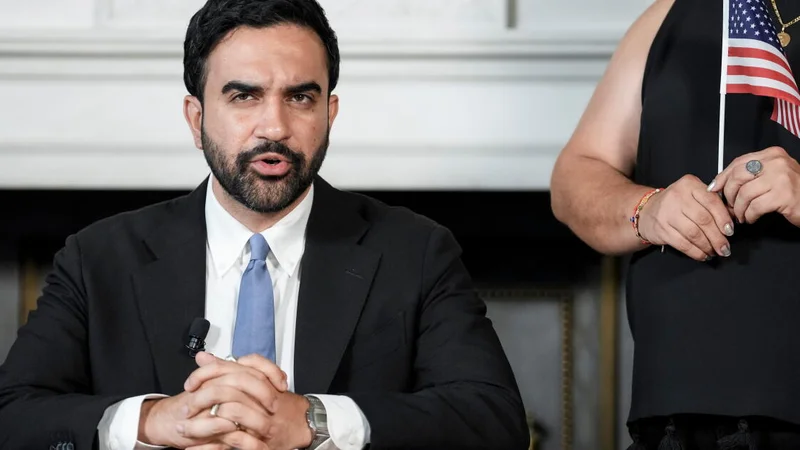
Image: Latimes
Main Takeaway
A record 43% of Americans view socialism favorably, Gallup found, as support for capitalism and free enterprise declines and Republican red-baiting loses force.
Jump to Key PointsSummary
Socialism reaches a new polling high
Socialism has reached its highest favorable rating in modern Gallup polling, with 43% of Americans expressing a positive view of the term. The figure, reported in September and October coverage, marks the first time support has exceeded 40% since Gallup began asking the question in 2010. The result places socialism inside the mainstream of American political debate, even as the word remains contested and many voters attach different meanings to it.
The shift is part of a broader movement in economic attitudes. Favorability toward capitalism, big business and free enterprise has weakened over the past decade, while younger Americans show greater openness to government-provided benefits and stronger public control over essential services. Gallup data cited by Fortune, U.S. News and the New York Post provide the central measure, while Truthout emphasizes the decline in capitalist principles.
What Americans mean by socialism
The 43% figure reflects approval of a political label, not uniform support for a single economic system. Americans have used “socialism” to describe state ownership, Scandinavian-style social democracy, expanded public benefits and policies such as universal health care. The term’s meaning has shifted since Gallup first measured it, when Cold War definitions were more closely tied to government control of industry and opposition to private enterprise.
That semantic change helps explain why favorable views can coexist with continued support for private businesses and markets. Fortune’s analysis points to younger voters who use socialism as shorthand for economic security, while U.S. News coverage connects the trend to the visibility of New York Mayor Zohran Mamdani and Sen. Bernie Sanders. The polling captures an attitude change, but it doesn't establish that a majority favors abolishing capitalism or nationalizing the economy.
Trump’s red-baiting strategy
Republican attacks on Democrats as communists, socialists or Marxists have become a central part of Donald Trump’s political messaging. Commentators describe the strategy as an effort to activate conservative fears of ideological takeover, particularly as Republicans campaign toward the midterm elections and Trump frames legal pressure against him as an attack on his supporters.
The approach draws on McCarthy-era political language, but its effectiveness faces a changed electorate. The Independent and its Yahoo News partner describe the campaign as a modernized Red Scare, while Politico argues that Trump revived the tactic after his federal indictment to connect his personal legal conflict with broader conservative grievances. The Los Angeles Times places the rhetoric in a historical frame, noting that communism has lost much of its former geopolitical force and that “communist” increasingly functions as a generalized political insult.
Why the backlash matters
The polling indicates that red-baiting no longer carries the automatic stigma it held during the Cold War. A growing share of voters hears “socialism” through the lens of housing costs, health care, wages and corporate power rather than through historical conflicts with the Soviet Union. That doesn't mean voters have abandoned markets, but it does mean Republican warnings require more explanation than a label alone.
The result also gives Democrats a complicated opening. Candidates can present public investment and stronger social programs as practical responses to household pressure, yet broad approval of socialism doesn't guarantee support for every policy promoted under that banner. The Independent’s discussion of Democratic gains in generic-ballot polling places the ideological shift alongside an unfavorable electoral environment for Republicans, while Truthout highlights dissatisfaction with business power and free enterprise.
The electoral test ahead
The midterm elections will show whether favorable views of socialism translate into votes, policy support or simply rejection of conservative attacks. Republican campaigns are using “communist takeover” warnings to motivate MAGA voters, while Democrats face pressure to turn economic frustration into a clear governing program. Polling cited by the Independent points to Democratic strength in several Senate contests, including traditionally Republican states, but those results remain separate from the national socialism measure.
Mamdani’s profile gives the debate a visible political figure, and Trump’s rhetoric keeps the issue in national headlines. The central contest is therefore over both policy and language: Republicans are trying to make socialism a warning, while Democrats and left-leaning voters increasingly treat it as a broad description of economic fairness. Gallup’s next readings and campaign results will reveal whether the record rating marks a durable realignment or a temporary response to economic and political dissatisfaction.
What the polling signals
The record rating signals a weakening cultural taboo around socialism, not a settled national mandate for a socialist economy. Americans are more receptive to the label because economic insecurity, corporate concentration and public-service costs have changed the debate. Capitalism remains deeply embedded in American life, but its political reputation has lost ground as voters assess who benefits from the current system.
For Republicans, repeated communist accusations risk sounding detached from voters who associate socialism with cheaper health care or stronger worker protections. For Democrats, the challenge is sharper: a popular label can attract attention, but voters still demand concrete policies and competent delivery. The 43% result matters because it changes the starting point of that argument.
[Source tags reflect the outlets whose reporting or analysis is integrated in each section.]
Key Points
Socialism reached a record 43% favorable rating among Americans in Gallup polling conducted in 2026.
American support for capitalism, big business and free enterprise has declined over the past decade.
Younger voters often associate socialism with social-democratic benefits rather than state ownership of industry.
Donald Trump’s communist accusations revive Red Scare rhetoric as midterm elections approach.
Democrats gain an opening on economic policy but must translate favorable labels into specific proposals.
Questions Answered
Gallup found that 43% of Americans view socialism favorably. That is the highest rating since Gallup began asking the question in 2010.
Socialism is gaining favor as voters connect it with health care, housing, wages, worker protections and economic security. Younger Americans also use the term to describe social-democratic policies rather than full state ownership of the economy.
Donald Trump is using communist, socialist and Marxist accusations to attack political opponents and mobilize conservative voters. Commentators describe the messaging as a revival of Red Scare rhetoric ahead of the midterm elections.
The Gallup poll does not show that Americans uniformly want to abolish capitalism. It measures favorable views of the word socialism, which voters use to describe several different policies and economic models.
The socialism polling could make Republican red-baiting less effective while giving Democrats room to emphasize economic intervention and public services. Democrats still need to connect broad sentiment to specific policies and candidates.
Source Reliability
40% of sources are highly trusted · Avg reliability: 75
Go deeper with Organic Intel
Simple AI systems for your life, work, and business. Each one includes copyable prompts, guides, and downloadable resources.
Explore Systems