Microsoft Spins Up 6,000-Person Frontier Unit With $2.5 Billion to Push Enterprise AI Adoption
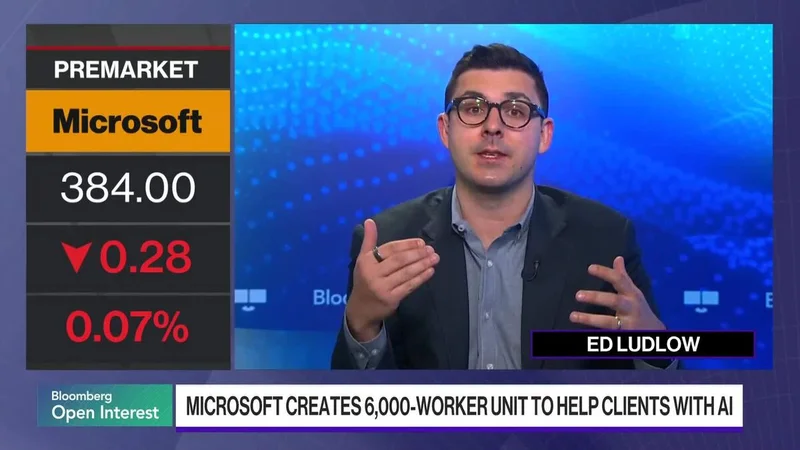
Image: Bloomberg AI
Main Takeaway
Microsoft committed $2.5 billion and 6,000 engineers to a new Frontier subsidiary aimed at helping enterprises deploy AI tools at scale.
Jump to Key PointsSummary
Why Microsoft built a 6,000-person AI army
Microsoft is not waiting for customers to figure out AI on their own. The company announced a new operating business, Microsoft Frontier, staffed with 6,000 industry and engineering experts and backed by $2.5 billion in investment. According to TechCrunch, the unit is designed to deliver successful enterprise AI deployments using Microsoft's existing AI tools, positioning it as a hands-on partner for businesses struggling to move from AI pilots to production systems.
The move places Microsoft directly alongside Amazon, OpenAI, and Anthropic, all of which have launched similar forward-deployed engineering teams. Judson Althoff, CEO of Microsoft's commercial business, explicitly rejected the Forward Deployed Engineer label in a statement, arguing the initiative goes beyond that model. Bloomberg reports that Althoff frames Frontier as the largest, most capable, outcome-driven engineering organization of its kind. The unit will handle both technical implementation and strategic planning for clients.
How the hiring and firing both serve AI strategy
The 6,000-person mobilization arrives alongside a separate workforce restructuring that cut roughly 6,000 roles from Microsoft's global payroll, about 3% of staff. According to Informationweek, the layoffs hit across departments and included Gabriela de Queiroz, Microsoft's Director of AI, who posted about her departure on LinkedIn. The cuts targeted middle management layers rather than performance-based eliminations.
Okoone notes the layoffs are not crisis-driven but part of a strategic realignment to simplify the management stack and shift engineering investment toward AI-driven innovation. Fewer layers means faster execution, or so the theory goes. The symmetry is striking: Microsoft subtracted 6,000 general roles while adding 6,000 specialized AI deployment roles. The net headcount change is roughly neutral, but the skill composition shift is dramatic.
What Frontier actually does for enterprise clients
Microsoft Frontier exists because most enterprises have bought AI tools they cannot deploy well. According to Bloomberg, the new organization handles the technical and strategic work of deploying artificial intelligence for businesses, bridging the gap between Microsoft's product suite and actual customer outcomes. This includes integrating Copilot, Azure AI services, and other tools into existing workflows.
The $2.5 billion commitment signals serious long-term investment rather than a skunkworks project. TechCrunch reports that Frontier will operate as its own business unit with dedicated resources and accountability metrics. For Microsoft, this creates a feedback loop: Frontier engineers learn what works in production, then feed that intelligence back into product development. For customers, it offers a way to outsource the hardest part of AI adoption, the messy integration work, to Microsoft directly.
Why competitors already field similar teams
Amazon, OpenAI, and Anthropic all operate forward-deployed engineering or customer success teams that embed specialists with enterprise clients. Microsoft's entry validates the model while attempting to outscale rivals. The 6,000 headcount figure, if fully staffed, would dwarf comparable units at competitors.
Bloomberg's coverage emphasizes that Althoff's resistance to the FDE label suggests Microsoft wants to differentiate Frontier as more strategic and less about temporary embedding. The distinction may matter for customer contracts and talent recruiting. Enterprise buyers often prefer vendors who commit to outcomes rather than simply placing contractors on-site. By framing Frontier as an outcome-driven organization, Microsoft is positioning for larger, longer-term engagements.
What this signals about enterprise AI demand
The investment size reveals Microsoft's conviction that enterprise AI adoption is still in early innings despite years of hype. Companies have purchased licenses and experimented with tools, but widespread production deployment remains elusive. Frontier is a bet that hands-on engineering support will unlock the next wave of adoption.
The dual workforce moves, layoffs and specialized hiring, reflect a broader industry pattern. As Okoone observes, AI is reshaping internal operations, not just external products. Microsoft's own workforce restructuring mirrors what it now sells to customers: using AI to do more with leaner teams. Whether Frontier succeeds depends on whether enterprises want Microsoft engineers embedded in their operations, or whether they prefer to build internal capabilities. The $2.5 billion suggests Microsoft is confident they will pay for the help.
Key Points
Microsoft created Frontier, a 6,000-person AI deployment subsidiary with $2.5 billion in funding.
Judson Althoff leads the unit and rejected comparisons to forward-deployed engineering models.
The announcement followed layoffs of 6,000 roles including AI Director Gabriela de Queiroz.
Frontier competes directly with similar enterprise AI services from Amazon, OpenAI, and Anthropic.
Microsoft's net headcount stays flat while shifting dramatically toward AI-specialized roles.
Questions Answered
Microsoft Frontier is a new operating business unit with 6,000 employees and $2.5 billion in committed investment. It helps enterprise customers deploy Microsoft AI tools including Copilot and Azure AI services.
Microsoft restructured its workforce to eliminate middle management layers and shift resources toward AI-specialized roles. The net headcount change is roughly neutral, but the skill composition changed dramatically toward AI deployment expertise.
Judson Althoff explicitly rejected the forward-deployed engineer label, arguing Frontier goes beyond temporary embedding to become an outcome-driven strategic partner for enterprise AI adoption.
Gabriela de Queiroz, Microsoft's Director of AI, announced her departure on LinkedIn as part of the 6,000-person workforce reduction that spanned departments and geographies.
Most enterprises have purchased AI tools but struggle to move from pilots to production deployments. Frontier provides hands-on engineering and strategic support to bridge that implementation gap.
Source Reliability
40% of sources are highly trusted · Avg reliability: 67
Go deeper with Organic Intel
Simple AI systems for your life, work, and business. Each one includes copyable prompts, guides, and downloadable resources.
Explore Systems