Ken Griffin Says AI Bubble Is Nearly Certain as Spending and Valuations Race Ahead of Results
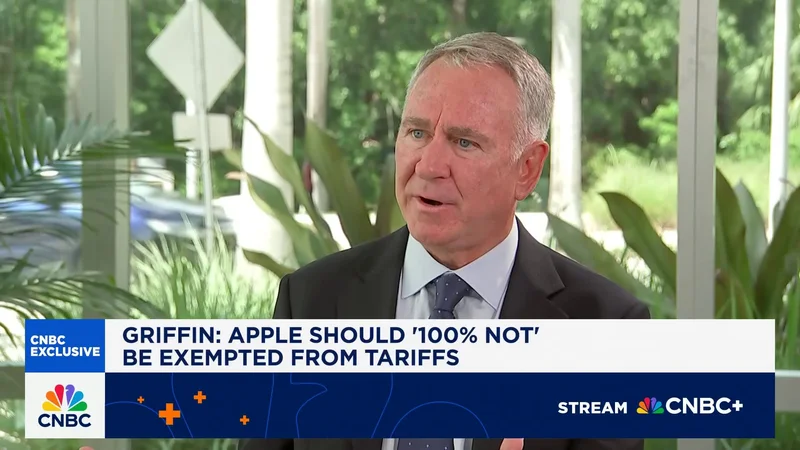
Image: Cnbc
Main Takeaway
Citadel founder Ken Griffin says AI markets are almost certainly in a bubble, pointing to soaring data-center spending, inflated promises and echoes of the dot-com era.
Jump to Key PointsSummary
Griffin’s warning reaches a sharper pitch
Ken Griffin, founder and chief executive of Citadel, says investors are almost certainly in an artificial intelligence bubble, escalating his earlier comparison between today’s market and the dot-com era. He made the latest comments in an interview with Bloomberg at Citadel’s annual Future event on Oct. 20, 2026.
Griffin’s argument centers on the gap between the scale of AI investment and the evidence of economic returns. He has repeatedly described the boom as a mix of genuine technological progress, aggressive capital spending and promotional claims designed to sustain investor enthusiasm. His latest warning places him among the most prominent finance executives challenging the market’s assumptions about AI valuations.
Spending is outrunning proof
The central concern is the extraordinary cost of building AI infrastructure before companies have demonstrated comparable gains in revenue or productivity. Griffin said U.S. data-center spending is projected to reach $500 billion in a single year, a figure that requires companies to promise transformative outcomes to attract the necessary financing.
That spending covers data centers, advanced chips, networking equipment and electricity, creating a powerful investment cycle across the technology industry. The Motley Fool cited J.P. Morgan strategist Michael Cembalest, who said AI-related stocks accounted for 75% of S&P 500 returns, 80% of earnings growth and 90% of capital-spending growth since ChatGPT launched in November 2022. The concentration raises the cost of disappointment if results fail to match expectations.
Echoes of the dot-com era
Griffin’s comparison with the late-1990s internet boom rests on market concentration, elevated valuations and a story that has spread faster than proven business results. He told CNBC in September 2025 that there were “obviously echoes of the dot-com bubble” in the market, linking the current AI trade to the technology surge that ended in a severe early-2000s downturn.
The comparison doesn't mean AI lacks commercial value. Internet companies eventually transformed the economy even after many investors lost money, and AI has already changed software development, customer service and corporate research. The concern is that useful technology can coexist with overpriced assets. The S&P 500’s 72% rise since ChatGPT’s release, cited by The Motley Fool, has made AI exposure central to portfolio performance and increased the consequences of a sharp reversal.
Hype shapes the jobs debate
Griffin also rejects the loudest claims that AI will rapidly eliminate nearly every job. He argues that apocalyptic forecasts help companies justify the enormous checks needed to fund data centers and model development, especially when the immediate productivity gains remain uneven.
AI has shifted influence toward technology teams, according to Griffin’s comments summarized by Business Insider, but current tools often fall short of the sweeping promises attached to them. Finance Yahoo quoted him describing the jobs panic as largely driven by the need to present AI as a force that will “profoundly change the world.” That framing can attract capital, but it also distorts public expectations about adoption, labor markets and the pace of workplace change.
Investors face a divided market
The bubble debate leaves investors with 2 truths to weigh: AI infrastructure is receiving enormous capital, and the technology is producing real use cases. Griffin’s warning targets the prices and expectations surrounding the boom rather than the existence of AI demand itself.
For public markets, the risk is concentrated exposure. If revenue growth, margins or productivity gains slow, companies tied to chips, cloud computing and data centers face pressure even if AI adoption continues. If results keep improving, the strongest businesses can survive a broad repricing while weaker projects lose access to funding. Griffin’s comments therefore point to a selection problem, not a simple verdict on the technology.
What happens after the warning
The next test is whether AI companies can convert infrastructure spending into durable cash flow. Investors will focus on model pricing, enterprise renewal rates, utilization of data centers, power availability and evidence that customers are saving money or generating new revenue.
Griffin’s repeated warnings also put pressure on executives to separate measurable performance from grand predictions. The debate will continue as companies build larger systems, expand computing capacity and compete for capital. A correction would affect the broader market because AI-related shares have driven such a large share of recent index gains, while sustained earnings growth would strengthen the case that current spending reflects a long investment cycle rather than a purely speculative surge.
Key Points
Ken Griffin says AI markets are almost certainly in a bubble amid soaring infrastructure spending and ambitious promises.
AI-related stocks have driven much of the S&P 500’s gains, earnings growth and capital spending since ChatGPT launched.
Griffin compares current AI valuations and market concentration with conditions surrounding the late-1990s dot-com bubble.
Citadel’s CEO says dramatic AI job-loss forecasts help companies justify hundreds of billions in data-center investment.
Investors must assess whether AI infrastructure spending produces durable revenue, margins, cash flow and productivity gains.
Questions Answered
Ken Griffin says AI is in a bubble because investment, valuations and spending promises have moved ahead of proven economic returns. He points to enormous data-center commitments and a narrative that presents AI as certain to transform the world.
Ken Griffin said AI markets show echoes of the dot-com bubble. He cited concentrated technology gains, high expectations and the risk that valuable technology can still be attached to overpriced investments.
Ken Griffin cited projected U.S. data-center spending of $500 billion in a single year. He said companies need sweeping promises about AI’s impact to secure financing on that scale.
Ken Griffin recognizes that AI has real uses and is shifting influence toward technology teams. His criticism targets inflated expectations and valuations, especially where productivity gains have not matched infrastructure spending.
Investors should watch AI revenue growth, enterprise renewals, model pricing, data-center utilization, margins and customer productivity gains. Those measures will show whether current spending creates durable cash flow or faces a market repricing.
Source Reliability
50% of sources are highly trusted · Avg reliability: 82
Go deeper with Organic Intel
Simple AI systems for your life, work, and business. Each one includes copyable prompts, guides, and downloadable resources.
Explore Systems