Humanoid Robots Leap From Labs to Streets as AI Race Intensifies
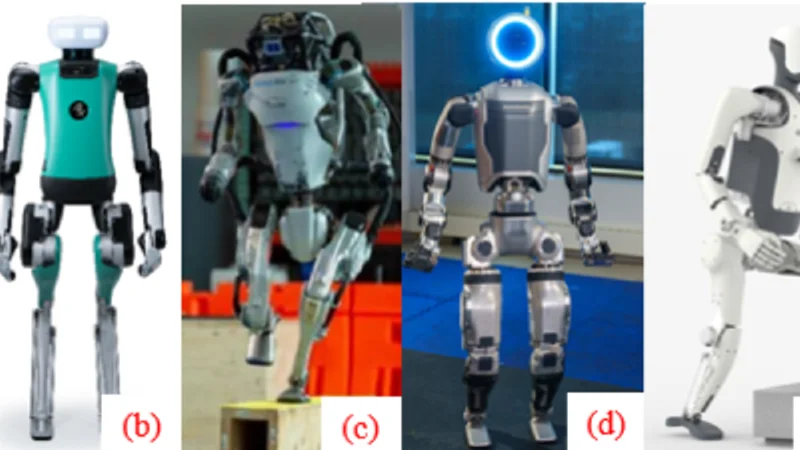
Image: Nature
Main Takeaway
Billions pour into humanoid robotics as AI breakthroughs push machines from factory floors to daily life, but questions remain about real-world value.
Jump to Key PointsSummary
The current state of play
Humanoid robots have crossed the threshold from lab curiosity to commercial reality. Unitree, AgiBot and UBTech have already shipped over 13,000 units globally in 2025, with China claiming roughly 90% of production capacity according to market tracking data. Boston Dynamics has begun limited production of its electric Atlas robot, though 2026 units are fully committed to Hyundai and partners with factory deployments targeted for 2028. The numbers point to a market growing at 40% compound annual growth rate, with projections ranging from $4-8 billion in 2026 revenue.
What separates today's robots from predecessors
The integration of large language models and multimodal AI has fundamentally changed what's possible. Where previous generations required extensive programming for each task, today's humanoids can understand natural language commands, adapt to new situations through learning, and operate in environments designed for humans. Recent demonstrations show robots pouring beer, boxing with precision, stacking shelves and even playing mahjong. The 2025 World Artificial Intelligence Conference in Shanghai featured over 150 humanoid robots performing these tasks autonomously, marking a shift from controlled lab environments to public demonstrations.
Where the money is flowing
Investment patterns reveal the stakes. Analyst forecasts for 2030 humanoid shipments range wildly from under 1 million to over 6 million units annually, representing tens of billions in potential revenue. This uncertainty hasn't slowed capital deployment. The race has attracted traditional robotics companies, automotive manufacturers, and AI startups alike. Chinese manufacturers dominate current production, but US and European companies are investing heavily in next-generation capabilities. Sereact recently raised $110 million to scale its Cortex 2 embodied AI model, illustrating how software and AI components are becoming as valuable as the physical robots themselves.
The gap between capability and deployment
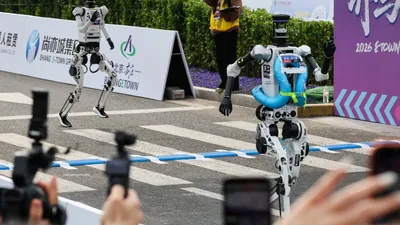
Despite impressive demonstrations, most humanoid applications remain experimental. Construction sites, healthcare facilities, and retail environments present challenges that current robots struggle to handle reliably. Safety concerns top the list, as Deloitte notes that small AI errors can cascade into equipment damage or safety incidents in physical systems. The Beijing half-marathon illustrates both progress and limitations: robots completed the race this year after most failed to finish in 2024, but their performance still lagged significantly behind human competitors. Real-world deployment requires reliability levels that current AI systems haven't consistently achieved.
What this means for workers and industries
The potential impact spans far beyond manufacturing. Healthcare, retail, public space maintenance and personal assistance represent massive addressable markets. The World Economic Forum projects billions of humanoid robots operating globally by 2040, performing work far beyond current factory automation. This creates both opportunity and disruption. Companies can benefit from 24/7 operation and reduced labor costs, but workers face displacement in roles that involve routine physical tasks. The key question isn't whether humanoids will enter these spaces, but how quickly they'll become reliable enough to trust with critical functions.
Technical challenges that still need solving
Current humanoids remain distant from human-level intelligence and reliability. While they can mimic human appearance and basic movements, true human-like cognition and adaptation remains elusive. The construction industry roadmap published in Scientific Reports highlights specific gaps: enhanced mobility and dexterity have improved, but autonomous decision-making in complex, unstructured environments still requires breakthroughs. Battery life, safety systems, and the ability to handle edge cases without human intervention represent significant technical hurdles. Most importantly, the AI models driving these robots must achieve error rates low enough for commercial deployment.
Regulatory and safety considerations
The physical nature of humanoid robots raises unique safety challenges. Unlike software AI, errors in embodied systems can cause immediate physical harm. Deloitte emphasizes that extensive safety testing may not prevent unpredictable behavior, as AI systems can act in ways not anticipated during development. This creates regulatory challenges as governments struggle to create frameworks that protect public safety without stifling innovation. Clear guardrails will be essential for widespread adoption, particularly in healthcare and public spaces where robot failures could have serious consequences.
What happens next
The next 24 months will determine whether humanoid robotics follows the trajectory of smartphones or remains a niche technology. Success hinges on proving reliability in controlled deployments before expanding to general use. Hyundai's exclusive access to Boston Dynamics Atlas robots for 2026-2027 suggests we'll see early industrial applications soon. Meanwhile, Chinese manufacturers will likely continue scaling production to drive costs down. The real test comes when these robots move beyond impressive demos to consistent, valuable performance in real-world conditions. Those who solve reliability and safety first will define the industry's future.
Key Points
Over 13,000 humanoid robots shipped globally in 2025, with China controlling 90% of production capacity
Integration of large language models and multimodal AI enables natural language interaction and adaptive learning
Market projections range wildly from 1-6 million units annually by 2030, representing $4-8B in 2026 revenue growing at 40% CAGR
Real-world deployment faces significant challenges around reliability, safety, and autonomous decision-making in unstructured environments
Applications span healthcare, retail, construction, and personal assistance, but regulatory frameworks are still developing
Questions Answered
Over 13,000 units shipped globally in 2025, with Chinese manufacturers (Unitree, AgiBot, UBTech) producing the vast majority.
Modern humanoids integrate large language models and multimodal AI, enabling natural language commands, adaptive learning, and operation in human-designed environments without extensive reprogramming.
Reliability in unstructured environments, safety concerns around AI errors causing physical harm, battery life limitations, and the need for regulatory frameworks that balance innovation with public safety.
Manufacturing and warehouse operations will likely lead, followed by healthcare, retail service, construction, and eventually personal assistance as reliability improves.
Highly uncertain - current forecasts range from under 1 million to over 6 million units annually by 2030. Success depends on solving reliability and safety challenges in the next 2-3 years.
Current humanoids still lack true human-level intelligence. They can perform impressive tasks and adapt to some degree, but remain distant from human-like cognition and autonomous decision-making in complex scenarios.
Source Reliability
58% of sources are highly trusted · Avg reliability: 66
Go deeper with Organic Intel
Simple AI systems for your life, work, and business. Each one includes copyable prompts, guides, and downloadable resources.
Explore Systems